


X-ray absorption spectroscopy (XAS) corroboration of the uptake and storage of CeO(2) nanoparticles and assessment of their differential toxicity in four edible plant species
- PMID: 20187606
- PMCID: PMC2852460
- DOI: 10.1021/jf904472e
X-ray absorption spectroscopy (XAS) corroboration of the uptake and storage of CeO(2) nanoparticles and assessment of their differential toxicity in four edible plant species
Abstract
Fate, transport, and possible toxicity of cerium oxide nanoparticles (nanoceria, CeO(2)) are still unknown. In this study, seeds of alfalfa (Medicago sativa), corn (Zea mays), cucumber (Cucumis sativus), and tomato (Lycopersicon esculentum) were treated with nanoceria at 0-4000 mg L(-1). The cerium uptake and oxidation state within tissues were determined using inductively coupled plasma-optical emission spectroscopy (ICP-OES) and X-ray absorption spectroscopy (XAS), respectively. The germination rate and root elongation were also determined. Results showed that nanoceria significantly reduced corn germination (about 30% at 2000 mg L(-1); p < 0.05), and at 2000 mg L(-1), the germination of tomato and cucumber was reduced by 30 and 20%, respectively (p < 0.05). The root growth was significantly promoted (p < 0.05) by nanoceria in cucumber and corn but reduced (p < 0.05) in alfalfa and tomato. At almost all concentrations, nanoceria promoted shoot elongation in the four plant species. XAS data clearly showed the nanoceria within tissues of the four plant species. To the authors' knowledge, this is the first report on the presence nanoceria within plants.
Figures
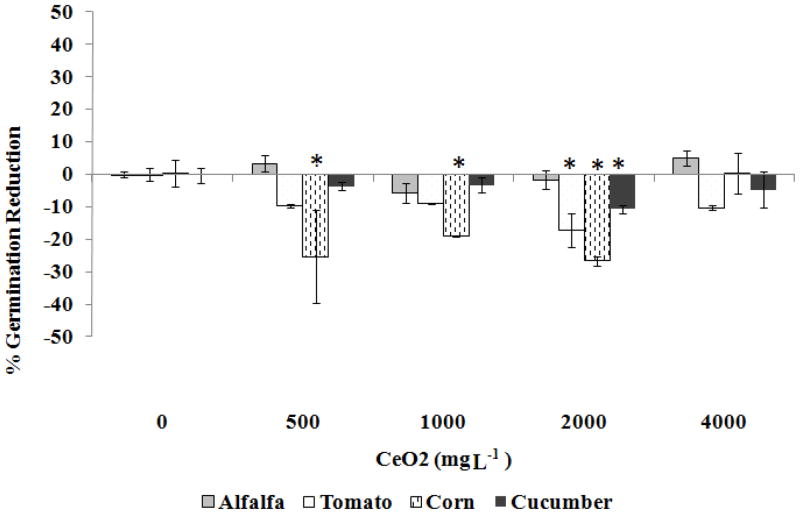
 alfalfa, □ tomato,
  corn, and ■ cucumber seeds treated with CeO2 NPs solutions at 0–4000 mg/L. Data represent mean ± SE of three replicates. One-way ANOVA and Tukey’s test were used to determine statistical significance of the differences between treatment means. *Statistically significant at p ≤ 0.05.
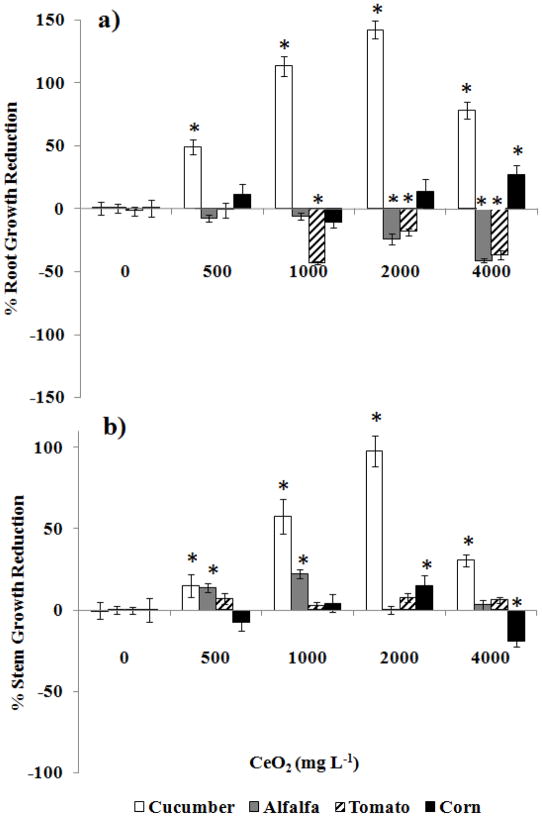 alfalfa, □ tomato, and corn seedlings exposed to 0–4000 mg/L CeO2 NP suspensions. Data represent mean ± SE of three replicates. One-way ANOVA and Tukey’s test were used to determine statistical differences between treatment means. *Statistically significant at p ≤ 0.05.
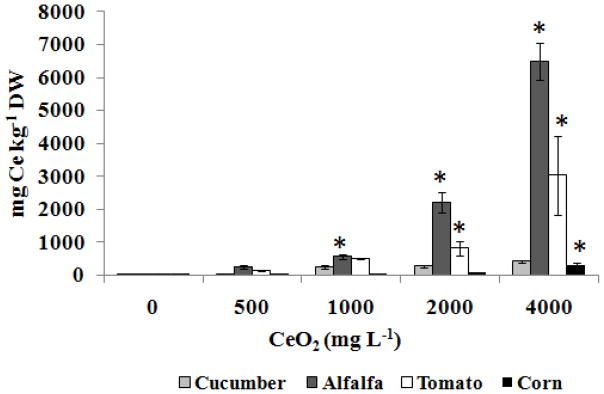 alfalfa, □ tomato, and corn seedlings treated with CeO2 NP suspensions at 0–4000 mg/L. Data are mean ± SE of three replicates. One-way ANOVA and Tukey’s test were used to determine statistical differences between treatment means. *Statistically significant at p ≤ 0.05.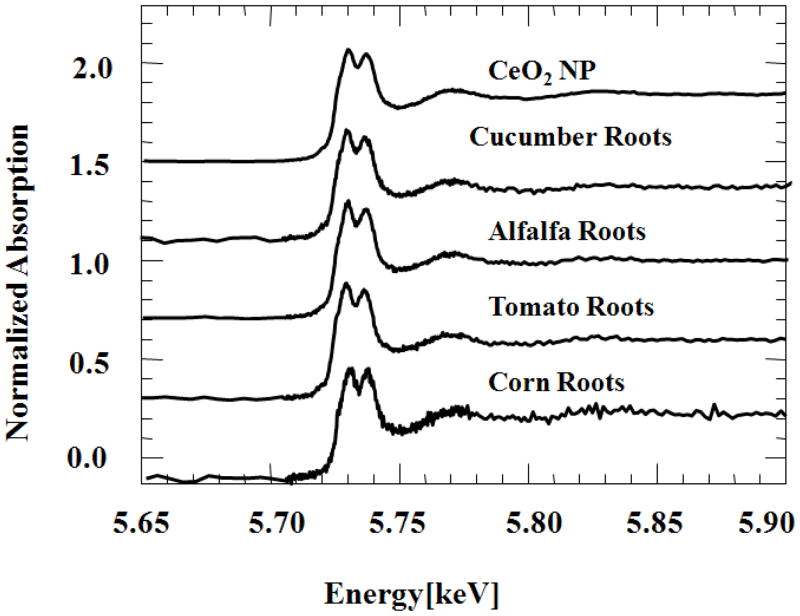
References
-
- Ju-Nam Y, Lead JR. Manufactured nanoparticles: An overview of their chemistry, interactions and potential environmental implications. Sci Total Environ. 2008;400:396–414. - PubMed
-
- Darlington TK, Neigh AM, Spencer MT, Nguyen OT, Oldenburg SJ. Nanoparticle characteristics affecting environmental fate and transport through soil. Environ Toxicol Chem. 2009;28:1191–1199. - PubMed
-
- Lin D, Xing B. Phytotoxocity of nanoparticles: inhibition of seed germination and root growth. Environ Pollut. 2007;150:243–250. - PubMed
-
- Pidgeon N, Harthorn BH, Bryant K, Rogers-Hayden T. Deliberating the risks of nanotechnologies for energy and health applications in the United States and United Kingdom. Nature Nanotech. 2009;4:95–98. - PubMed
-
- Yuan D, Shan X, Huai Q, Wen B, Zhu X. Uptake and distribution of rare elements in rice seeds cultured in fertilizer solution of rare elements. Chemosphere. 2001;43:327–37. - PubMed
Publication types
MeSH terms
Substances
Grants and funding
LinkOut - more resources
Full Text Sources
