


Abnormal moral reasoning in complete and partial callosotomy patients
- PMID: 20188113
- PMCID: PMC2876192
- DOI: 10.1016/j.neuropsychologia.2010.02.021
Abnormal moral reasoning in complete and partial callosotomy patients
Abstract
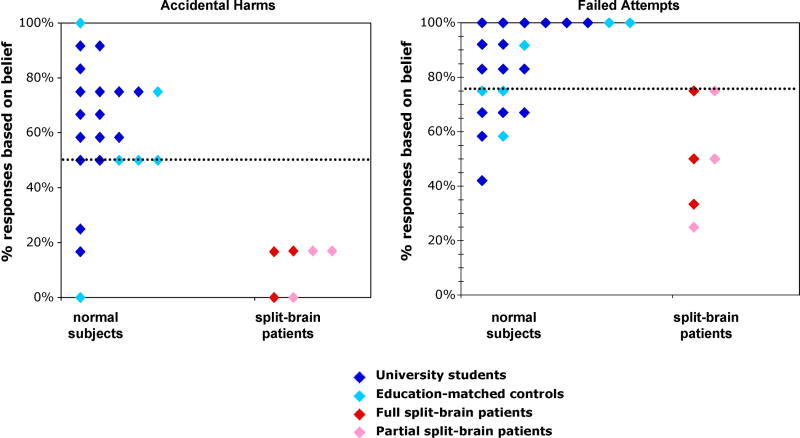
Recent neuroimaging studies suggest lateralized cerebral mechanisms in the right temporal parietal junction are involved in complex social and moral reasoning, such as ascribing beliefs to others. Based on this evidence, we tested 3 anterior-resected and 3 complete callosotomy patients along with 22 normal subjects on a reasoning task that required verbal moral judgments. All 6 patients based their judgments primarily on the outcome of the actions, disregarding the beliefs of the agents. The similarity in performance between complete and partial callosotomy patients suggests that normal judgments of morality require full interhemispheric integration of information critically supported by the right temporal parietal junction and right frontal processes.
Copyright 2010 Elsevier Ltd. All rights reserved.
Figures
References
-
- Apperly IA, Riggs KJ, Simpson A, Chiavarino C, Samson D. Is belief reasoning automatic? Psychological Science. 2006;17(10):841–844. - PubMed
-
- Apperly IA, Butterfill SA. Do humans have two systems to track beliefs and belief-like states? Psychological Review. in press. - PubMed
-
- Baird JA, Astington JW. The role of mental state understanding in the development of moral cognition and moral action. New Directions for Child and Adolescent Development. 2004;103:37–49. - PubMed
Publication types
MeSH terms
Grants and funding
LinkOut - more resources
Full Text Sources
