


Quadriceps weakness predicts risk for knee joint space narrowing in women in the MOST cohort
- PMID: 20188686
- PMCID: PMC2873062
- DOI: 10.1016/j.joca.2010.02.002
Quadriceps weakness predicts risk for knee joint space narrowing in women in the MOST cohort
Abstract
Objective: Quadriceps weakness has been reported with incident but not progressive knee osteoarthritis (OA) in longitudinal studies. This study examined the relationship between quadriceps strength and worsening of knee joint space narrowing (JSN) over 30 months.
Methods: Longitudinal, observational study of adults aged 50-79 years with OARSI JSN score <3 at baseline. Baseline measures included bilateral weight-bearing fixed flexion radiographs, isokinetic concentric quadriceps and hamstring strength, height and weight, and physical activity. Hamstring:quadriceps (H:Q) strength ratios also were evaluated. Worsening was defined as an increase in JSN score in the tibiofemoral and/or patellofemoral compartments on 30-month radiographs or total knee replacement. Knee-based analyses used generalized estimating equations, stratified by sex, to assess relationships between strength and knee JSN while controlling for covariance between knees within subjects as well as age, body mass index (BMI), history of knee injury and/or surgery, physical activity level and alignment.
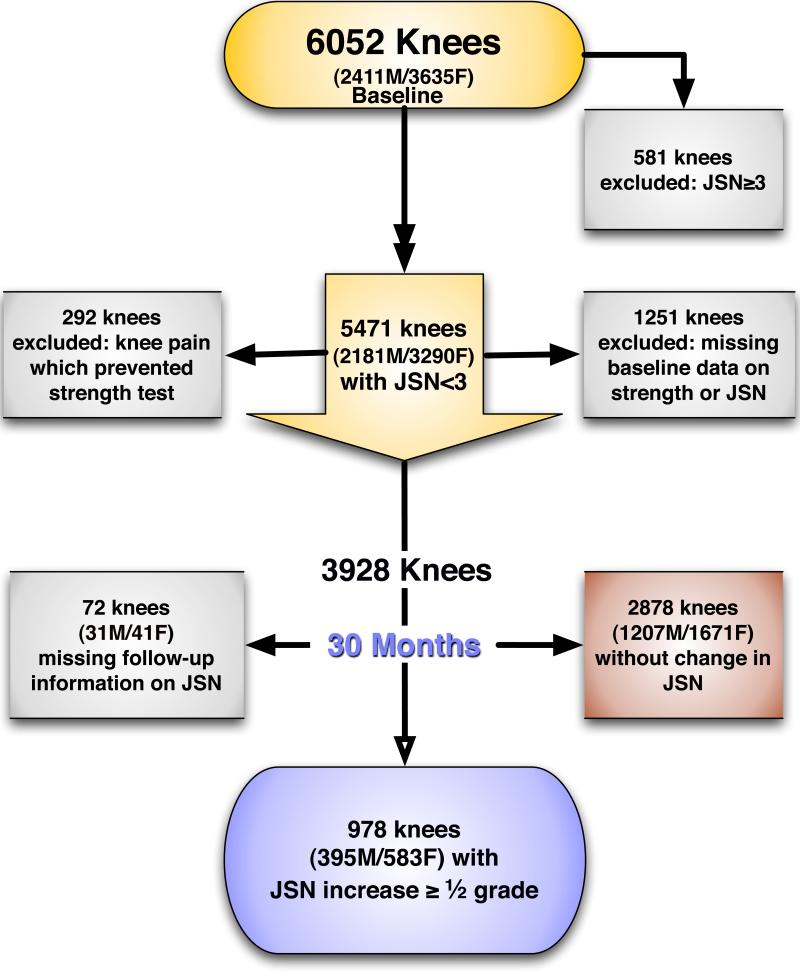
Results: 3856 knees (2254 females and 1602 males) with JSN score <3 at baseline and no missing follow-up data were included. Mean+/-SD age was 62.2+/-7.7 in women and 61.6+/-8.1 in men. Women in the lowest tertile of quadriceps strength had an increased risk of whole knee JSN (OR=1.66, 95% CI=1.26, 2.19) and tibiofemoral JSN (OR=1.69, 95% CI=1.26, 2.28). However, no associations were found between strength and JSN in men or H:Q<0.6 and JSN in men or women.
Conclusions: In women but not in men, quadriceps weakness was associated with increased risk for tibiofemoral and whole knee JSN.
Copyright 2010 Osteoarthritis Research Society International. Published by Elsevier Ltd. All rights reserved.
References
-
- Slemenda C, Heilman DK, Brandt KD, Katz BP, Mazzuca SA, Braunstein EM, et al. Reduced quadriceps strength relative to body weight: a risk factor for knee osteoarthritis in women? Arthritis Rheum. 1998;41:1951–9. - PubMed
-
- Hootman JM, FitzGerald S, Macera CA, Blair SN. Lower extremity muscle strength and risk of self-reported hip/knee osteoarthritis. Journal of Physical Activity and Health. 2004;4:321–30.
-
- Cooper C, Snow S, McAlindon TE, Kellingray S, Stuart B, Coggon D, et al. Risk factors for the incidence and progression of radiographic knee osteoarthritis. Arthritis Rheum. 2000;43:995–1000. - PubMed
-
- McAlindon TE, Felson DT, Zhang Y, Hannan MT, Aliabadi P, Weissman B, et al. Relation of dietary intake and serum levels of vitamin D to progression of osteoarthritis of the knee among participants in the Framingham Study. Ann Intern Med. 1996;125:353–9. - PubMed
Publication types
MeSH terms
Grants and funding
LinkOut - more resources
Full Text Sources
Medical
