


Why does troponin I have so many phosphorylation sites? Fact and fancy
- PMID: 20188739
- PMCID: PMC2854207
- DOI: 10.1016/j.yjmcc.2010.02.014
Why does troponin I have so many phosphorylation sites? Fact and fancy
Abstract
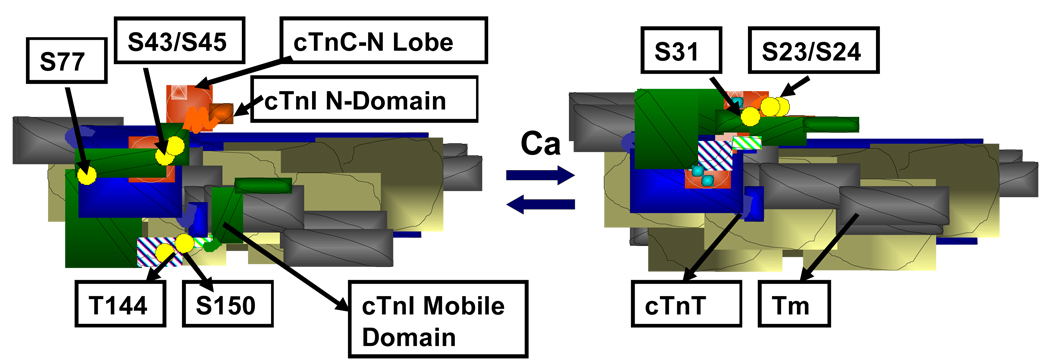
We discuss a current controversy regarding the relative role of phosphorylation sites on cardiac troponin I (cTnI) (Fig. 1) in physiological and patho-physiological cardiac function. Studies with mouse models and in vitro studies indicate that multi-site phosphorylations are involved in both control of maximum tension and sarcomeric responsiveness to Ca(2+). Thus one hypothesis is that cardiac function reflects a balance of cTnI phosphorylations and a tilt in this balance may be maladaptive in acquired and genetic disorders of the heart. Studies on human heart samples taken mainly at end-stage heart failure, and in depth proteomic analysis of human and rat heart samples demonstrate that Ser23/Ser24 are the major and perhaps the only sites likely to be relevant to control cardiac function. Thus functional significance of Ser23/Ser24 phosphorylation is taken as fact, whereas the function of some other sites is treated as fancy. Maybe the extremes will meet: in any case we both agree that further work needs to be carried out with relatively large mammals and with determination of the time course of changes in phosphorylation to identify transient modifications that may be relevant at a beat-to-beat basis. Moreover, we agree that the changes and effects of cTnI phosphorylation need to be fully integrated into the effects of other phosphorylations in the cardiac myocyte.
Copyright (c) 2010 Elsevier Ltd. All rights reserved.
Figures
References
-
- Stull JT, Brostrom CO, Krebs EG. Phosphorylation of the inhibitor component of troponin by phosphorylase kinase. J Biol Chem. 1972 Aug 25;247(16):5272–5274. - PubMed
-
- Pratje E, Heilmeyer LM. Phosphorylation of rabbit muscle troponin and actin by a 3', 5'-c-AMP-dependent protein kinase. FEBS Lett. 1972 Oct 15;27(1):89–93. - PubMed
-
- Metzger JM, Westfall MV. Covalent and noncovalent modification of thin filament action: the essential role of troponin in cardiac muscle regulation. Circ Res. 2004 Feb 6;94(2):146–158. - PubMed
-
- Kobayashi T, Solaro RJ. Calcium, thin filaments, and the integrative biology of cardiac contractility. Annu Rev Physiol. 2005;67:39–67. - PubMed
-
- Solaro RJ, Moir AJ, Perry SV. Phosphorylation of troponin I and the inotropic effect of adrenaline in the perfused rabbit heart. Nature. 1976 Aug 12;262(5569):615–617. - PubMed
Publication types
MeSH terms
Substances
Grants and funding
LinkOut - more resources
Full Text Sources
Research Materials
Miscellaneous
