


Physiological correlates of memory recall in infancy: vagal tone, cortisol, and imitation in preterm and full-term infants at 6 months
- PMID: 20189251
- PMCID: PMC2844902
- DOI: 10.1016/j.infbeh.2009.10.007
Physiological correlates of memory recall in infancy: vagal tone, cortisol, and imitation in preterm and full-term infants at 6 months
Abstract
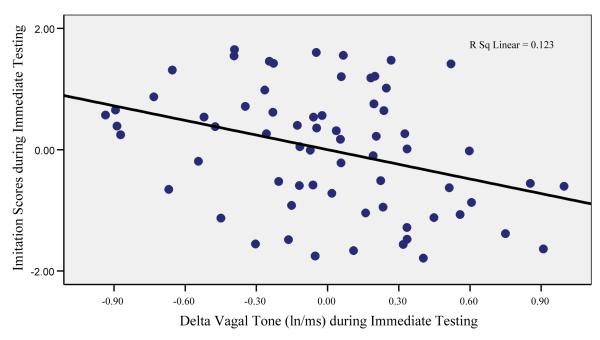
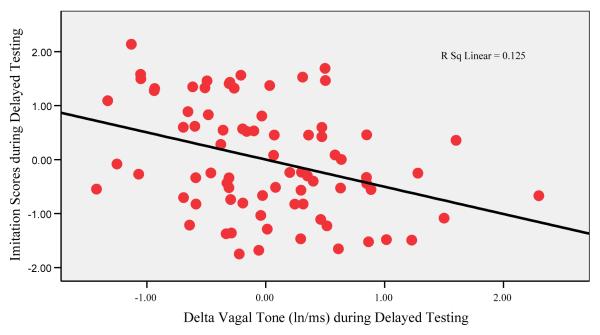
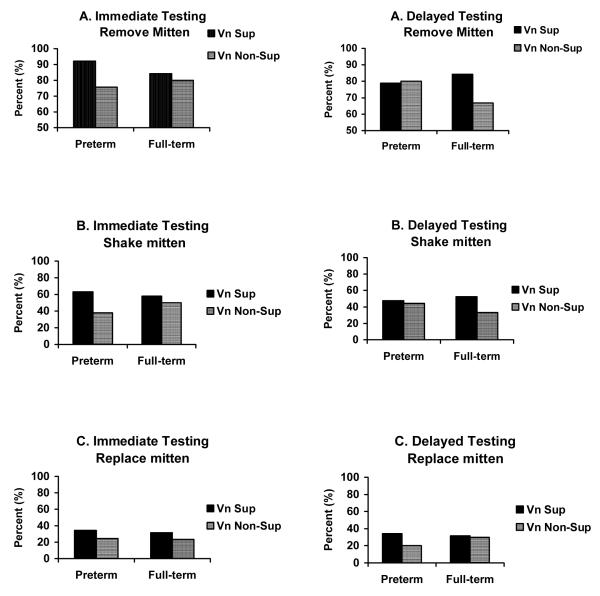
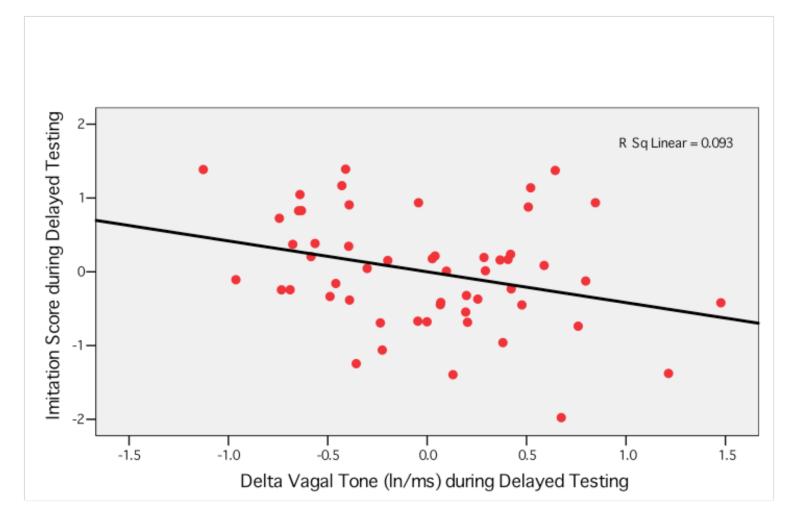
We examined the role of physiological regulation (heart rate, vagal tone, and salivary cortisol) in short-term memory in preterm and full-term 6-month-old infants. Using a deferred imitation task to evaluate social learning and memory recall, an experimenter modeled three novel behaviors (removing, shaking, and replacing a glove) on a puppet. Infants were tested immediately after being shown the behaviors as well as following a 10-min delay. We found that greater suppression of vagal tone was related to better memory recall in full-term infants tested immediately after the demonstration as well as in preterm infants tested later after a 10-min delay. We also found that preterm infants showed greater coordination of physiology (i.e., tighter coupling of vagal tone, heart rate, and cortisol) at rest and during retrieval than full-term infants. These findings provide new evidence of the important links between changes in autonomic activity and memory recall in infancy. They also raise the intriguing possibility that social learning, imitation behavior, and the formation of new memories are modulated by autonomic activity that is coordinated differently in preterm and full-term infants.
Copyright 2009 Elsevier Inc. All rights reserved.
Figures
References
-
- Abercrombie HC, Kalin NH, Thurow ME, Rosenkranz MA, Davidson RJ. Cortisol variation in humans affects memory for emotionally laden and neutral information. Behavioral Neuroscience. 2003;117:505–516. - PubMed
-
- Anderson P, Doyle LW. Neurobehavioral outcomes of school-age children born extremely low birth weight or very preterm in the 1990s. Journal of American Medical Association. 2003;289:3264–3272. - PubMed
-
- Barr R, Dowden A, Hayne H. Developmental changes in deferred imitation by 6- to 24-month-old infants. Infant Behavior and Development. 1996;19:159–170.
-
- Barr R, Hayne H. Age-relatedchangesinimitation: Implications for memorydevelopment. In: Rovee-Collier C, Lipsitt LP, Hayne H, editors. Progressininfancyresearch. Vol. 1. Lawrence Erlbaum Associates, Inc.; Mahwah, NJ: 2000. pp. 21–67.
-
- Barr R, Rovee-Collier C, Campanella J. Retrieval protracts deferred imitation by 6-month-olds. Infancy. 2005;7:263–283. - PubMed
Publication types
MeSH terms
Substances
Grants and funding
LinkOut - more resources
Full Text Sources
