Review
. 2010 Jun;22(3):314-20.
doi: 10.1016/j.coi.2010.01.018. Epub 2010 Feb 26.

Metabolism in T cell activation and differentiation

Affiliations
Review

Metabolism in T cell activation and differentiation

Erika L Pearce. Curr Opin Immunol. 2010 Jun.

Abstract

When naïve or memory T cells encounter foreign antigen along with proper co-stimulation they undergo rapid and extensive clonal expansion. In mammals, this type of proliferation is fairly unique to cells of the adaptive immune system and requires a considerable expenditure of energy and cellular resources. While research has often focused on the roles of cytokines, antigenic signals, and co-stimulation in guiding T cell responses, data indicate that, at a fundamental level, it is cellular metabolism that regulates T cell function and differentiation and therefore influences the final outcome of the adaptive immune response. This review will focus on some earlier fundamental observations regarding T cell bioenergetics and its role in regulating cellular function, as well as recent work that suggests that manipulating the immune response by targeting lymphocyte metabolism could prove useful in treatments against infection and cancer.


Figures

Figure 1
Figure 1
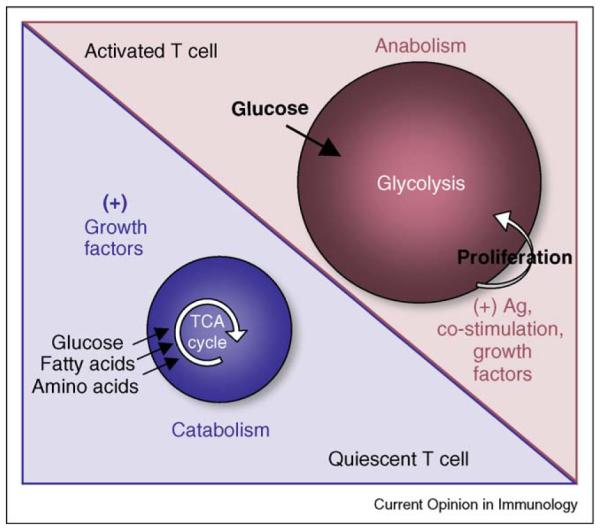
Activated and quiescent T cells have distinct metabolic phenotypes. Activated T cells (effector T cells) have an anabolic metabolism where they maintain a high rate of nutrient uptake and build biomass at the expense of ATP. In the presence of antigen and co stimulation, growth factor cytokines can stimulate glycolysis and support proliferation. Glycolysis provides ATP for proliferating T cells while fatty acids and amino acids are incorporated into cellular components. By contrast, quiescent T cells (naïve and memory T cells) have a catabolic metabolism where they use glucose, fatty acids, and amino acids for ATP generation through the TCA cycle and oxidative phosphorylation. Growth factor cytokines increase nutrient transporter expression and are important for cell survival, and in their absence, quiescent cells die of progressive atrophy.
Figure 2
Figure 2
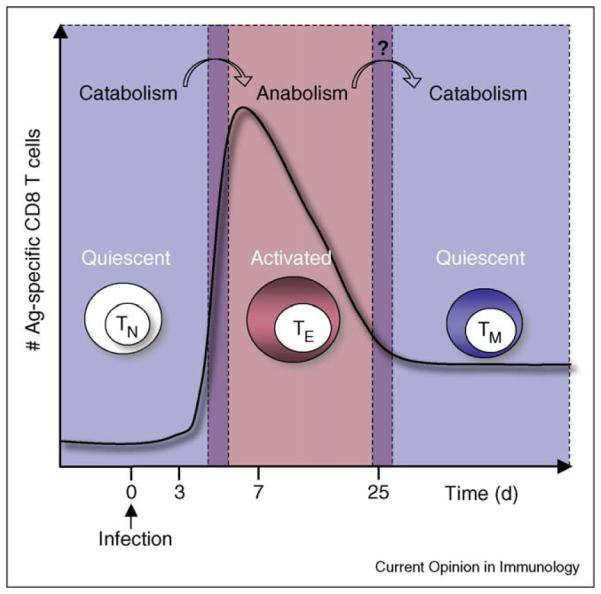
Metabolic transitions underpin T cell fate. In response to infection CD8 T cells undergo a developmental pattern characterized by first the expansion then contraction of antigen specific populations, followed by the persistence of long lived memory T cells. The striking divergence of metabolic phenotypes between activated and quiescent T cells suggests the idea that the conversion, or switching, between differing metabolic states is required for effective generation of a given T cell fate. This is true for the conversion from a resting metabolism to the highly glycolytic metabolism that is triggered by T cell activation. Recent data also suggest that the conversion to, or promotion of, catabolic processes (like fatty acid oxidation or autophagy) within antigen specific populations are important for the generation of memory T cells after infection. While cytokine receptor signaling supports a particular metabolic phenotype (Figure 1), the withdrawal of cytokines, or nutrients, can present a significant metabolic stress to a proliferating cell. In response to this stress, cells can promote catabolic pathways for survival. This appears to play a role in the generation of memory T cells following infection.
Figure 3
Figure 3
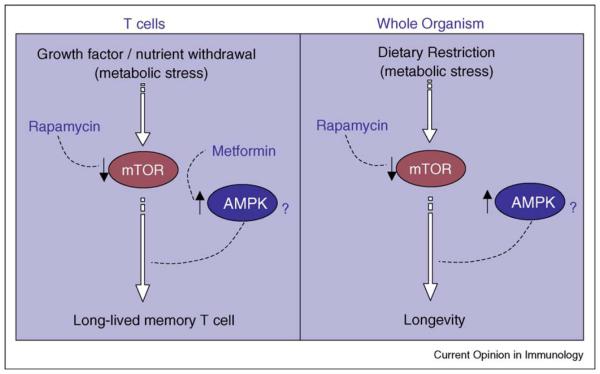
Analogous model of T cell longevity (left panel). The mTOR inhibitor rapamycin and the AMPK activator metformin have both been shown to promote the development of long-lived memory CD8 T cells. Longevity pathway (right panel). A conserved signaling cascade controls life span in yeast, worms, flies, and mice (figure adapted from [78••]).

References

    1. Raff MC. Size control: the regulation of cell numbers in animal development. Cell. 1996;861:173–175. - PubMed
    1. Krauss S, Brand MD, Buttgereit F. Signaling takes a breath—new quantitative perspectives on bioenergetics and signal transduction. Immunity. 2001;15:497–502. - PubMed
    1. Roos D, Loos JA. Changes in the carbohydrate metabolism of mitogenically stimulated human peripheral lymphocytes. II. Relative importance of glycolysis and oxidative phosphorylation on phytohaemagglutinin stimulation. Exp Cell Res. 1973;77:127–135. - PubMed
    1. Rathmell JC, Vander Heiden MG, Harris MH, Frauwirth KA, Thompson CB. In the absence of extrinsic signals, nutrient utilization by lymphocytes is insufficient to maintain either cell size or viability. Mol Cell. 2000;6:683–692. - PubMed
    1. Frauwirth KA, Riley JL, Harris MH, Parry RV, Rathmell JC, Plas DR, Elstrom RL, June CH, Thompson CB. The CD28 signaling pathway regulates glucose metabolism. Immunity. 2002;16:769–777. - PubMed

Publication types