. 2010 May;151(5):2078-86.
doi: 10.1210/en.2009-0850. Epub 2010 Feb 26.

Uncoupling protein-2 decreases the lipogenic actions of ghrelin

Affiliations

Uncoupling protein-2 decreases the lipogenic actions of ghrelin

Zane B Andrews et al. Endocrinology. 2010 May.

Abstract

The exact mechanisms through which ghrelin promotes lipogenesis are unknown. Uncoupling protein (UCP)-2 is a mitochondrial protein important in regulating reactive oxygen species; however, recent research shows that it may play an important role fat metabolism. Given that ghrelin increases UCP2 mRNA in white adipose tissue, we examined whether the lipogenic actions of ghrelin are modulated by UCP2 using ucp2(+/+) and ucp2(-/-) mice. Chronic ghrelin treatment either via osmotic minipumps or daily ip injections induced body weight gain in both ucp2(+/+) and ucp2(-/-) mice; however, body weight gain was potentiated in ucp2(-/-) mice. Increased body weight gain was completely due to increased body fat as a result of decreased fat oxidation in ucp2(-/-) mice. Ghrelin treatment of ucp2(-/-) mice resulted in a gene expression profile favoring lipogenesis. In a calorie-restriction model of negative energy balance, ghrelin to ucp2(+/+) mice did not increase body weight; however, ghrelin to ucp2(-/-) mice still induced body weight. These results show that UCP2 plays an important role in fat metabolism by promoting fat oxidation and restricts ghrelin-induced lipogenesis.


Figures
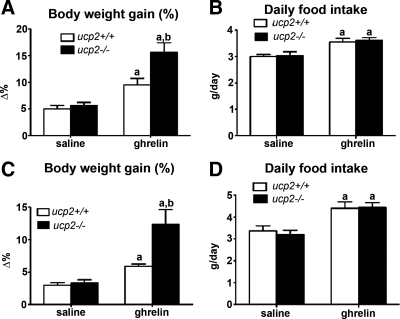
Figure 1
Figure 1
The lack of UCP2 increases weight gain in response to ghrelin. A, ucp2−/− mice show increased body weight gain after 14 d of ghrelin delivery via osmotic pumps relative to ucp2+/+ mice (10 nmol/d, n = 6–7, P < 0.05). Data are presented as the percent increase in body weight at the end of the 14-d treatment period relative to the starting body weight. B, Ghrelin via osmotic minipumps increased daily food intake (grams per day) in both ucp2+/+ and ucp2−/− mice; however, no difference between genotypes was observed (n = 6–7, P < 0.05). C, ucp2−/− mice show increased body weight gain, relative to saline injections, after daily ghrelin injections for 14 d (10 nmol, n = 6, P < 0.05). Data are presented as the percent increase in body weight at the end of the 14-d treatment period relative to the starting body weight. D, Ghrelin injections (ip, 10 nmol, n = 6, P < 0.05) increased daily food intake in both ucp2+/+ and ucp2−/− mice, although no difference between genotype was observed. This graph shows that ghrelin promotes greater weight gain in ucp2−/− mice independent of food intake. All data are expressed as mean ± sem. a, Significant with respect to saline controls; b, significant with respect to ucp2+/+ ghrelin.
Figure 2
Figure 2
The lack of UCP2 increases total body fat in response to ghrelin treatment. We measured total body fat, muscle, and fluid using NMR spectroscopy and calculated the fold increase by comparing measurements before and after ghrelin treatment. A, Ghrelin significantly increased total body fat in both ucp2+/+ and ucp2−/− mice (n = 6); however, the increase in ucp2−/− was further significantly elevated when compared with ucp2+/+ mice. B and C, No differences were observed in total body muscle or body fluid after ghrelin treatments. The dotted line represents basal levels measured before beginning the experiment. All data are expressed as mean ± sem. a, Significant with respect to saline controls; b, significant with respect to ucp2+/+ ghrelin.
Figure 3
Figure 3
Metabolic data from ucp2+/+ and ucp2−/− ghrelin-treated mice. Mice were placed in CLAMS metabolic monitoring systems (Columbus Instruments) for 4 d and treated daily with ghrelin (10 nmol, ip, n = 6/group). A, ucp2−/− mice exhibited a significantly higher RER after ghrelin treatment compared with ucp2+/+ mice, indicating that the lack of UCP2 reduces fat metabolism. RER is calculated as VCO2/VO2. B–E, No significant differences were measured in total VO2, VCO2, activity, or heat. All data are expressed as mean ± sem. a, Significant with respect to saline controls; b, significant with respect to ucp2+/+ ghrelin.
Figure 4
Figure 4
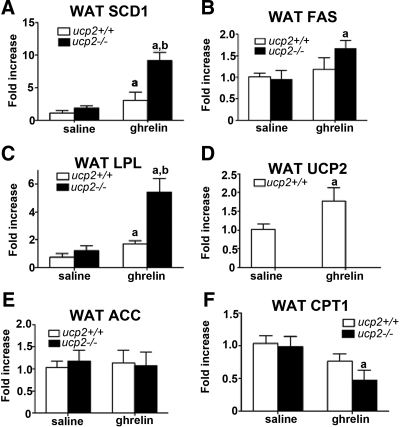
UCP2 controls fat metabolism gene expression profile in white adipose tissue after ghrelin delivery (10 nmol/d for 14 d) via osmotic minipumps. A, Ghrelin significantly increases white adipose tissue SCD1 gene expression in both ucp2−/− and ucp2+/+ ghrelin-treated mice relative to saline controls; however, ucp2−/− ghrelin mice show a further significant increase relative ucp2+/+ ghrelin mice (n = 6–7, P < 0.05). B, Ghrelin significantly increases FAS in white adipose tissue of ghrelin-treated ucp2−/− mice compared with saline controls. No effect of ghrelin was observed in ucp2+/+ mice (n = 6). C, Ghrelin significantly increases white adipose tissue LPL mRNA in both ucp2−/− and ucp2+/+ ghrelin-treated mice relative to saline controls; however, ucp2−/− ghrelin-treated mice show a further significant increase relative ucp2+/+ ghrelin mice (n = 6–7, P < 0.05). D, Ghrelin increases UCP2 mRNA in white adipose tissue (n = 6–7, P < 0.05). E, No effect of ghrelin on ACC was observed in either genotype (n = 6–7, P < 0.05). F, CPT1 was decreased in ghrelin-treated ucp2−/− mice relative to saline-treated ucp2−/− mice. Ghrelin had no significant effect on CPT1 mRNA in ucp2+/+ mice (n = 6, P < 0.05). All data are expressed as mean ± sem. a, Significant with respect to saline controls; b, significant with respect to ucp2+/+ ghrelin.
Figure 5
Figure 5
UCP2 controls fat metabolism gene expression profile in white adipose tissue after ghrelin injection. Ghrelin increases mRNA expression of genes promoting fat storage in white adipose tissue from ucp2−/− relative to ucp2+/+ mice (n = 6, P < 0.05). SCD1 (A), FAS (B), and LPL (C) are all increased after ghrelin injection in ucp2−/− relative to ucp2+/+. D, No difference in white adipose tissue ACC was observed between ghrelin-treated ucp2+/+ and ucp2−/− mice. E, Ghrelin suppressed CPT1 mRNA expression in ucp2−/− relative to ucp2+/+ mice. All data are expressed as mean ± sem. a, Significant with respect to ghrelin-treated ucp2+/+ mice.
Figure 6
Figure 6
Ghrelin induces weight gain in calorie-restricted ucp2−/− but not calorie-restricted ucp2+/+ mice. A, Daily weight gain of saline- and ghrelin-treated ucp2+/+ and ucp2−/− mice. Mice had free access to food until d 4, at which time they were given 70% of ad libitum food intake. Ghrelin (ip, 10 nmol) was given daily for 14 d at 1800 h from the start of the calorie restriction regimen. B, Percent change in body weight of saline and ghrelin-treated calorie-restricted ucp2+/+ and ucp2−/− mice at the end of the experimental period relative to the beginning. All data are expressed as mean ± sem. a, Significant with respect to saline controls; b, significant with respect to ucp2+/+ ghrelin.

References

    1. Tschöp M, Smiley DL, Heiman ML 2000 Ghrelin induces adiposity in rodents. Nature 407:908–913 - PubMed
    1. Ariyasu H, Takaya K, Tagami T, Ogawa Y, Hosoda K, Akamizu T, Suda M, Koh T, Natsui K, Toyooka S, Shirakami G, Usui T, Shimatsu A, Doi K, Hosoda H, Kojima M, Kangawa K, Nakao K 2001 Stomach is a major source of circulating ghrelin, and feeding state determines plasma ghrelin-like immunoreactivity levels in humans. J Clin Endocrinol Metab 86:4753–4758 - PubMed
    1. Tschöp M, Weyer C, Tataranni PA, Devanarayan V, Ravussin E, Heiman ML 2001 Circulating ghrelin levels are decreased in human obesity. Diabetes 50:707–709 - PubMed
    1. Andrews ZB, Liu ZW, Walllingford N, Erion DM, Borok E, Friedman JM, Tschöp MH, Shanabrough M, Cline G, Shulman GI, Coppola A, Gao XB, Horvath TL, Diano S 2008 UCP2 mediates ghrelin’s action on NPY/AgRP neurons by lowering free radicals. Nature 454:846–851 - PMC - PubMed
    1. Luquet S, Phillips CT, Palmiter RD 2007 NPY/AgRP neurons are not essential for feeding responses to glucoprivation. Peptides 28:214–225 - PubMed

Publication types