Multilocus sequence type analysis reveals both clonality and recombination in populations of Candida glabrata bloodstream isolates from U.S. surveillance studies
- PMID: 20190071
- PMCID: PMC2863408
- DOI: 10.1128/EC.00002-10
Multilocus sequence type analysis reveals both clonality and recombination in populations of Candida glabrata bloodstream isolates from U.S. surveillance studies
Abstract
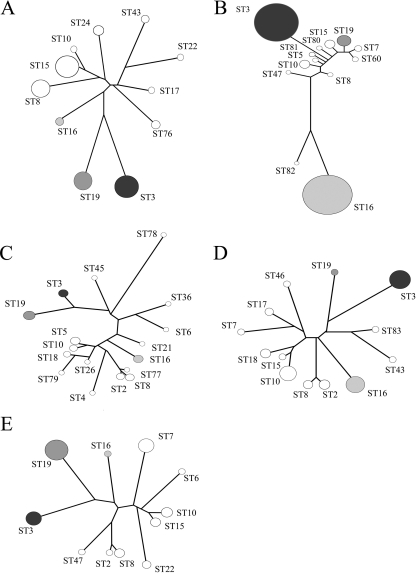
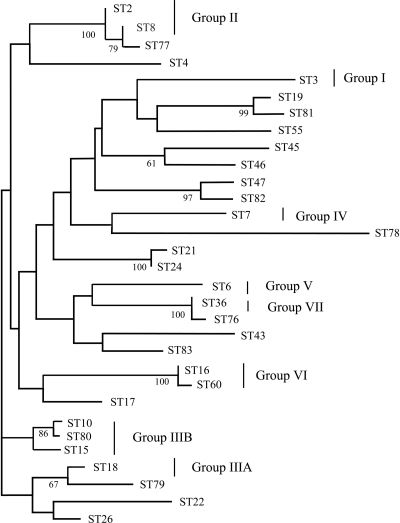
The human commensal yeast Candida glabrata is becoming increasingly important as an agent of nosocomial bloodstream infection. However, relatively little is known concerning the genetics and population structure of this species. We have analyzed 230 incident bloodstream isolates from previous and current population-based surveillance studies by using multilocus sequence typing (MLST). Our results show that in the U.S. cities of Atlanta, GA; Baltimore, MD; and San Francisco, CA during three time periods spanning 1992 to 2009, five populations of C. glabrata bloodstream isolates are defined by a relatively small number of sequence types. There is little genetic differentiation in the different C. glabrata populations. We also show that there has been a significant temporal shift in the prevalence of one major subtype in Atlanta. Our results support the concept that both recombination and clonality play a role in the population structure of this species.
Figures
References
-
- Agapow P.-M., Burt A. 2001. Indices of multilocus linkage disequilibrium. Mol. Ecol. Notes 1:101–102
-
- Ahlquist A., Farley M. M., Harrison L. H., Baughman W., Siegel B., Hollick R., Lockhart S. R., Magill S. S., Chiller T. 2009. Epidemiology of candidemia in metropolitan Atlanta and Baltimore City and County: preliminary results of population-based active, laboratory surveillance—2008-2010, abstr. M-1241. Abstr. 49th Intersci. Conf.Antimicrob. Agents Chemother., San Francisco, CA
-
- Brisse S., Pannier C., Angoulvant A., deMeeus T., Diancourt L., Faure O., Muller H., Peman J., Viviani M. A., Grillot R., Dujon B., Fairhead C., Hennequin C. 2009. Uneven distribution of mating types among genotypes of Candida glabrata isolates from clinical samples. Eukaryot. Cell 8:287–295 - PMC - PubMed
-
- Dodgson A. R., Pujol C., Pfaller M. A., Denning D. W., Soll D. R. 2005. Evidence for recombination in Candida glabrata. Fung. Genet. Biol. 42:233–243 - PubMed
MeSH terms
LinkOut - more resources
Full Text Sources
Medical