


doi: 10.1128/AEM.02016-09.
Epub 2010 Feb 26.
Impact of molecular hydrogen on chalcopyrite bioleaching by the extremely thermoacidophilic archaeon Metallosphaera sedula
Affiliations
- PMID: 20190092
- PMCID: PMC2849226
- DOI: 10.1128/AEM.02016-09
Item in Clipboard
Impact of molecular hydrogen on chalcopyrite bioleaching by the extremely thermoacidophilic archaeon Metallosphaera sedula
Appl Environ Microbiol.
2010 Apr.
Abstract
Hydrogen served as a competitive inorganic energy source, impacting the CuFeS(2) bioleaching efficiency of the extremely thermoacidophilic archaeon Metallosphaera sedula. Open reading frames encoding key terminal oxidase and electron transport chain components were triggered by CuFeS(2). Evidence of heterotrophic metabolism was noted after extended periods of bioleaching, presumably related to cell lysis.
Figures
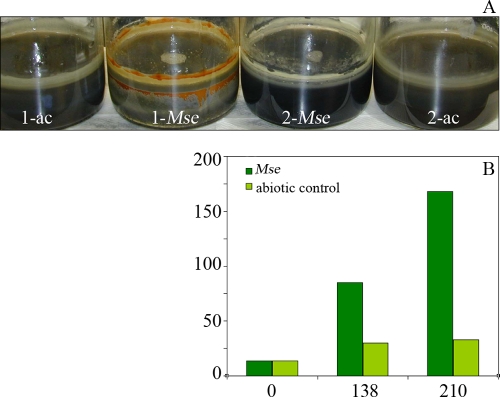
Chalcopyrite bioleaching by M. sedula. (A) Nine days postinoculation, chalcopyrite bioleaching by M. sedula exposed to an air headspace (1-Mse) is visually evident compared to its abiotic control (1-ac). No obvious evidence of bioleaching is visible for M. sedula grown in a hydrogen-containing headspace (2-Mse) or the associated abiotic control (2-ac). (B) Total soluble iron (mg/liter, measured as a function of hours postinoculation) is significantly higher in cultures containing M. sedula grown in a hydrogen-containing headspace than the abiotic control, indicating active bioleaching. Typical standard deviations of <10 mg/liter were found for the iron assay (n = 3 for abiotic controls; n = 9 for M. sedula cultures).
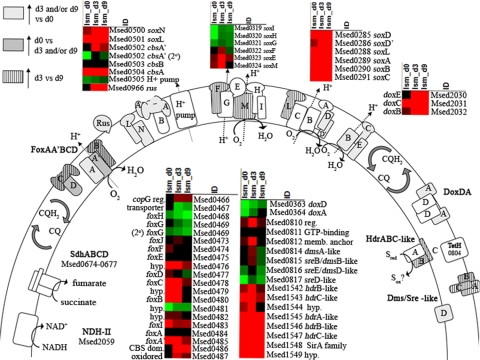
Heat plot of electron transfer components involved with oxidation of Fe(II) and RISCs. Heat plots were compiled using Array File Maker 4.0 (6). Red indicates levels of high transcription, black indicates average transcription (set to an LSM [least squares mean of normalized log2 transcription levels] of 0), and green indicates levels of low transcription, for M. sedula ORFs in the inoculum (d0), at 3 days of growth on CuFeS2 (d3), and at 9 days of growth on CuFeS2 (d9).
References
-
- Bagos, P. G., K. D. Tsirigos, S. K. Plessas, T. D. Liakopoulos, and S. J. Hamodrakas. 2009. Prediction of signal peptides in archaea. Protein Eng. Des. Sel. 22:27-35. - PubMed
MeSH terms
Substances
Associated data
- Actions
LinkOut - more resources
Full Text Sources
Other Literature Sources
Molecular Biology Databases
