


Computational morphodynamics: a modeling framework to understand plant growth
- PMID: 20192756
- PMCID: PMC4120954
- DOI: 10.1146/annurev-arplant-042809-112213
Computational morphodynamics: a modeling framework to understand plant growth
Abstract
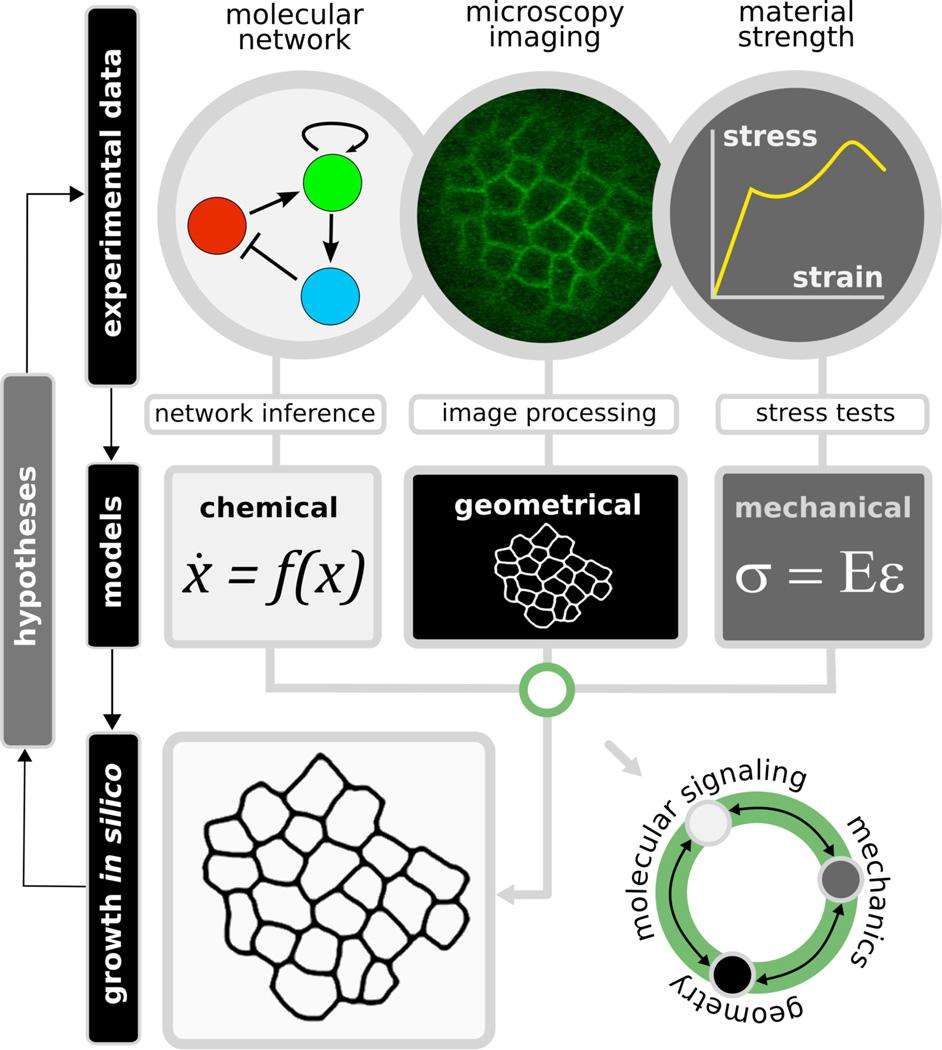
Computational morphodynamics utilizes computer modeling to understand the development of living organisms over space and time. Results from biological experiments are used to construct accurate and predictive models of growth. These models are then used to make novel predictions that provide further insight into the processes involved, which can be tested experimentally to either confirm or rule out the validity of the computational models. This review highlights two fundamental challenges: (a) to understand the feedback between mechanics of growth and chemical or molecular signaling, and (b) to design models that span and integrate single cell behavior with tissue development. We review different approaches to model plant growth and discuss a variety of model types that can be implemented to demonstrate how the interplay between computational modeling and experimentation can be used to explore the morphodynamics of plant development.
Figures
References
-
- Alvarez-Buylla ER, Benitez M, Davila EB, Chaos A, Espinosa-Soto C, Padilla-Longoria P. Gene regulatory network models for plant development. Curr Opin Plant Biol. 2007;10:83–91. - PubMed
-
- Baskin TI. Anisotropic expansion of the plant cell wall. Annual Review of Cell and Developmental Biology. 2005;21:203–222. - PubMed
-
- Becker EB, Carey GF, Oden JT. Finite elements. v. Englewood Cliffs, N.J.: Prentice-Hall.; 1981. pp. 1–6.
-
- Beltman JB, Maree AF, de Boer RJ. Spatial modelling of brief and long interactions between T cells and dendritic cells. Immunol Cell Biol. 2007;85:306–314. - PubMed
Publication types
MeSH terms
Grants and funding
LinkOut - more resources
Full Text Sources
