


Review
Two decades of clinical gene therapy--success is finally mounting
Affiliations
- PMID: 20193635
- PMCID: PMC3586794
Item in Clipboard
Review
Two decades of clinical gene therapy--success is finally mounting
Discov Med.
2010 Feb.
Abstract
Human gene therapy has made substantial progress since the initiation of the first clinical trials 20 years ago. Here, we summarized important applications of gene transfer protocols in the treatment of various human diseases using different viral vectors. Recent successful trials on the treatment of ocular diseases and inherited immune deficiencies are particularly encouraging and have raised hopes that human gene therapy as a standard treatment option will finally become a reality. While immune responses and insertional mutagenesis pose obstacles for this novel form of molecular medicine, continuous progress suggests that a wider range of diseases can be treated with gene therapy in the future.
Figures

Ex vivo gene transfer to bone marrow-derived CD34 hematopoietic stem cells (HSCs) of a patient with inherited severe immune deficiency. Autologous HSCs are cultured and infected with a recombinant retroviral or lentiviral vector carrying a functional copy of the defective gene (for example, ADA, gamma-c, or ABCD1). The gene-corrected cells are then injected back into the patient. For some protocols, the patients may receive mild myeloablation prior to infusion of the HSCs.
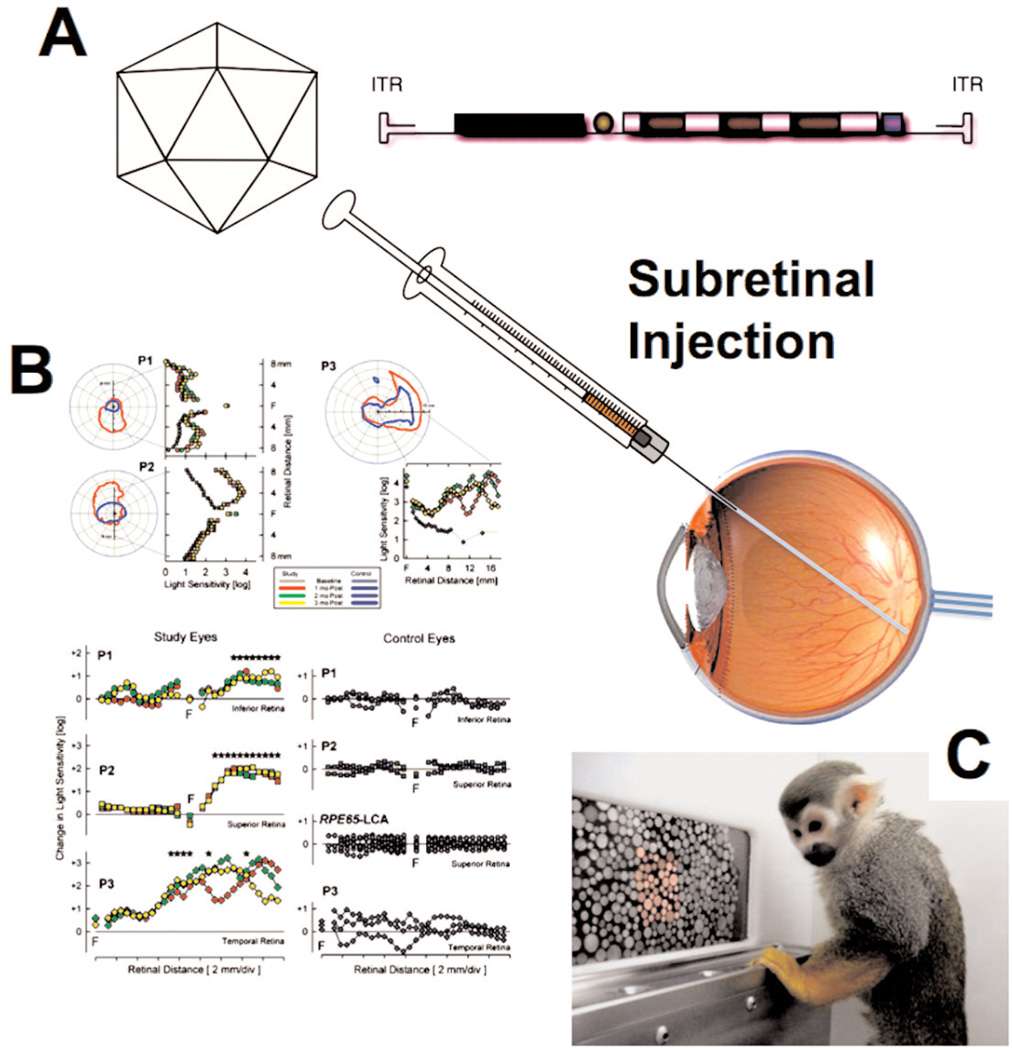
In vivo gene transfer for ocular diseases. A. An adeno-associated viral (AAV) vector is injected into the subretinal space using a surgical procedure. B. Gene transfer of RPE-65 to the retina restored light sensitivity in patients with Leber’s congenital amaurosis (LCA) (from Proc Natl Acad Sci USA 105(39):15112-7, 2008; © 2008 by The National Academy of Sciences of the USA). C. A similar protocol for AAV-mediated L-opsin corrected color blindness in squirrel monkeys.
References
-
- Acland GM, Aguirre GD, Ray J, Zhang Q, Aleman TS, Cideciyan AV, Pearce-Kelling SE, Anand V, Zeng Y, Maguire AM, et al. Gene therapy restores vision in a canine model of childhood blindness. Nat Genet. 2001;28(1):92–95. - PubMed
-
- Aiuti A, Cattaneo F, Galimberti S, Benninghoff U, Cassani B, Callegaro L, Scaramuzza S, Andolfi G, Mirolo M, Brigida I, et al. Gene therapy for immunodeficiency due to adenosine deaminase deficiency. N Engl J Med. 2009;360(5):447–458. - PubMed
-
- Aiuti A, Slavin S, Aker M, Ficara F, Deola S, Mortellaro A, Morecki S, Andolfi G, Tabucchi A, Carlucci F, et al. Correction of ADA-SCID by stem cell gene therapy combined with nonmyeloablative conditioning. Science. 2002;296(5577):2410–2413. - PubMed
-
- Bainbridge JW, Smith AJ, Barker SS, Robbie S, Henderson R, Balaggan K, Viswanathan A, Holder GE, Stockman A, Tyler N, et al. Effect of gene therapy on visual function in Leber’s congenital amaurosis. N Engl J Med. 2008;358(21):2231–2239. - PubMed
Publication types
MeSH terms
Grants and funding
LinkOut - more resources
Full Text Sources
Other Literature Sources
Medical