


Neural correlates of recognition memory for emotional faces and scenes
- PMID: 20194514
- PMCID: PMC3023078
- DOI: 10.1093/scan/nsq003
Neural correlates of recognition memory for emotional faces and scenes
Abstract
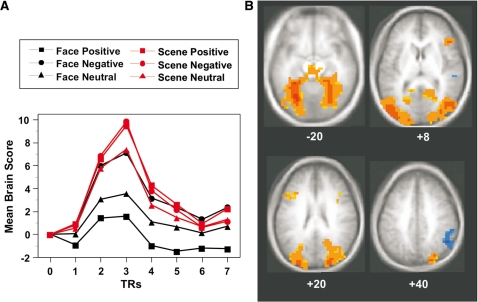
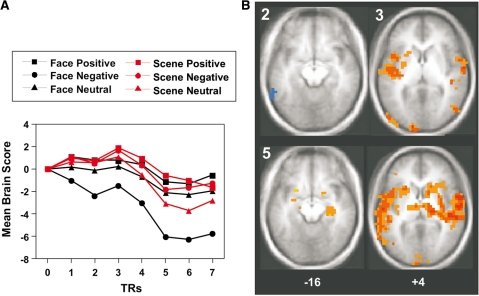
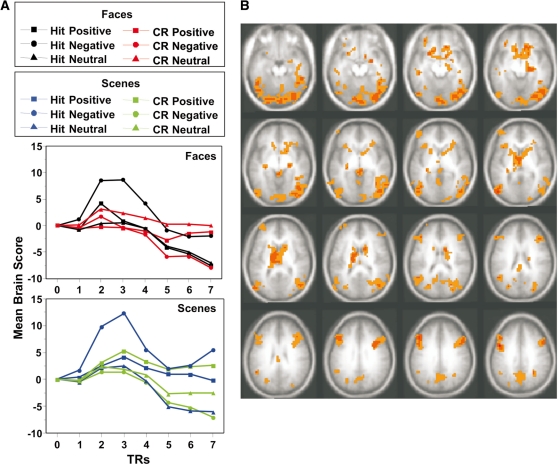
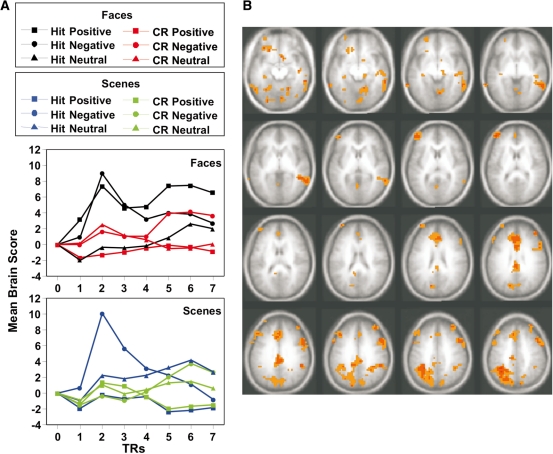
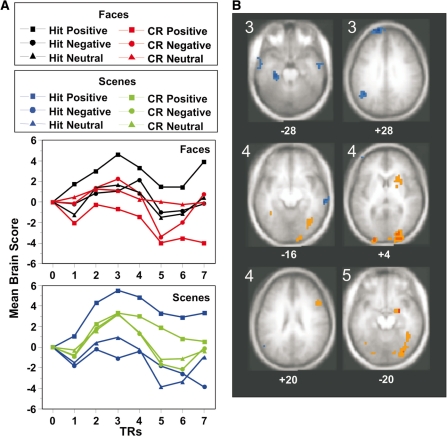
We examined the influence of emotional valence and type of item to be remembered on brain activity during recognition, using faces and scenes. We used multivariate analyses of event-related fMRI data to identify whole-brain patterns, or networks of activity. Participants demonstrated better recognition for scenes vs faces and for negative vs neutral and positive items. Activity was increased in extrastriate cortex and inferior frontal gyri for emotional scenes, relative to neutral scenes and all face types. Increased activity in these regions also was seen for negative faces relative to positive faces. Correct recognition of negative faces and scenes (hits vs correct rejections) was associated with increased activity in amygdala, hippocampus, extrastriate, frontal and parietal cortices. Activity specific to correctly recognized emotional faces, but not scenes, was found in sensorimotor areas and rostral prefrontal cortex. These results suggest that emotional valence and type of visual stimulus both modulate brain activity at recognition, and influence multiple networks mediating visual, memory and emotion processing. The contextual information in emotional scenes may facilitate memory via additional visual processing, whereas memory for emotional faces may rely more on cognitive control mediated by rostrolateral prefrontal regions.
Figures
Similar articles
-
Level of processing modulates the neural correlates of emotional memory formation.J Cogn Neurosci. 2011 Apr;23(4):757-71. doi: 10.1162/jocn.2010.21487. Epub 2010 Mar 29. J Cogn Neurosci. 2011. PMID: 20350176 Free PMC article.
-
Neural mechanisms of context effects on face recognition: automatic binding and context shift decrements.J Cogn Neurosci. 2010 Nov;22(11):2541-54. doi: 10.1162/jocn.2009.21379. J Cogn Neurosci. 2010. PMID: 19925208 Free PMC article.
-
Influence of emotional expression on memory recognition bias in schizophrenia as revealed by fMRI.Schizophr Bull. 2010 Jul;36(4):800-10. doi: 10.1093/schbul/sbn172. Epub 2009 Jan 27. Schizophr Bull. 2010. PMID: 19176471 Free PMC article.
-
Memory for friends or foes: the social context of past encounters with faces modulates their subsequent neural traces in the brain.Soc Neurosci. 2009;4(5):384-401. doi: 10.1080/17470910902941793. Epub 2009 Jul 27. Soc Neurosci. 2009. PMID: 19637101
-
Frontolimbic responses to emotional face memory: the neural correlates of first impressions.Hum Brain Mapp. 2009 Nov;30(11):3748-58. doi: 10.1002/hbm.20803. Hum Brain Mapp. 2009. PMID: 19530218 Free PMC article.
Cited by
-
Functional connectivity between the amygdala and prefrontal cortex in medication-naive individuals with major depressive disorder.J Psychiatry Neurosci. 2013 Nov;38(6):417-22. doi: 10.1503/jpn.120117. J Psychiatry Neurosci. 2013. PMID: 24148846 Free PMC article.
-
Emotion and motion: superior memory for emotional but not for moving stimuli.Psychol Res. 2025 Mar 24;89(2):71. doi: 10.1007/s00426-025-02105-4. Psychol Res. 2025. PMID: 40126710 Free PMC article.
-
The Predictive Role of the Posterior Cerebellum in the Processing of Dynamic Emotions.Cerebellum. 2024 Apr;23(2):545-553. doi: 10.1007/s12311-023-01574-w. Epub 2023 Jun 7. Cerebellum. 2024. PMID: 37285048 Free PMC article.
-
NEVER forget: negative emotional valence enhances recapitulation.Psychon Bull Rev. 2018 Jun;25(3):870-891. doi: 10.3758/s13423-017-1313-9. Psychon Bull Rev. 2018. PMID: 28695528 Free PMC article. Review.
-
Conduct disorder symptomatology is associated with an altered functional connectome in a large national youth sample.Dev Psychopathol. 2022 Oct;34(4):1573-1584. doi: 10.1017/S0954579421000237. Epub 2021 Apr 14. Dev Psychopathol. 2022. PMID: 33851904 Free PMC article.
References
-
- Addis DR, Moscovitch M, Crawley AP, McAndrews MP. Recollective qualities modulate hippocampal activation during autobiographical memory retrieval. Hippocampus. 2004;14:752–62. - PubMed
-
- Adolphs R, Cahill L, Schul R, Babinsky R. Impaired declarative memory for emotional material following bilateral amygdala damage in humans. Learning and Memory. 1997;4:291–300. - PubMed
-
- Adolphs R, Tranel D, Damasio H, Damasio A. Impaired recognition of emotion in facial expressions following bilateral damage to the human amygdala. Nature. 1994;372:669–72. - PubMed
