


Geographic access and the use of screening mammography
- PMID: 20195174
- PMCID: PMC3647348
- DOI: 10.1097/MLR.0b013e3181ca3ecb
Geographic access and the use of screening mammography
Abstract
Background: Screening mammography rates vary geographically and have recently declined. Inadequate mammography resources in some areas may impair access to this technology. We assessed the relationship between availability of mammography machines and the use of screening.
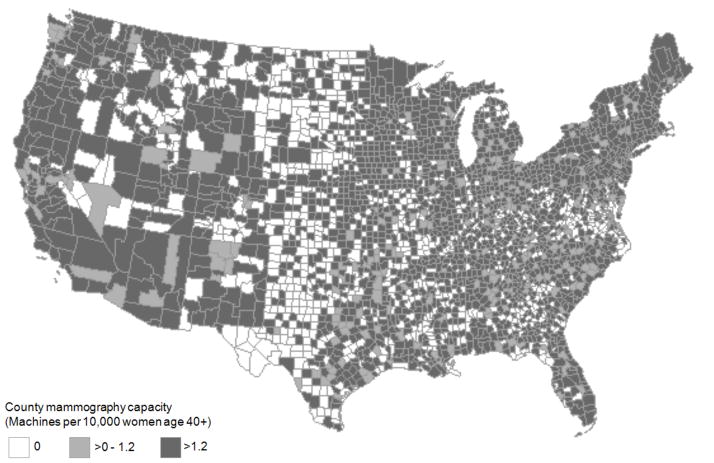
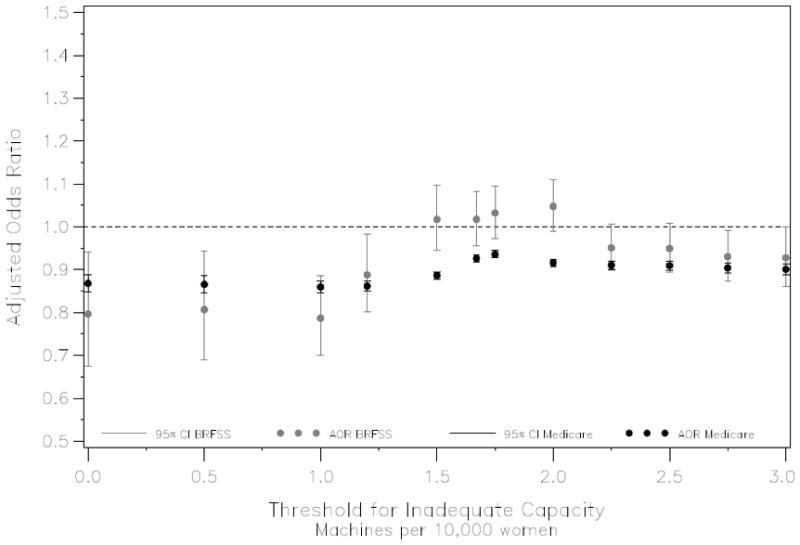
Methods: The location and number of all mammography machines in the United States were identified from US Food and Drug Administration records of certified facilities. Inadequate capacity was defined as <1.2 mammography machines per 10,000 women age 40 or older, the threshold required to meet the Healthy People 2010 target screening rate. The impact of capacity on utilization was evaluated in 2 cohorts: female respondents age 40 or older to the 2006 Behavioral Risk Factor Surveillance System survey (BRFSS) and a 5% nationwide sample of female Medicare beneficiaries age 65 or older in 2004-2005.
Results: About 9% of women in the BRFSS cohort and 13% of women in the Medicare cohort lived in counties with <1.2 mammography machines per 10,000 women age 40 or older. In both cohorts, residence in a county with inadequate mammography capacity was associated with lower odds of a recent mammogram (adjusted odds ratio in BRFSS: 0.89, 95% CI: 0.80-0.98, P < 0.05; adjusted odds ratio in Medicare: 0.86, 95% CI: 0.85-0.87, P < 0.05), controlling for demographic and health care characteristics.
Conclusion: In counties with few or no mammography machines, limited availability of imaging resources may be a barrier to screening. Efforts to increase the number of machines in low-capacity areas may improve mammography rates and reduce geographic disparities in breast cancer screening.
Figures
References
-
- Freedman DA, Petitti DB, Robins JM. On the efficacy of screening for breast cancer. Int J Epidemiol. 2004;33:43–55. - PubMed
-
- Kerlikowske K. Efficacy of screening mammography among women aged 40 to 49 years and 50 to 69 years: comparison of relative and absolute benefit. J Natl Cancer Inst Monogr. 1997;22:79–86. - PubMed
-
- Dodd GD. American Cancer Society guidelines from the past to the present. Cancer. 1993;72:1429–1432. - PubMed
-
- U.S. Preventive Services Task Force. Screening for Breast Cancer: Recommendations and Rationale. Rockville, MD: Agency for Healthcare Research and Quality; 2002.
-
- Miller JW, King JB, Ryerson AB, et al. Mammography use from 2000 to 2006: state-level trends with corresponding breast cancer incidence rates. AJR Am J Roentgenol. 2009;192:352–360. - PubMed
Publication types
MeSH terms
Grants and funding
LinkOut - more resources
Full Text Sources
