


Mesalazine reduces mutations in transforming growth factor beta receptor II and activin type II receptor by improvement of replication fidelity in mononucleotide repeats
- PMID: 20197483
- PMCID: PMC3437339
- DOI: 10.1158/1078-0432.CCR-09-2854
Mesalazine reduces mutations in transforming growth factor beta receptor II and activin type II receptor by improvement of replication fidelity in mononucleotide repeats
Abstract
Purpose: Mesalazine (5-aminosalicylic acid, 5-ASA) has chemopreventive properties in colitis-associated cancer. In vitro, it improves replication fidelity at (CA)13 microsatellites independent of mismatch repair proficiency. Therefore, 5-ASA might be advantageous in patients with hereditary nonpolyposis colorectal cancer. At this point, however, it is uncertain whether this improvement of replication fidelity is specific for (CA)13 repetitive sequences. Here, we tested the effect of 5-ASA on replication fidelity in mononucleotide, dinucleotide, and tetranucleotide repeats.
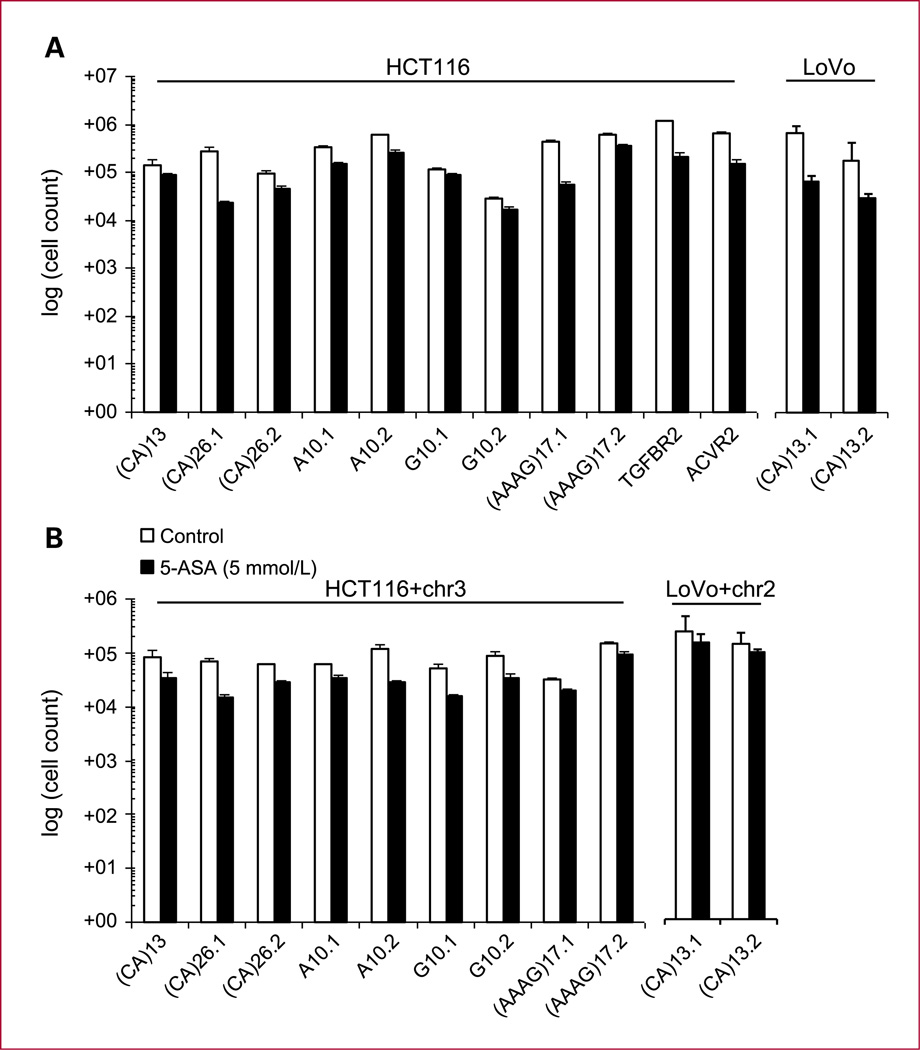
Experimental design: HCT116 and HCT116+chr3 cells were transfected with pIREShyg2-EGFP reporter plasmids harboring the following microsatellites: A10, G10, (CA)13, (CA)26, (AAAG)17, poly-A tracts, and their flanking sequences of transforming growth factor beta receptor II (TGFBR2; A10) and activin type II receptor (ACVR2; A8). Stably transfected single-cell clones were selected, characterized by Southern blotting, sorted into six-well plates, and cultured with or without 5-ASA. Frameshift mutations that shift the enhanced green fluorescence protein into its proper reading frame were quantified by flow cytometry.
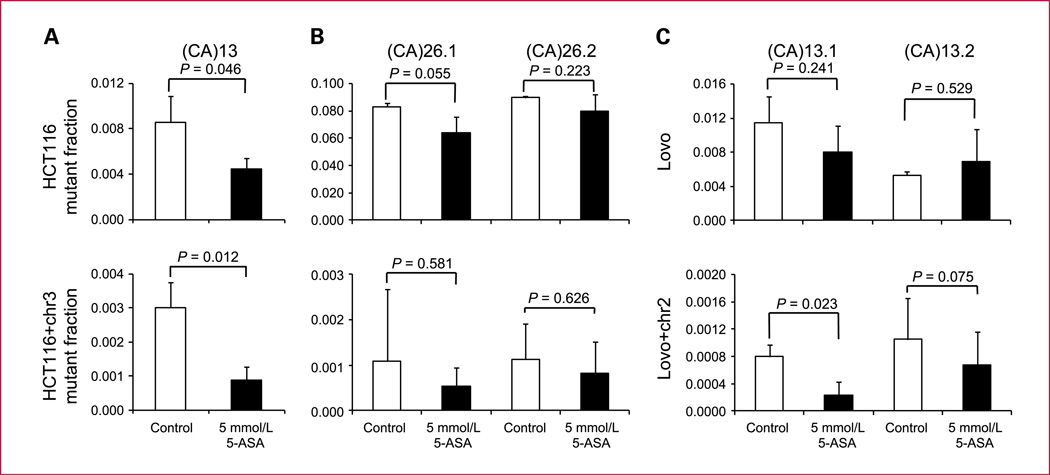
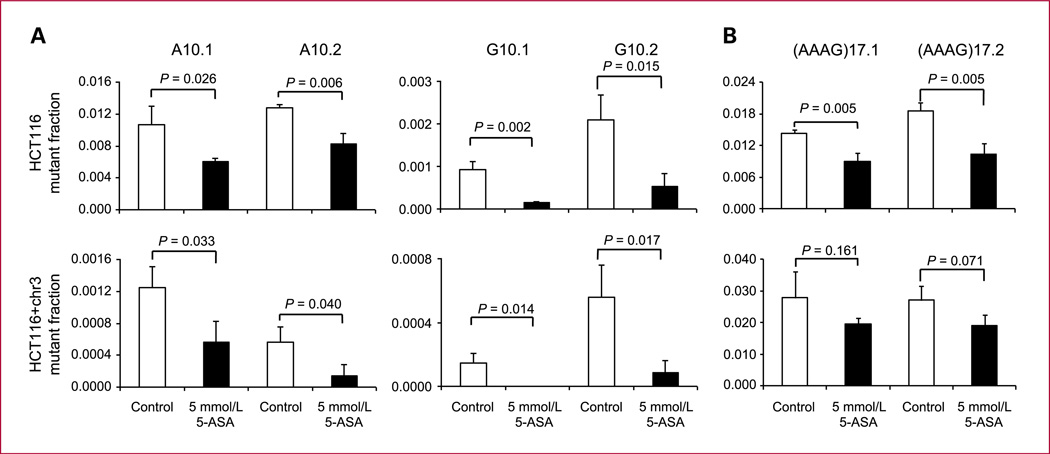
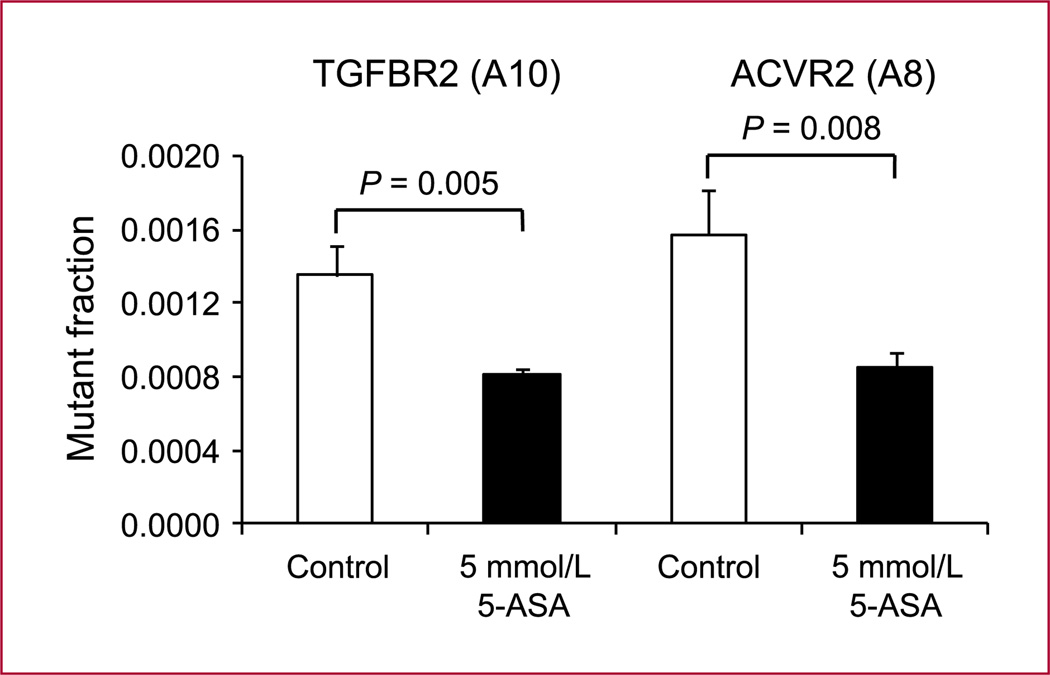
Results: In HCT116, 5-ASA reduced the mutant fraction at (CA)13 by 48.3%, at A10 by 35.6-43.6%, at G10 by 74.9-83.6%, and at (AAAG)17 by 37.6-44.4%. Similar results were observed in hMLH1-proficient HCT116+chr3 cells. Moreover, the presence of 5-ASA significantly reduced mutations in TGFBR2 (A10) and ACVR2 (A8) by 39.9% and 46.2%, respectively.
Conclusions: 5-ASA increases replication fidelity in mononucleotide, dinucleotide, and tetranucleotide repeats and reduces mutations in tumor suppressor genes TGFBR2 and ACVR2, a finding that may provoke in vivo studies for the prevention of colorectal cancer in hereditary nonpolyposis colorectal cancer.
Conflict of interest statement
C. Gasche has research collaborations with Giuliani SpA and Shire Pharmaceuticals. The other authors do not have a conflict of interest to report.
Figures
References
-
- Itzkowitz SH, Yio X. Inflammation and cancer IV. Colorectal cancer in inflammatory bowel disease: the role of inflammation. Am J Physiol Gastrointest Liver Physiol. 2004;287:G7–17. - PubMed
-
- Croog VJ, Ullman TA, Itzkowitz SH. Chemoprevention of colorectal cancer in ulcerative colitis. Int J Colorectal Dis. 2003;18:392–400. - PubMed
-
- Rubin DT, Cruz-Correa MR, Gasche C, et al. Colorectal cancer prevention in inflammatory bowel disease and the role of 5-aminosalicylic acid: a clinical review and update. Inflamm Bowel Dis. 2007;14:265–274. - PubMed
-
- Velayos FS, Terdiman JP, Walsh JM. Effect of 5-aminosalicylate use on colorectal cancer and dysplasia risk: a systematic review and metaanalysis of observational studies. Am J Gastroenterol. 2005;100:1345–1353. - PubMed
-
- Velayos FS, Loftus EV, Jr, Jess T, et al. Predictive and protective factors associated with colorectal cancer in ulcerative colitis: a case-control study. Gastroenterology. 2006;130:1941–1949. - PubMed
Publication types
MeSH terms
Substances
Grants and funding
LinkOut - more resources
Full Text Sources
Medical
