. 2010 Mar 2;3(111):ra15.
doi: 10.1126/scisignal.2000502.

Polycomb group proteins as epigenetic mediators of neuroprotection in ischemic tolerance

Affiliations

Polycomb group proteins as epigenetic mediators of neuroprotection in ischemic tolerance

Martha Stapels et al. Sci Signal. .

Abstract

Exposing the brain to sublethal ischemia affects the response to a subsequent, otherwise injurious ischemia, resulting in transcriptional suppression and neuroprotection, a response called ischemic tolerance. Here, we show that the proteomic signature of the ischemic-tolerant brain is characterized by increased abundance of transcriptional repressors, particularly polycomb group (PcG) proteins. Knocking down PcG proteins precluded the induction of ischemic tolerance, whereas in an in vitro model, overexpressing the PcG proteins SCMH1 or BMI1 induced tolerance to ischemia without preconditioning. We found that PcG proteins are associated with the promoter regions of genes encoding two potassium channel proteins that show decreased abundance in ischemic-tolerant brains. Furthermore, PcG proteins decreased potassium currents in cultured neuronal cells, and knocking down potassium channels elicited tolerance without preconditioning. These findings reveal a previously unknown mechanism of neuroprotection that involves gene repressors of the PcG family.


Figures
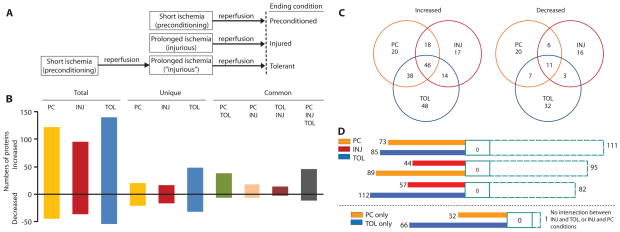
Fig. 1
Fig. 1
Proteomic signature of ischemic-tolerant brains. (A) Experimental paradigm. In mice, 15-min MCAO (preconditioning ischemia) followed by 72-hour reperfusion protects the cortex from ischemic injury when the preconditioned brain is subjected to 1-hour MCAO. Without preconditioning ischemia, 1-hour MCAO causes massive cortical and striatal infarction (1). (B) Numbers of cortical proteins showing changes in abundance under various ischemic conditions, as determined by highly reproducible, quantitative MS analyses (fig. S1). Most of the proteins analyzed (~400) did not show a change in abundance under any given condition. Complete lists of proteins and their quantities under various conditions are provided in tables S1 and S2 to S6. (C) Venn diagram of proteins that changed in abundance. (D) Intersection of data sets involving proteins that increased in abundance (top, including proteins that increased in abundance in more than one ischemic condition; bottom, involving proteins that increased in abundance only under a specific ischemic condition). This figure presents numbers of network objects (see Materials and Methods for definition) that are unique to a particular ischemic condition (color-filled), associated with two of three conditions (open) or all three conditions (dashed line). PC, ischemic-preconditioned; INJ, ischemic-injured; TOL, ischemic-tolerant.
Fig. 2
Fig. 2
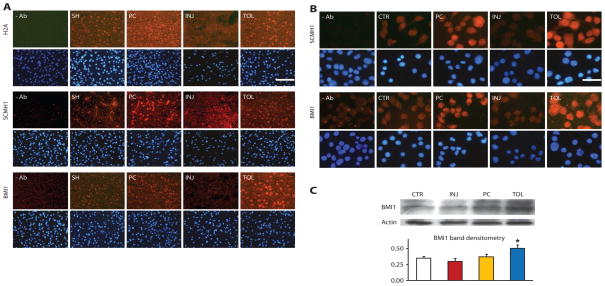
Differential changes of representative gene repressor proteins under different ischemic conditions in brains and cultured neuronal cells. (A) Immunohistochemical analysis of H2A, SCMH1, and BMI1 showed increased immunoreactivity (red) in ischemic-preconditioned (PC) and ischemic-tolerant (TOL) brains, relative to that in sham brains (SH), but decreased immunoreactivity in injured brains (INJ). Mice were subjected to the MCAO treatment paradigm described in Fig. 1. Bottom rows show DAPI staining (blue) to reveal nuclei. At least two brains of each condition were analyzed with similar results. The scale bar represents 50 μm. (B and C) Increased immunoreactivity of SCMH1 and BMI1 in NS20Y cells under simulated ischemic-tolerant (OGD-tolerant) conditions. Four groups of differentiated NS20Y cells were treated with the following conditions: (1) control (CTR); (2) preconditioning (PC); (3) injurious (INJ); (4) tolerant (TOL) (details are in Materials and Methods). Cells were then fixed and examined by immunocytochemistry for SCMH1 or BMI1 (B). BMI1 was also analyzed by Western blot (Western blot of actin serves as a loading control), with parallel analysis of actin (C, bottom) as a loading control. Similar results were obtained in at least three independent cultures. Scale bar, 25 μm. *P < 0.05.
Fig. 3
Fig. 3
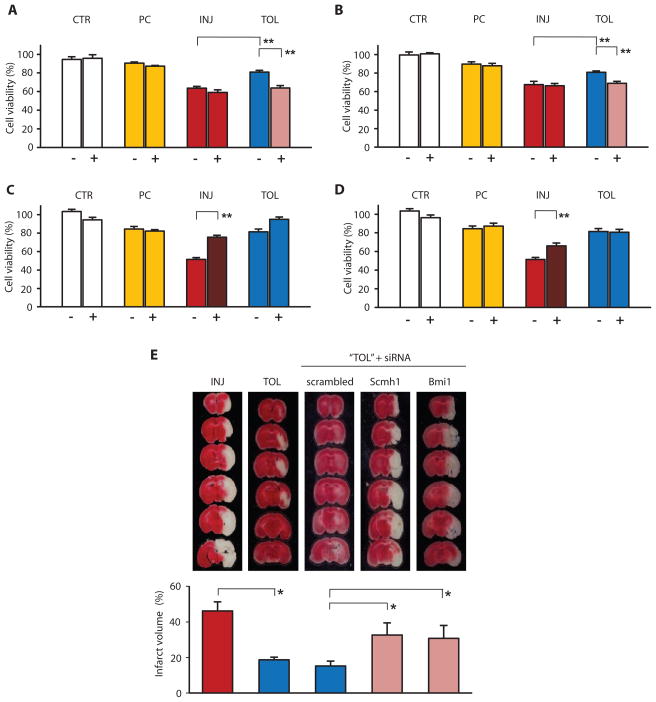
Dependence of ischemic tolerance on PcG protein abundance in vitro and in vivo. Before differentiation and OGD, NS20Y cells were transiently transfected with scrambled RNA (−) or siRNA oligonucleotides (+) directed against Scmh1 (A) or Bmi1 (B), or stably transfected with plasmid encoding recombinant Scmh1 (C) or Bmi1 (D), respectively. OGD-induced injury was assessed by cell viability (percent to control cells). Data represent mean ± SE of at least three independent cultures. A 40 to 50% decrease in viability was caused by 2-hour OGD, which could be prevented by a preceding 30-min OGD. (E) Effects of knocking down PcG expression on ischemic tolerance in vivo. One-hour MCAO caused massive infarction of the mouse cortex (INJ), which was avoided when the brain was exposed to a 15-min preconditioning ischemia (TOL). Administration of siRNA directed against Scmh1 or Bmi1, but not scrambled RNA, significantly diminished the preconditioning ischemia-induced ischemic tolerance. Tissue infarction was revealed (top) and quantified (bottom; mean ± SE, n = 5 to 8 animals each group) by vital dye staining of fresh brain slices. Altered PcG protein abundance with the application of siRNA or ORF cDNA are demonstrated in fig. S3. *P < 0.05; **P < 0.005.
Fig. 4
Fig. 4
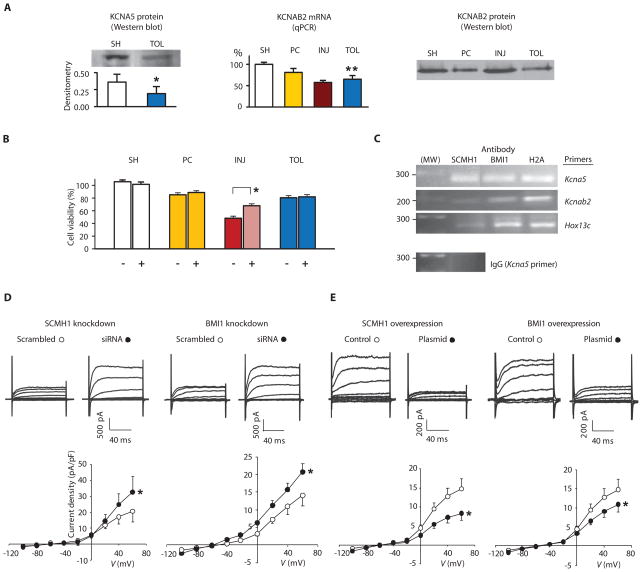
Implication of potassium channel suppression in ischemic tolerance and inhibition of K+ current by PcG proteins. (A) Analyses of potassium channel abundance in brain. Left, KCNA5; middle and right, KCNAB2. SH, PC, INJ, and TOL: as noted in Fig. 1. (B) Effects of knocking down potassium channels on tolerance. NS20Y cells were transfected with scrambled RNA (−) or a mixture of siRNA oligos (+) against Kcna5 and Kcnab2, followed by differentiation and OGD treatments as described in Figs. 2B and 3, A and B. Data are presented as mean ± SE of at least three independent cultures. (C) Results of ChIP assays of NS20Y cells, with antibodies noted in the figure and PCR primers, also noted in the figure, for the promoter region of Kcna5, Kcnab2, or Hox13c. Predicted sizes for PCR fragments are 270, 184, and 271 base pairs for Kcna5, Kcnab2, and Hox13c, respectively. Antibody against H2A and Hox13c primers were included as positive controls and immunoglobulin G (IgG) as a negative control. The analyses were repeated twice on two independent cultures with similar results. (D and E) Effects of knocking down (D) or overexpressing (E) SCMH1 or BMI1 on potassium currents. NS20Y cells were transfected with siRNA oligos or plasmids as noted in the figure and differentiated (n = 6 to 8 each condition). *P < 0.05; **P < 0.005.

References

    1. Stenzel-Poore MP, Stevens SL, Xiong Z, Lessov NS, Harrington CA, Mori M, Meller R, Rosenzweig HL, Tobar E, Shaw TE, Chu X, Simon RP. Effect of ischaemic preconditioning on genomic response to cerebral ischaemia: Similarity to neuroprotective strategies in hibernation and hypoxia-tolerant states. Lancet. 2003;362:1028–1037. - PubMed
    1. Takada Y, Isono K, Shinga J, Turner JM, Kitamura H, Ohara O, Watanabe G, Singh PB, Kamijo T, Jenuwein T, Burgoyne PS, Koseki H. Mammalian Polycomb Scmh1 mediates exclusion of Polycomb complexes from the XY body in the pachytene spermatocytes. Development. 2007;134:579–590. - PubMed
    1. Berger J, Kurahashi H, Takihara Y, Shimada K, Brock HW, Randazzo F. The human homolog of Sex comb on midleg (SCMH1) maps to chromosome 1p34. Gene. 1999;237:185–191. - PubMed
    1. Tomotsune D, Takihara Y, Berger J, Duhl D, Joo S, Kyba M, Shirai M, Ohta H, Matsuda Y, Honda BM, Simon J, Shimada K, Brock HW, Randazzo F. A novel member of murine Polycomb-group proteins, Sex comb on midleg homolog protein, is highly conserved, and interacts with RAE28/mph1 in vitro. Differentiation. 1999;65:229–239. - PubMed
    1. Cao R, Tsukada Y, Zhang Y. Role of Bmi-1 and Ring1A in H2A ubiquitylation and Hox gene silencing. Mol Cell. 2005;20:845–854. - PubMed

Publication types

MeSH terms