


Oophorectomy, menopause, estrogen, and cognitive aging: the timing hypothesis
- PMID: 20197698
- PMCID: PMC2859235
- DOI: 10.1159/000289229
Oophorectomy, menopause, estrogen, and cognitive aging: the timing hypothesis
Abstract
Background: The concept of neuroprotective effects of estrogen in women remains controversial.
Objective: To explore the timing hypothesis in relation to cognitive aging and dementia.
Methods: We reviewed existing literature, conducted some reanalyses, and combined results graphically.
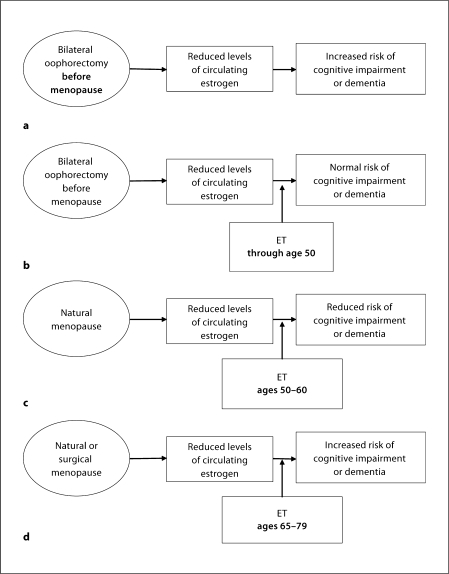
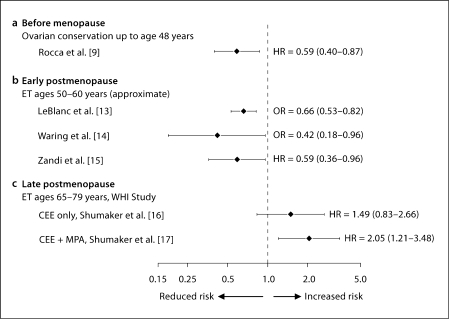
Results: Current evidence suggests that estrogen may have either protective effects or harmful effects on the brain depending on age, type of menopause (natural versus surgical), or stage of menopause. The comparison of women with ovarian conservation versus women who underwent bilateral oophorectomy provided evidence for a sizeable neuroprotective effect of estrogen in women in the premenopausal years (most commonly before age 50 years). Several case-control studies and cohort studies also showed a neuroprotective effect in women who received estrogen treatment in the early postmenopausal phase (most commonly at ages 50-60 years). However, recent clinical trials showed that women who initiated estrogen treatment in the late postmenopausal phase (ages 65-79 years) experienced an increased risk of dementia and cognitive decline.
Conclusion: The neuroprotective effects of estrogen depend on age, type of menopause, and stage of menopause (timing hypothesis).
Copyright 2010 S. Karger AG, Basel.
Figures
References
-
- Manson JE, Bassuk SS, Harman SM, Brinton EA, Cedars MI, Lobo R, Merriam GR, Miller VM, Naftolin F, Santoro N. Postmenopausal hormone therapy: new questions and the case for new clinical trials. Menopause. 2006;13:139–147. - PubMed
-
- Siegfried T. Neuroscience: it's all in the timing. Nature. 2007;445:359–361. - PubMed
-
- McEwen BS, Alves SE. Estrogen actions in the central nervous system. Endocr Rev. 1999;20:279–307. - PubMed
-
- Monk D, Brodaty H. Use of estrogens for the prevention and treatment of Alzheimer's disease. Dement Geriatr Cogn Disord. 2000;11:1–10. - PubMed
-
- Gibbs RB, Aggarwal P. Estrogen and basal forebrain cholinergic neurons: implications for brain aging and Alzheimer's disease-related cognitive decline. Horm Behav. 1998;34:98–111. - PubMed
Publication types
MeSH terms
Substances
Grants and funding
LinkOut - more resources
Full Text Sources
Other Literature Sources
Medical
