. 2009 Dec 15;3(3):337-43.
doi: 10.3389/neuro.01.030.2009. eCollection 2009.

Intracortical cartography in an agranular area

Affiliations

Intracortical cartography in an agranular area

Gordon M G Shepherd. Front Neurosci. .

Abstract

A well-defined granular layer 4 is a defining cytoarchitectonic feature associated with sensory areas of mammalian cerebral cortex, and one with hodological significance: the local axons ascending from cells in thalamorecipient layer 4 and connecting to layer 2/3 pyramidal neurons form a major feedforward excitatory interlaminar projection. Conversely, agranular cortical areas, lacking a distinct layer 4, pose a hodological conundrum: without a laminar basis for the canonical layer 4-->2/3 pathway, what is the basic circuit organization? This review highlights current challenges and prospects for local-circuit electroanatomy and electrophysiology in agranular cortex, focusing on the mouse. Different lines of evidence, drawn primarily from studies of motor areas in frontal cortex in rodents, support the view that synaptic circuits in agranular cortex are organized around prominent descending excitatory layer 2/3-->5 pathways targeting multiple classes of projection neurons.

Keywords: frontal; motor; pyramidal neuron; synaptic circuits.


Figures
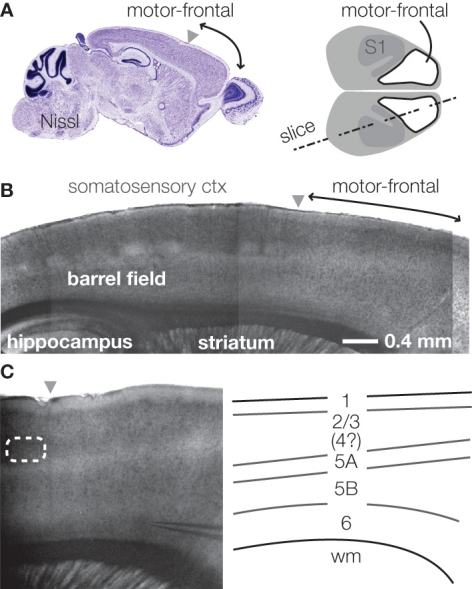
Figure 1
Figure 1
Layers in the mouse's agranular cortex. (A) Sagittal section through the mouse's motor-frontal cortex (left). Source: Allen Brain Atlas’ reference atlas (mouse.brain-map.org). Schematic top view of mouse cortex, showing location of motor-frontal area (right). (B) Bright-field image of slice (slice angle indicated in (A), right). Anterior is to the right. The agranular motor-frontal cortex lacks the distinct layer 4 barrels seen in somatosensory cortex. (C) Laminar labeling scheme in mouse motor-frontal cortex. Bright-field image of motor-frontal cortex slice (left). Schematic (right) indicates the major layers.
Figure 2
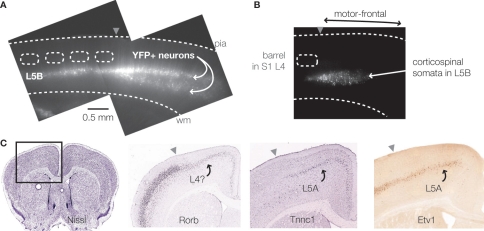
Figure 2
Laminar stratification of cell classes. (A) Epifluorescence image of slice prepared from a YFP-H mouse. The single layer of YFP-positive neurons in L5B in somatosensory cortex expands to two bands in L5B of motor-frontal cortex. (B) Laminar epifluorescence image of slice showing location of corticospinal neurons in L5B. Neurons were retrogradely labeled by injecting fluorescent beads into the spinal cord. (C) Labeling patterns of molecular markers. Coronal section through the mouse's motor-frontal cortex (far left). Gene expression pattern of Rorb, a layer 4 marker, shows strong expression in granular (somatosensory) cortex, and weak expression in agranular (motor-frontal) cortex. Expression pattern of Tnnc1 shows layer 5A-like pattern in motor-frontal cortex. That for Etv1 is similar in granular and agranular areas. Sources: GENSAT (www.gensat.org) (far right), and Allen Brain Atlas’ reference atlas (mouse.brain-map.org) (all others).
Figure 3
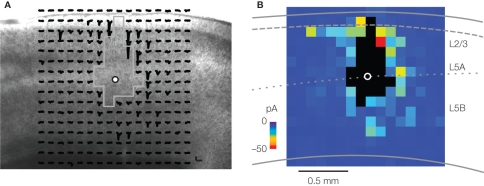
Figure 3
Synaptic mapping of excitatory inputs to layer 5 pyramidal neurons. (A) Image of slice with array of traces superimposed, showing spatial distribution of presynaptic partners of a pyramidal neuron located at the border of L5A and L5B. Strongest responses were evoked at stimulating sites in L2/3 and L5. (B) Synaptic input map for the same neuron, constructed by averaging the responses to photostimulation across the three map trials. For details, see Yu et al. (2008).

References

    1. Arenkiel B. R., Peca J., Davison I. G., Feliciano C., Deisseroth K., Augustine G. J., Ehlers M. D., Feng G. (2007). In vivo light-induced activation of neural circuitry in transgenic mice expressing channelrhodopsin-2. Neuron 54, 205–21810.1016/j.neuron.2007.03.005 - DOI - PMC - PubMed
    1. Ayling O. G., Harrison T. C., Boyd J. D., Goroshkov A., Murphy T. H. (2009). Automated light-based mapping of motor cortex by photoactivation of channelrhodopsin-2 transgenic mice. Nat. Methods 6, 219–22410.1038/nmeth.1303 - DOI - PubMed
    1. Binzegger T., Douglas R. J., Martin K. A. (2004). A quantitative map of the circuit of cat primary visual cortex. J. Neurosci. 24, 8441–845310.1523/JNEUROSCI.1400-04.2004 - DOI - PMC - PubMed
    1. Brecht M., Krauss A., Muhammad S., Sinai-Esfahani L., Bellanca S., Margrie T. W. (2004). Organization of rat vibrissa motor cortex and adjacent areas according to cytoarchitectonics, microstimulation, and intracellular stimulation of identified cells. J. Comp. Neurol. 479, 360–37310.1002/cne.20306 - DOI - PubMed
    1. Brown S. P., Hestrin S. (2009). Intracortical circuits of pyramidal neurons reflect their long-range axonal targets. Nature 457, 1133–113610.1038/nature07658 - DOI - PMC - PubMed

LinkOut - more resources