. 2010 Jun;53(6):1099-109.
doi: 10.1007/s00125-010-1667-2. Epub 2010 Mar 3.

Global microRNA expression profiles in insulin target tissues in a spontaneous rat model of type 2 diabetes

Affiliations

Global microRNA expression profiles in insulin target tissues in a spontaneous rat model of type 2 diabetes

B M Herrera et al. Diabetologia. 2010 Jun.

Abstract

Aims/hypothesis: MicroRNAs regulate a broad range of biological mechanisms. To investigate the relationship between microRNA expression and type 2 diabetes, we compared global microRNA expression in insulin target tissues from three inbred rat strains that differ in diabetes susceptibility.

Methods: Using microarrays, we measured the expression of 283 microRNAs in adipose, liver and muscle tissue from hyperglycaemic (Goto-Kakizaki), intermediate glycaemic (Wistar Kyoto) and normoglycaemic (Brown Norway) rats (n = 5 for each strain). Expression was compared across strains and validated using quantitative RT-PCR. Furthermore, microRNA expression variation in adipose tissue was investigated in 3T3-L1 adipocytes exposed to hyperglycaemic conditions.

Results: We found 29 significantly differentiated microRNAs (p(adjusted) < 0.05): nine in adipose tissue, 18 in liver and two in muscle. Of these, five microRNAs had expression patterns that correlated with the strain-specific glycaemic phenotype. MiR-222 (p(adjusted) = 0.0005) and miR-27a (p(adjusted) = 0.006) were upregulated in adipose tissue; miR-195 (p(adjusted) = 0.006) and miR-103 (p(adjusted) = 0.04) were upregulated in liver; and miR-10b (p(adjusted) = 0.004) was downregulated in muscle. Exposure of 3T3-L1 adipocytes to increased glucose concentration upregulated the expression of miR-222 (p = 0.008), miR-27a (p = 0.02) and the previously reported miR-29a (p = 0.02). Predicted target genes of these differentially expressed microRNAs are involved in pathways relevant to type 2 diabetes.

Conclusion: The expression patterns of miR-222, miR-27a, miR-195, miR-103 and miR-10b varied with hyperglycaemia, suggesting a role for these microRNAs in the pathophysiology of type 2 diabetes, as modelled by the Gyoto-Kakizaki rat. We observed similar patterns of expression of miR-222, miR-27a and miR-29a in adipocytes as a response to increased glucose levels, which supports our hypothesis that altered expression of microRNAs accompanies primary events related to the pathogenesis of type 2 diabetes.


Figures
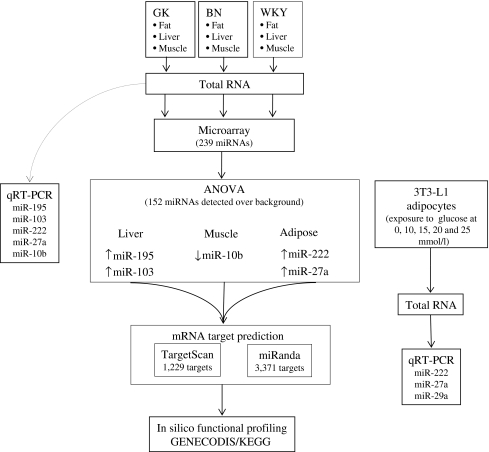
Fig. 1
Fig. 1
Outline of study design and results
Fig. 2
Fig. 2
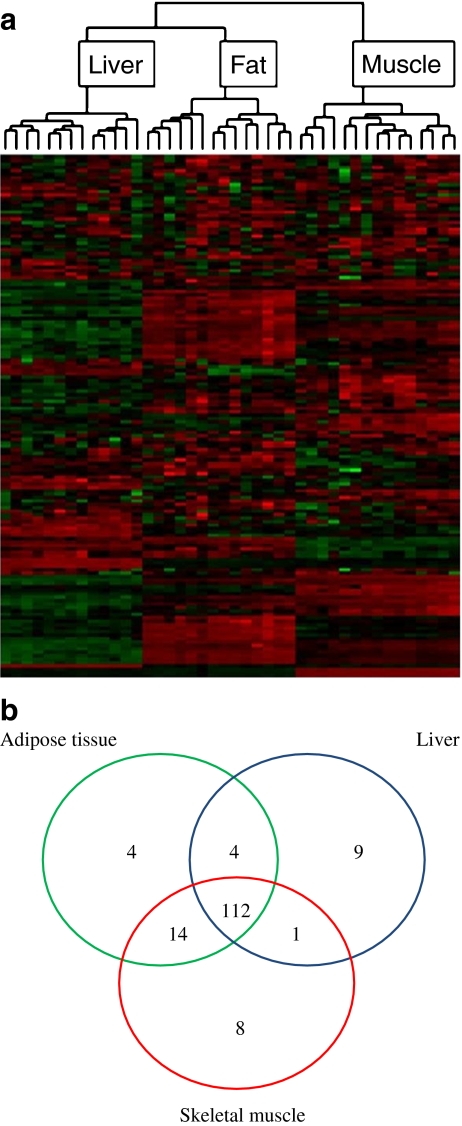
miRNA expression was specific in insulin target tissues from GK, WKY and BN rats. a Unsupervised hierarchical clustering analysis for expression of 152 miRNAs differentiated samples by tissue. Each row represents an miRNA and each column a tissue sample. Colours represent relative intensity of the detected signal in each sample, red representing high expression and green representing low expression. b Summary of miRNA expression across three insulin target tissues (adipose tissue, liver and skeletal muscle) for 152 miRNAs detected above background levels
Fig. 3
Fig. 3
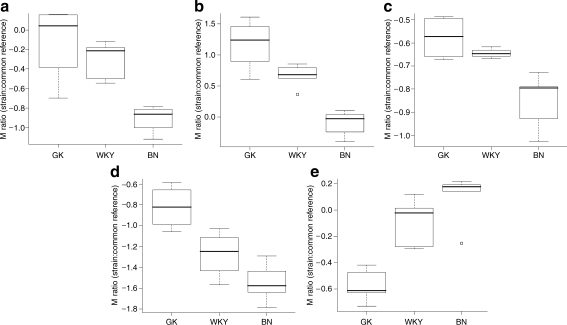
Box plots of expression in strains GK, WKY and BN (relative to a common reference) for five miRNAs whose expression was consistent with glycaemic status. The pattern GK>WKY>BN was observed for miR-27a (a) and miR-222 (b) in adipose tissue, and for mir-103 (c) and miR-195 (d) in liver, whereas GK<WKY<BN was observed for miR-10b in muscle (e). Circles represent outliers
Fig. 4
Fig. 4
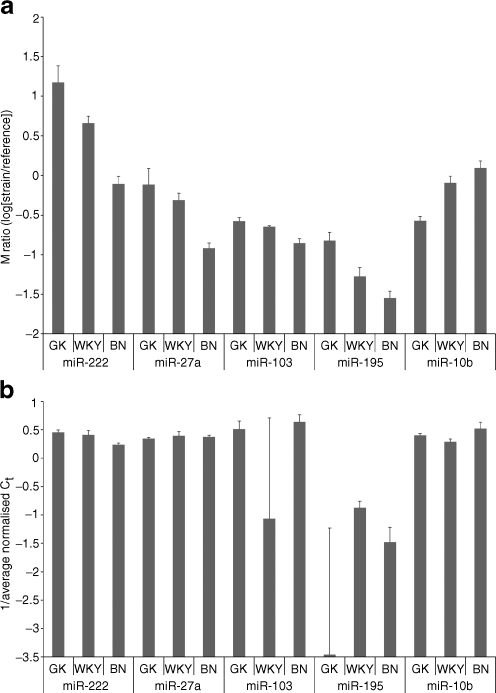
Signal intensity ratios between strains GK, WKY and BN for array data (a) and quantitative reverse transcriptase PCR (b) for miR-222 and miR-27a in adipose tissue, miR103 and miR-195 in liver and miR-10b in muscle. a Microarray log-ratio intensities for array data for each sample relative to the common reference. Positive values indicate higher expression in the experimental sample relative to the common reference, and vice versa for negative values. Error bars show the SE. The larger the mean log-ratio for a given strain, the more highly expressed the corresponding miRNA. b Expression of miRNAs detected using qRT-PCR. Data are presented as the inverse of the Ct score. Columns indicate expression relative to the control genes (snoRNA and 4.5S RNA) and error bars show the SE
Fig. 5
Fig. 5
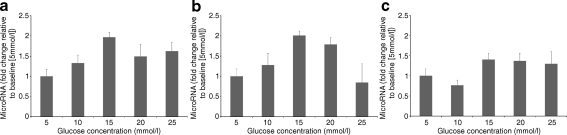
Relative changes in expression of miRNAs in 3T3-L1 adipocytes following stimulation with glucose. Fold changes in expression of a miR-29a, b miR-222 and c miR-27a in response to exposure of 3t3-L1 adipocytes to glucose 5, 10, 15, 20 and 25 mmol/l for 24 h. MicroRNA expression was assayed by qRT-PCR. Fold changes were calculated using the formula image method and are relative to baseline expression at 5 mmol/l. Error bars represent the standard deviation

References

    1. Bartel DP. MicroRNAs: genomics, biogenesis, mechanism, and function. Cell. 2004;116:281–297. doi: 10.1016/S0092-8674(04)00045-5. - DOI - PubMed
    1. Liang Y, Ridzon D, Wong L, Chen C. Characterization of microRNA expression profiles in normal human tissues. BMC Genomics. 2007;8:166. doi: 10.1186/1471-2164-8-166. - DOI - PMC - PubMed
    1. Krutzfeldt J, Stoffel M. MicroRNAs: a new class of regulatory genes affecting metabolism. Cell Metab. 2006;4:9–12. doi: 10.1016/j.cmet.2006.05.009. - DOI - PubMed
    1. Lynn FC, Skewes-Cox P, Kosaka Y, McManus MT, Harfe BD, German MS. MicroRNA expression is required for pancreatic islet cell genesis in the mouse. Diabetes. 2007;56:2938–2945. doi: 10.2337/db07-0175. - DOI - PubMed
    1. Poy MN, Eliasson L, Krutzfeldt J, et al. A pancreatic islet-specific microRNA regulates insulin secretion. Nature. 2004;432:226–230. doi: 10.1038/nature03076. - DOI - PubMed

Publication types

MeSH terms