. 2010 Apr 6;49(13):2843-50.
doi: 10.1021/bi1000678.

Molecular mechanism of flop selectivity and subsite recognition for an AMPA receptor allosteric modulator: structures of GluA2 and GluA3 in complexes with PEPA

Affiliations

Molecular mechanism of flop selectivity and subsite recognition for an AMPA receptor allosteric modulator: structures of GluA2 and GluA3 in complexes with PEPA

Ahmed H Ahmed et al. Biochemistry. .

Abstract

Glutamate receptors are important potential drug targets for cognitive enhancement and the treatment of schizophrenia in part because they are the most prevalent excitatory neurotransmitter receptors in the vertebrate central nervous system. One approach to the application of therapeutic agents to the AMPA subtype of glutamate receptors is the use of allosteric modulators, which promote dimerization by binding to a dimer interface thereby reducing the degree of desensitization and deactivation. AMPA receptors exist in two alternatively spliced variants (flip and flop) that differ in desensitization and receptor activation profiles. Most of the structural information about modulators of the AMPA receptor targets the flip subtype. We report here the crystal structure of the flop-selective allosteric modulator, PEPA, bound to the binding domains of the GluA2 and GluA3 flop isoforms of AMPA receptors. Specific hydrogen bonding patterns can explain the preference for the flop isoform. This includes a bidentate hydrogen bonding pattern between PEPA and N754 of the flop isoforms of GluA2 and GluA3 (the corresponding position in the flip isoform is S754). Comparison with other allosteric modulators provides a framework for the development of new allosteric modulators with preferences for either the flip or flop isoforms. In addition to interactions with N/S754, specific interactions of the sulfonamide with conserved residues in the binding site are characteristics of a number of allosteric modulators. These, in combination with variable interactions with five subsites on the binding surface, lead to different stoichiometries, orientations within the binding pockets, and functional outcomes.


Figures
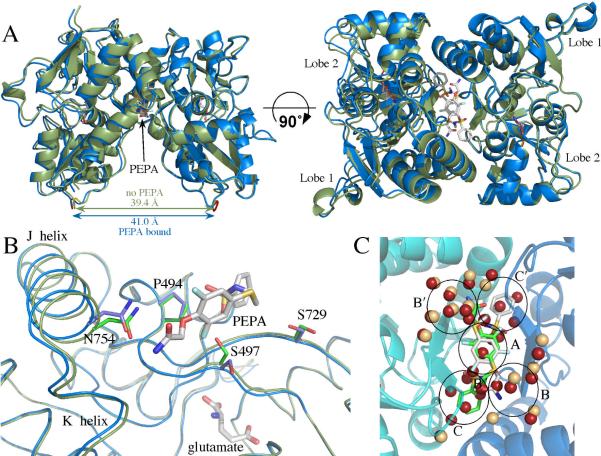
Figure 1
Figure 1
(A) Comparison of glutamate-bound GluA2o S1S2 in the presence (blue) and the absence of PEPA (green) in two orientations. Both orientations of PEPA are shown. Note that the binding of PEPA results in a separation of the two components of the dimer (distance between the Cα atoms of the threonine in the linker) by approximately 1.5 Å. (B) One monomer of GluA2o S1S2 in the presence (blue) and the absence of PEPA (green) with one orientation of PEPA shown. Both the J/K helices and the strand near S497 are displaced upon binding PEPA. Also, the sidechains of S497 and S729 change rotameric states. (C) Comparison of the water molecules at the dimer interface in the presence (tan spheres) and the absence of PEPA (red spheres). PEPA is shown in both orientations. Despite the greater separation of the dimer interface, a number of the ordered water molecules found in the absence of PEPA are displaced by PEPA. The black circles delineate subsites of the allosteric modulator binding site as described previously (31).
Figure 2
Figure 2
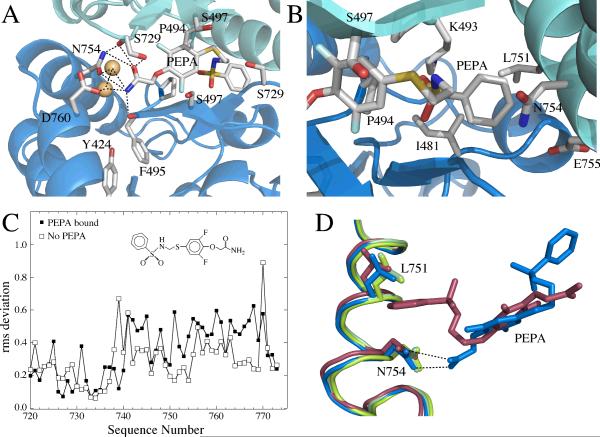
The PEPA binding site, emphasizing the important interactions, shown in two orientations. (A) A view of the amide side of PEPA bound to GluA2 S1S2. The hydrogen bonding network with the amide of PEPA is shown as dotted lines. The H-bond with the sidechain of S729 is difficult to display in the orientation used in the figure. (B) A view of the phenyl group of PEPA inserted into a hydrophobic pocket in GluA2 S1S2. (C) RMS plot showing more variability in the J/K helices for the PEPA-bound structure than the unbound structure. (D) J/K helix showing where differences in the two orientations were analyzed. The amide of PEPA-N754 interaction (blue) maintains the position of the J helix in the absence of PEPA (green) The J helix is displaced on the phenyl side of PEPA (red).
Figure 3
Figure 3
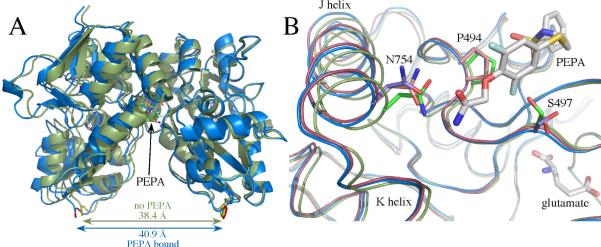
(A) Comparison of glutamate-bound GluA3o S1S2 in the presence (blue) and the absence of PEPA (green) in two orientations. Both orientations of PEPA are shown. Note that the binding of PEPA results in a separation of the two components of the dimer (distance between the Cα atoms of the threonine in the linker) by approximately 2.5 Å. (B) One monomer of GluA3o S1S2 in the presence (blue) and the absence of PEPA (green) with one orientation of PEPA shown. Shown for comparison is the PEPA-bound form of GluA2o (red). Both the J/K helices and the strand near S497 are displaced upon binding PEPA for both GluA2o and GluA3o. Also, the sidechains of S497 and S729 are in different rotameric states for GluA3o bound to PEPA compared with GluA3o in the absence of PEPA and GluA2o bound to PEPA. Also, N754 is displaced in PEPA-bound GluA3o, such that only one H-bond is possible with the amide of PEPA.
Figure 4
Figure 4
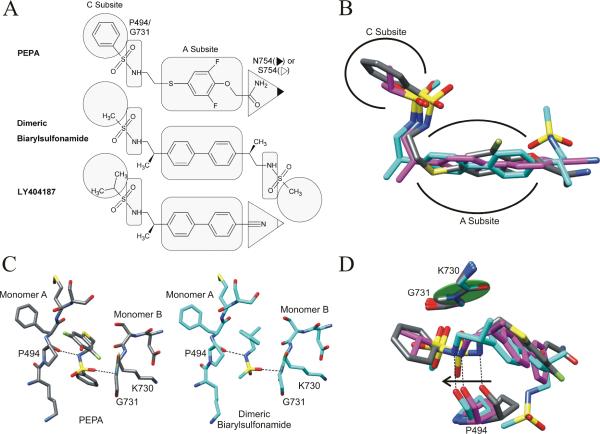
(A) Members of the full spanning class of allosteric modulators. The shape-highlighted regions of the modulators illuminate key contact points to the specific binding pocket residues and subsites (as labeled for PEPA). (B) Overlay of the full spanning modulator structures. The structures were aligned at both sets of P494 and G731 residues. PEPA (gray) occupies a similar arrangement of subsites as the dimeric biarylsulfonamide (PDB entry 3bbr, cyan, 30) and LY404187 (PDB entry 3kgc, magenta, 8). (C) The sulfonamide bridges the two monomers in both PEPA and the dimeric biarylsulfonamide with the same interactions to P494 and G731. (D) The hydrogen bond between the carbonyl of P494 and the sulfonamide is maintained when the modulator is in a shifted position relative to the peptide plane of K730 and G731 (green disk) located on the opposite monomer.

References

    1. Christopoulos A. Allosteric binding sites on cell-surface receptors: novel targets for drug discovery. Nat Rev Drug Discov. 2002;1:198–210. - PubMed
    1. Changeux JP, Taly A. Nicotinic receptors, allosteric proteins and medicine. Trends Mol Med. 2008;14:93–102. - PubMed
    1. Bowie D. Ionotropic glutamate receptors & CNS disorders. CNS Neurol Disord Drug Targets. 2008;7:129–143. - PMC - PubMed
    1. Dingledine R, Borges K, Bowie D, Traynelis S. The glutamate receptor ion channels. Pharmacol. Rev. 1999;51:7–61. - PubMed
    1. Oswald RE, Ahmed A, Fenwick MK, Loh AP. Structure of glutamate receptors. Current drug targets. 2007;8:573–582. - PubMed

Publication types