


The development of a web- and a print-based decision aid for prostate cancer screening
- PMID: 20199680
- PMCID: PMC2845091
- DOI: 10.1186/1472-6947-10-12
The development of a web- and a print-based decision aid for prostate cancer screening
Abstract
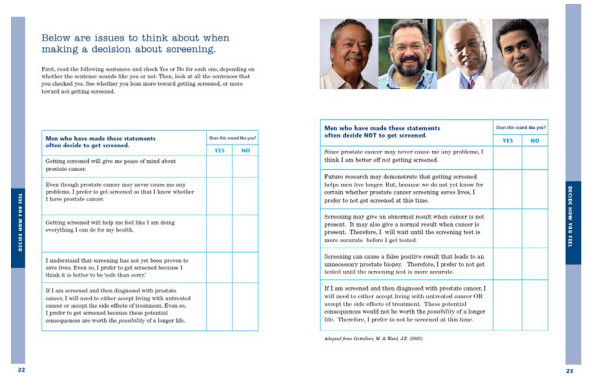
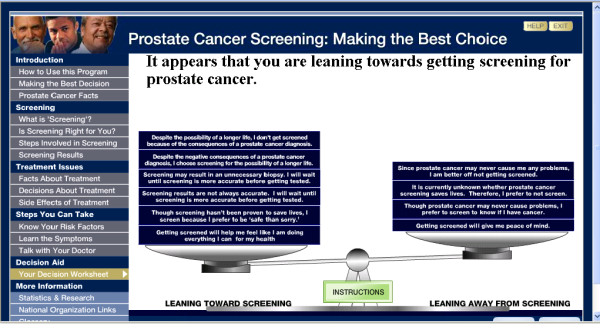
Background: Whether early detection and treatment of prostate cancer (PCa) will reduce disease-related mortality remains uncertain. As a result, tools are needed to facilitate informed decision making. While there have been several decision aids (DAs) developed and tested, very few have included an exercise to help men clarify their values and preferences about PCa screening. Further, only one DA has utilized an interactive web-based format, which allows for an expansion and customization of the material. We describe the development of two DAs, a booklet and an interactive website, each with a values clarification component and designed for use in diverse settings.
Methods: We conducted two feasibility studies to assess men's (45-70 years) Internet access and their willingness to use a web- vs. a print-based tool. The booklet was adapted from two previous versions evaluated in randomized controlled trials (RCTs) and the website was created to closely match the content of the revised booklet. Usability testing was conducted to obtain feedback regarding draft versions of the materials. The tools were also reviewed by a plain language expert and the interdisciplinary research team. Feedback on the content and presentation led to iterative modifications of the tools.
Results: The feasibility studies confirmed that the Internet was a viable medium, as the majority of men used a computer, had access to the Internet, and Internet use increased over time. Feedback from the usability testing on the length, presentation, and content of the materials was incorporated into the final versions of the booklet and website. Both the feasibility studies and the usability testing highlighted the need to address men's informed decision making regarding screening.
Conclusions: Informed decision making for PCa screening is crucial at present and may be important for some time, particularly if a definitive recommendation either for or against screening does not emerge from ongoing prostate cancer screening trials. We have detailed our efforts at developing print- and web-based DAs to assist men in determining how to best meet their PCa screening preferences. Following completion of our ongoing RCT designed to test these materials, our goal will be to develop a dissemination project for the more effective tool.
Trial registration: NCT00623090.
Figures
References
-
- American Cancer Society. Cancer Facts and Figures 2009. http://www.cancer.org/downloads/STT/500809web.pdf
-
- Ries LAG, Melbert D, Krapcho M, Stinchcomb DG, Howlader N, Horner MJ. SEER Cancer Statistics Review. National Cancer Institute. Bethesda, MD; 1975. http://seer.cancer.gov/csr/1975_2005/ based on November 2007 SEER data submission, posted to the SEER web site 2008.
-
- Stanford JL, Stephenson RA, Coyle LM, Cerhan J, Correa R, Eley JW. Prostate Cancer Trends 1973-1995. SEER Program, National Cancer Institute. NIH publication; 1999. pp. 99–4543.
Publication types
MeSH terms
Associated data
Grants and funding
LinkOut - more resources
Full Text Sources
Medical
Research Materials
