


The genetic effects of the dopamine D1 receptor gene on chicken egg production and broodiness traits
- PMID: 20199684
- PMCID: PMC2848132
- DOI: 10.1186/1471-2156-11-17
The genetic effects of the dopamine D1 receptor gene on chicken egg production and broodiness traits
Abstract
Background: The elevation of egg production and the inhibition of incubation behavior are the aims of modern poultry production. Prolactin (PRL) gene is confirmed to be critical for the onset and maintenance of these reproductive behaviors in birds. Through PRL, dopamine D1 receptor (DRD1) was also involved in the regulation of chicken reproductive behavior. However, the genetic effects of this gene on chicken egg production and broodiness have not been studied extensively. The objective of this research was to evaluate the genetic effects of the DRD1 gene on chicken egg production and broodiness traits.
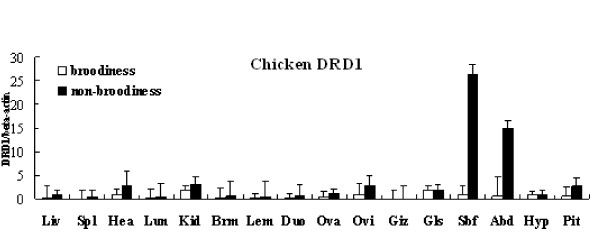
Results: In this study, the chicken DRD1 gene was screened for the polymorphisms by cloning and sequencing and 29 variations were identified in 3,342 bp length of this gene. Seven single nucleotide polymorphism (SNPs) among these variations, including a non-synonymous mutation (A+505G, Ser169Gly), were located in the coding region and were chosen to analyze their association with chicken egg production and broodiness traits in 644 Ningdu Sanhuang individuals. Two SNPs, G+123A and C+1107T, were significantly associated with chicken broody frequency (P < 0.05). Significant association was also found between the G+1065A - C+1107T haplotypes and chicken broody frequency (P < 0.05). In addition, the haplotypes of G+123A and T+198C were significantly associated with weight of first egg (EW) (P = 0.03). On the other hand, the distribution of the DRD1 mRNA was observed and the expression difference was compared between broodiness and non-broodiness chickens. The DRD1 mRNA was predominantly expressed in subcutaneous fat and abdominal fat of non-broodiness chicken, and then in heart, kidney, oviduct, glandular stomach, hypothalamus, and pituitary. In subcutaneous fat and abdominal fat, the level of non-broodiness was 26 to 28 times higher than that of broodiness. In pituitary, it was 5-fold higher. In heart, oviduct, and kidney, a 2-3 times decrease from non-broodiness to broodiness was displayed. In glandular stomach and hypothalamus, the level seen in non-broodiness and broodiness was almost the same.
Conclusion: The polymorphisms of the DRD1 gene and their haplotypes were associated with chicken broody frequency and some egg production traits. The mRNA distribution was significant different between broodiness and non-broodiness chickens.
Figures
References
-
- Sharp PJ. Genes for persistency of egg laying: White Leghorns and broodiness. Roslin Institute Edinburgh Annual Report. 2004. pp. 38–42.
-
- Romanov MN, Talbot RT, Wilson PW, Sharp PJ. Genetic control of incubation behavior in the domestic hen. Poult Sci. 2002;81:928–931. - PubMed
-
- Cui JX, Du HL, Liang Y, Deng XM, Li N, Zhang XQ. Association of polymorphisms in the promoter region of chicken prolactin with egg production. Poult Sci. 2006;85:26–31. - PubMed
Publication types
MeSH terms
Substances
LinkOut - more resources
Full Text Sources
