. 2010 Apr 30;285(18):13471-9.
doi: 10.1074/jbc.M109.097394. Epub 2010 Mar 3.

Perception of the Arabidopsis danger signal peptide 1 involves the pattern recognition receptor AtPEPR1 and its close homologue AtPEPR2

Affiliations

Perception of the Arabidopsis danger signal peptide 1 involves the pattern recognition receptor AtPEPR1 and its close homologue AtPEPR2

Elzbieta Krol et al. J Biol Chem. .

Abstract

Plasma membrane-borne pattern recognition receptors, which recognize microbe-associated molecular patterns and endogenous damage-associated molecular patterns, provide the first line of defense in innate immunity. In plants, leucine-rich repeat receptor kinases fulfill this role, as exemplified by FLS2 and EFR, the receptors for the microbe-associated molecular patterns flagellin and elongation factor Tu. Here we examined the perception of the damage-associated molecular pattern peptide 1 (AtPep1), an endogenous peptide of Arabidopsis identified earlier and shown to be perceived by the leucine-rich repeat protein kinase PEPR1. Using seedling growth inhibition, elicitation of an oxidative burst and induction of ethylene biosynthesis, we show that wild type plants and the pepr1 and pepr2 mutants, affected in PEPR1 and in its homologue PEPR2, are sensitive to AtPep1, but that the double mutant pepr1/pepr2 is completely insensitive. As a central body of our study, we provide electrophysiological evidence that at the level of the plasma membrane, AtPep1 triggers a receptor-dependent transient depolarization through activation of plasma membrane anion channels, and that this effect is absent in the double mutant pepr1/pepr2. The double mutant also fails to respond to AtPep2 and AtPep3, two distant homologues of AtPep1 on the basis of homology screening, implying that the PEPR1 and PEPR2 are responsible for their perception too. Our findings provide a basic framework to study the biological role of AtPep1-related danger signals and their cognate receptors.


Figures
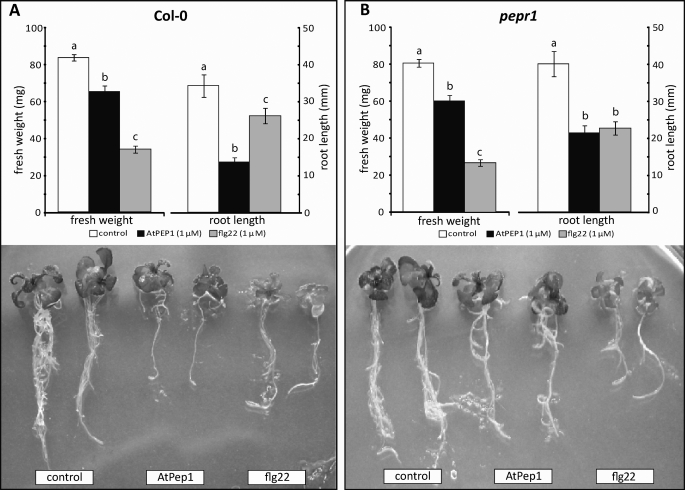
FIGURE 1.
FIGURE 1.
Effect of AtPep1 and flg22 peptide on wild type seedlings and pepr1 mutants. Seedlings (5 days old) of Arabidopsis Col-0 WT (A) and pepr1 mutants (B) were incubated for 10 days in MS medium in the presence of AtPep1 (1 μm) or flg22 (1 μm) or in absence of elicitors. Growth was quantified by determining the total fresh weight per seedling and length of the longest root per seedling. The experiment was repeated three times with similar results. Shown are mean ± S.E. (fresh weight, n = 6; root length, n = 12). The means shown with the same letters were not significantly different based on the least significant difference test (p < 0.05). Representative seedlings were photographed.
FIGURE 2.
FIGURE 2.
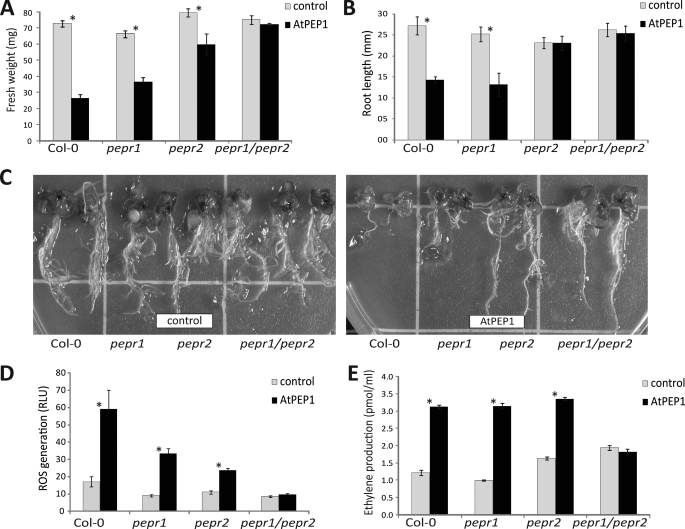
Biological responses of Col-0 WT plants, pepr1, and pepr2 single mutants and pepr1/pepr2 double mutants to AtPep1 (1 μm). Open bars represent untreated controls, filled bars represent AtPep1 treatments. Error bars represent S.E. (n ≥ 6). Asterisks (*) indicate a significant difference based on t test analysis (p < 0.05). All experiments were repeated three times with similar results. A–C, growth response. Growth was quantified by determining the total fresh weight per seedling (A) and length of the longest root per seedling (B) after 10 days of growth in the absence or presence of AtPep1 (1 μm). Representative seedlings were photographed (C). D, ROS production. ROS production was registered continuously with cut and preincubated leaf pieces using the luminol bioassay. The basal level of ROS production before addition of AtPep1 (open bars) is compared with the average ROS production during a 30-min measurement after addition of 1 μm AtPep1 (filled bars). See supplemental Fig. S1 for the full kinetic of ROS production. E, ethylene production: ethylene production by cut and preincubated leaf pieces was measured after 4 h of incubation.
FIGURE 3.
FIGURE 3.
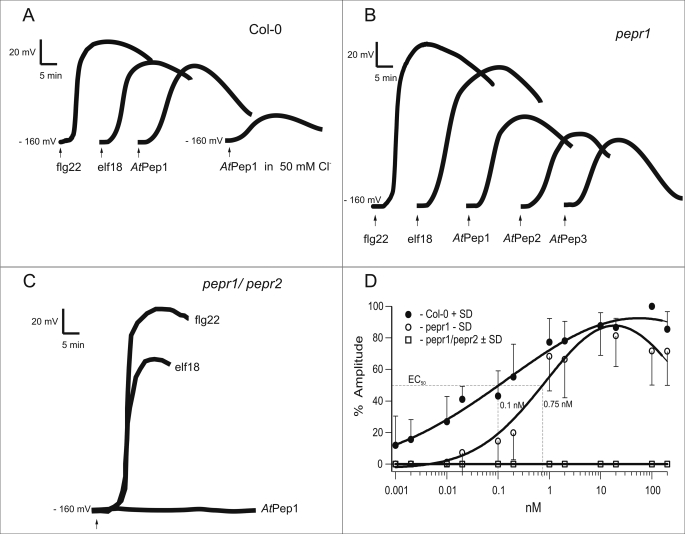
Plasma membrane depolarization in response to various stimuli. Mesophyll cells of WT plants (Col-0, A), the pepr1 mutant (B), or the pepr1/pepr2 double mutant (C) were impaled with a microelectrode, and the electrical potential difference across the plasma membrane was registered continuously after addition of various stimuli (10 nm) as indicated in the figure. All peptides elicited transient membrane potential depolarizations with flg22 showing the highest amplitude. Traces are representative measurements of individual experiments (number of repetitions are indicated in Tables 1 and 2). Dose-response curves (D) of the membrane depolarization in response to AtPep1 were obtained from mesophyll cells of WT plants (Col-0, ●), the pepr1 single mutant (○), and the pepr1/pepr2 double mutant (■). The peak depolarization was determined and expressed as a percentage of the maximal depolarization observed in Col-0 with 100 nm AtPep1. Error bars represent S.D. of 6–13 independent assays per data point.
FIGURE 4.
FIGURE 4.
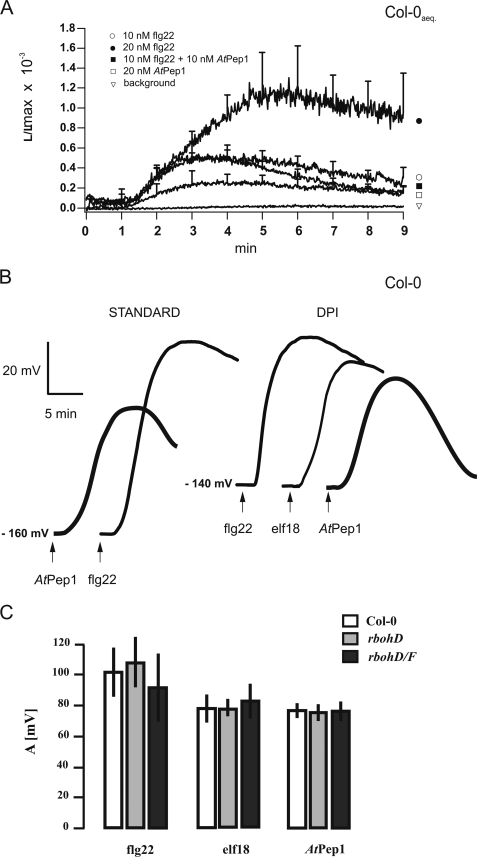
Calcium and ROS signaling in response to DAMPs. A, cytoplasmic calcium levels rise following stimulation with AtPep1 and flg22. Leaf pieces of apoaequorin-transformed Arabidopsis Col-0 plants were preincubated with coelenterazine and then stimulated with different doses of flg22 and AtPep1. Luminescence was continuously monitored. The traces are the mean of at least 5 individual assays (see supplemental Table S1). Error bars represent S.D. B and C, MAMP- or DAMP-triggered membrane depolarization is independent of ROS production. When mesophyll cells of WT plants (Col-0) were examined in the presence of diphenyleneiodonium (B), a plasma membrane response to indicated elicitors (10 nm) was an elicitor-triggered depolarization. Accordingly, wild type plants, rbohD single mutant and rbohD/F double mutant defected in plasma membrane NADPH oxidase subunit(s) showed wild type membrane responses to 10 nm flg22, 10 nm elf18, and 10 nm AtPep1 (C). In the latter depiction of the amplitudes the error bars represent S.D. calculated from 3 to 6 independent repetitions.

References

    1. Boller T., Felix G. (2009) Annu. Rev. Plant Biol. 60, 379–406 - PubMed
    1. Boller T., He S. Y. (2009) Science 324, 742–744 - PMC - PubMed
    1. Zipfel C. (2009) Curr. Opin. Plant Biol. 12, 414–420 - PubMed
    1. Ryan C. A., Huffaker A., Yamaguchi Y. (2007) Cell Microbiol. 9, 1902–1908 - PubMed
    1. Ryan C. A., Pearce G. (2003) Proc. Natl. Acad. Sci. U.S.A. 100, Suppl. 2, 14577–14580 - PMC - PubMed

Publication types

MeSH terms

Substances

LinkOut - more resources