. 2010 Apr 1;184(7):3331-5.
doi: 10.4049/jimmunol.0903022. Epub 2010 Mar 3.

A critical role for the g protein-coupled receptor mFPR2 in airway inflammation and immune responses

Affiliations

A critical role for the g protein-coupled receptor mFPR2 in airway inflammation and immune responses

Keqiang Chen et al. J Immunol. .

Abstract

The formylpeptide receptor-like 1, now officially termed FPR2, in human and its mouse homolog mFPR2 mediate leukocyte migration in response to agonists associated with inflammation and immune responses. To clarify the in vivo role of the receptor, we generated mice deficient in mFPR2. mFPR2(-/-) mice showed markedly reduced severity in OVA/alum-induced allergic airway inflammation. This was associated with diminished recruitment of CD11c(+) dendritic cells into the airway mucosa and secondary lymphoid organs, as well as reduced production of Type 2 cytokines and Igs. We also found that the bronchoalveolar lavage fluid from wild type mice with airway inflammation contained mFPR2 agonist activity. This study reveals a critical role for mFPR2 in the progression of allergic airway inflammation and immune responses.


Conflict of interest statement

Disclosures

The authors have no financial conflicts of interest.

Figures
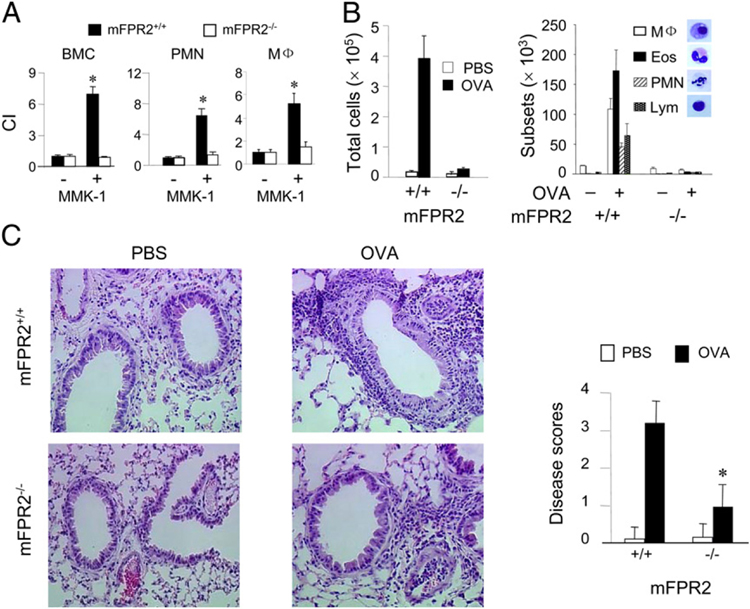
FIGURE 1.
FIGURE 1.
Reduced severity of allergic airway inflammation in mFPR2−/− mice. A, Migration of BMCs, Casein-induced peritoneal neutrophils (PMNs) and thioglycolate-induced peritoneal macrophages (MF) from WT and mFPR2−/− mice in response to the mFPR2 ligand MMK-1 (1025 M). The results are expressed as chemotaxis index representing fold increase in cell response to MMK-1 versus medium control (−). Asterisk indicates significantly increased migration shown by BMCs, PMNs, or Mϕ; from WT mice (p < 0.01). B, Total number and differential counts of leukocytes contained in the BAL liquid from mice. Eos, eosinophil; Lym, lymphocyte. C, Histology showing infiltration of inflammatory cells in the perivascular and peribronchial regions of the lung tissues (H&E, original magnification ×200). The severity of lung inflammation was scored and the asterisk indicates significantly reduced severity in mFPR2−/− mice (p < 0.01). Mice used were 8-wk-old females.
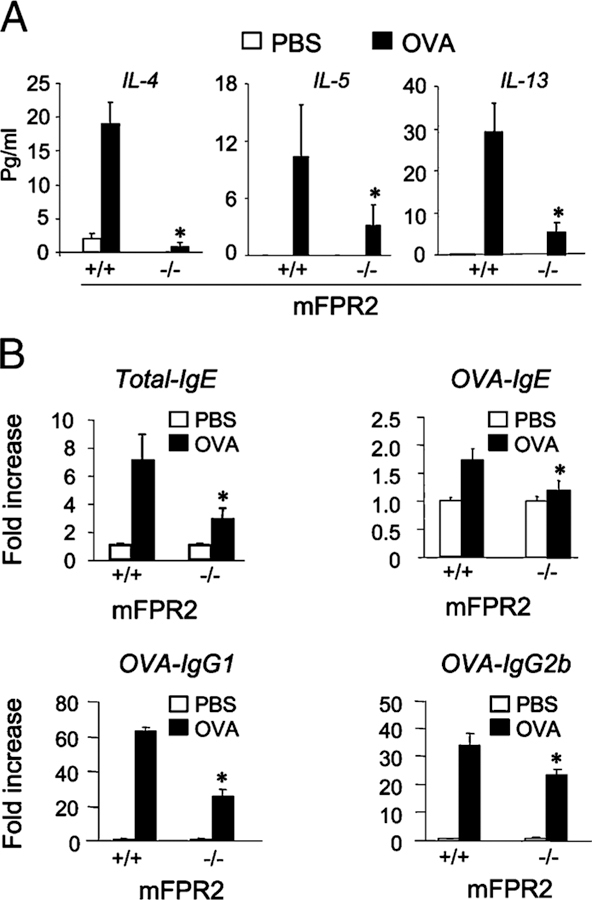
FIGURE 2.
FIGURE 2.
Reduced type 2 cytokine and Ig production in mFPR2−/− mice. A, The levels of type 2 cytokines IL-4, IL-5, and IL-13 measured in the BAL liquid of mice. Asterisk indicates significantly lower levels of cytokines in the BAL liquid of mFPR2−/− mice compared with WT littermates (p < 0.01). B, The levels of total IgE, OVA-specific IgE (OVA-IgE), IgG1 (OVA-IgG1), and IgG2b (OVA-IgG2b) detected in mouse sera. Asterisk indicates significantly reduced serum Ig levels in OVA-immunized and airway-challenged mFPR2−/− mice (p < 0.01). All mice used were 8-wk-old female littermates.
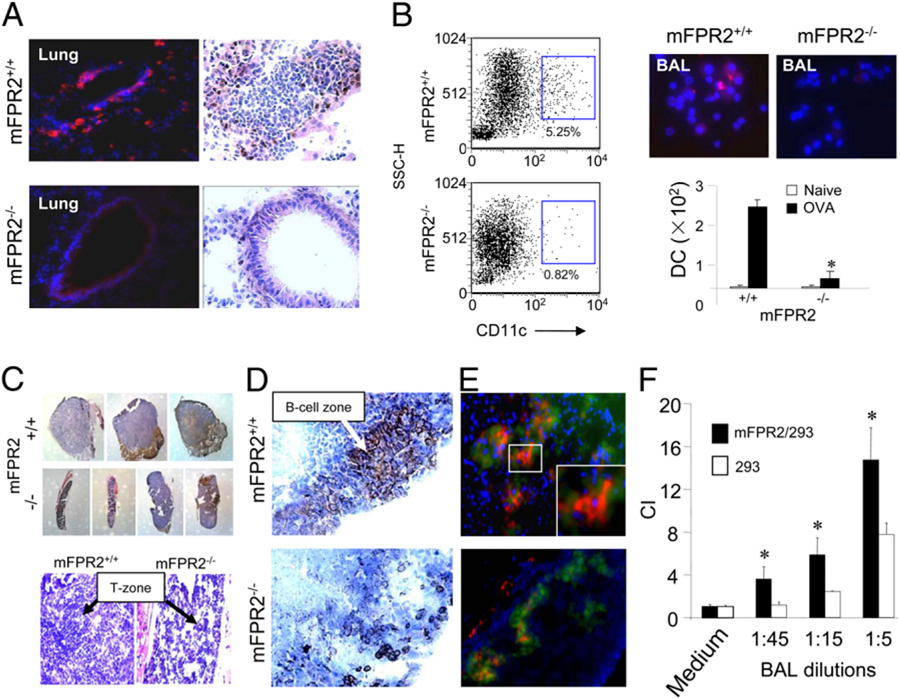
FIGURE 3.
FIGURE 3.
Reduction of DC recruitment in OVA-immunized mFPR2−/− mice. A, The recruitment of CD11c+ DCs to the airway mucosal region of OVA-sensitized and airway-challenged mice. CD11c immunofluorescence is shown in red; nuclei are shown by DAPI in blue (original magnification ×400). CD11c immunohistochemistry is shown in brown. B, Reduction of CD11c+ DCs in the BAL liquid of OVA sensitized and airway challenged mFPR2−/− mice. Left panels, FACS analysis of the percentage of CD11c+ DCs in the BAL liquid. Upper right panels, CD11c immunostaining in the BAL liquid shown in red; nuclei shown by DAPI in blue (original magnification ×400). Lower right panel, Numbers of CD11c+ DCs in the BAL liquid. Asterisk indicates significantly lower number of DCs in the BAL liquid of mFPR2−/− mice. C, The size and histology of the MLNs (original magnification ×35; H&E, original magnification ×200) from OVA-sensitized and airway-challenged mice. T zone, T cell zone. D, CD45R/B220+ B cells (brown) in MLNs (original magnification ×400). E, CD11c+ cells in MLNs (original magnification ×400) detected with red fluorescence. T cells were in green. Nuclei were stained with DAPI in blue. Insets, An amplified CD11c+ cell area among T cells in the MLN of WT mice (original magnification ×1000). F, Chemotaxis of mFPR2-transfected 293 cells and parental 293 cells in response to BAL liquid from immunized WT mice. *Significantly increased chemotaxis of mFPR2-transfected 293 cells (mFPR2/293) compared with the response of parental 293 cells (293).

References

    1. Ye RD, Boulay F, Wang JM, Dahlgren C, Gerard C, Parmentier M, Serhan CN, and Murphy PM 2009. International Union of Basic and Clinical Pharmacology. LXXIII. Nomenclature for the formyl peptide receptor (FPR) family. Pharmacol. Rev 61: 119–161. - PMC - PubMed
    1. , Le Y, Murphy PM, and Wang JM 2002. Formyl-peptide receptors revisited. Trends Immunol 23: 541–548. - PubMed
    1. Gao JL, Lee EJ, and Murphy PM 1999. Impaired antibacterial host defense in mice lacking the N-formylpeptide receptor. J. Exp. Med 189: 657–662. - PMC - PubMed
    1. Chiang N, Fierro IM, Gronert K, and Serhan CN 2000. Activation of lipoxin A(4) receptors by aspirin-triggered lipoxins and select peptides evokes ligand-specific responses in inflammation. J. Exp. Med 191: 1197–1208. - PMC - PubMed
    1. Levy BD, De Sanctis GT, Devchand PR, Kim E, Ackerman K, Schmidt BA, Szczeklik W, Drazen JM, and Serhan CN 2002. Multi-pronged inhibition of airway hyper-responsiveness and inflammation by lipoxin A(4). Nat. Med 8: 1018–1023. - PubMed

Publication types

MeSH terms