Smoking, gender, and ethnicity predict somatic BRAF mutations in colorectal cancer
- PMID: 20200438
- PMCID: PMC2872124
- DOI: 10.1158/1055-9965.EPI-09-1112
Smoking, gender, and ethnicity predict somatic BRAF mutations in colorectal cancer
Abstract
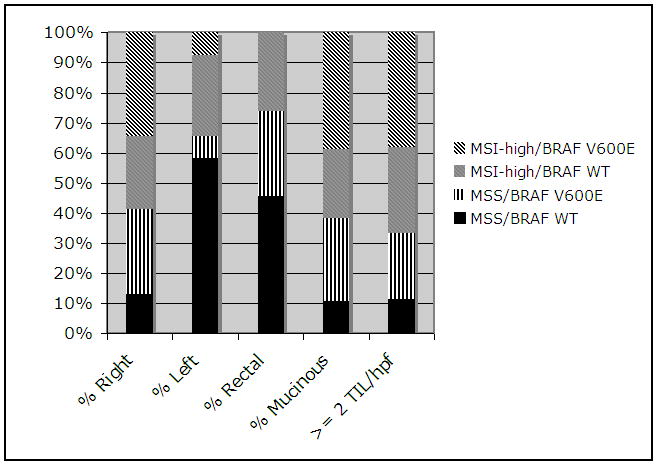
Approximately 5% to 15% of all colorectal cancers (CRC) have an activating BRAF somatic mutation, which may be associated with a distinct risk profile compared with tumors without BRAF mutations. Here, we measured the prevalence and epidemiologic correlates of the BRAF V600E somatic mutation in cases collected as a part of a population-based case-control study of CRC in northern Israel. The prevalence of BRAF V600E was 5.0% in this population, and the mutation was more likely to be found in tumors from cases who were of Ashkenazi Jewish descent [odds ratio (OR), 1.87; 95% confidence interval (95% CI), 1.01-3.47], female (OR, 1.97; P = 1.17-3.31), and older (73.8 years versus 70.3 years; P < 0.001). These results were similar when restricting to only tumors with microsatellite instability. Whether smoking was associated with a BRAF somatic mutation depended on gender. Although men were less likely to have a tumor with a BRAF somatic mutation, men who smoked were much more likely to have a tumor with a somatic BRAF mutation (OR(interaction), 4.95; 95% CI, 1.18-20.83) than women who never smoked. We note the strong heterogeneity in the reported prevalence of the BRAF V600E mutation in studies of different ethnicities, with a lower prevalence in Israel than other Western populations but a higher prevalence among Jewish than non-Jewish Israeli cases. Epidemiologic studies of CRC should incorporate somatic characteristics to fully appreciate risk factors for this disease.
Figures
References
-
- Barratt PL, Seymour MT, Stenning SP, et al. DNA markers predicting benefit from adjuvant fluorouracil in patients with colon cancer: a molecular study. Lancet. 2002;360:1381–1391. - PubMed
-
- Farrington SM, McKinley AJ, Carothers AD, et al. Evidence for an age-related influence of microsatellite instability on colorectal cancer survival. Int J Cancer. 2002;98:844–850. - PubMed
-
- Hemminki A, Mecklin JP, Jarvinen H, Aaltonen LA, Joensuu H. Microsatellite instability is a favorable prognostic indicator in patients with colorectal cancer receiving chemotherapy. Gastroenterology. 2000;119:921–928. - PubMed
-
- Jernvall P, Makinen MJ, Karttunen TJ, Makela J, Vihko P. Microsatellite instability: impact on cancer progression in proximal and distal colorectal cancers [see comments] Eur J Cancer. 1999;35:197–201. - PubMed
-
- Lee S, Cho NY, Choi M, Yoo EJ, Kim JH, Kang GH. Clinicopathological features of CpG island methylator phenotype-positive colorectal cancer and its adverse prognosis in relation to KRAS/BRAF mutation. Pathol Int. 2008;58:104–13. - PubMed
Publication types
MeSH terms
Substances
Grants and funding
LinkOut - more resources
Full Text Sources
Medical
Research Materials