


Evidence of altered polyamine concentrations in cerebral cortex of suicide completers
- PMID: 20200507
- PMCID: PMC2874419
- DOI: 10.1038/npp.2010.17
Evidence of altered polyamine concentrations in cerebral cortex of suicide completers
Abstract
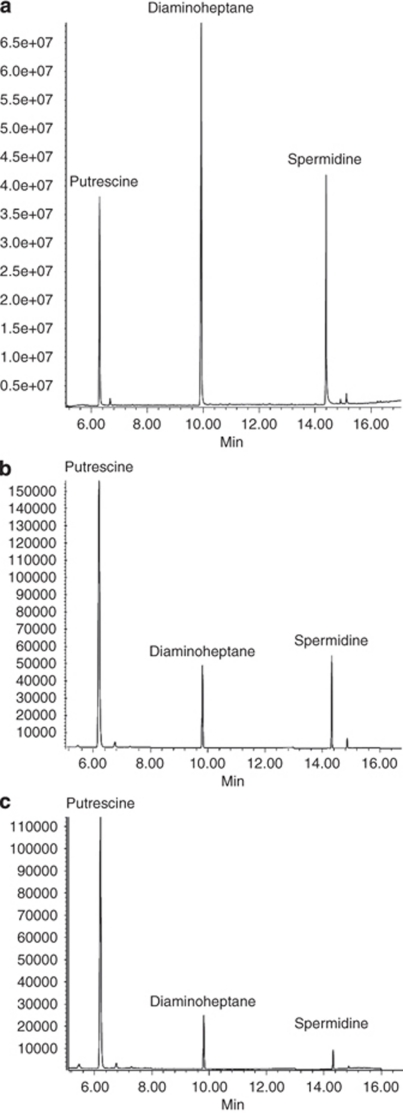
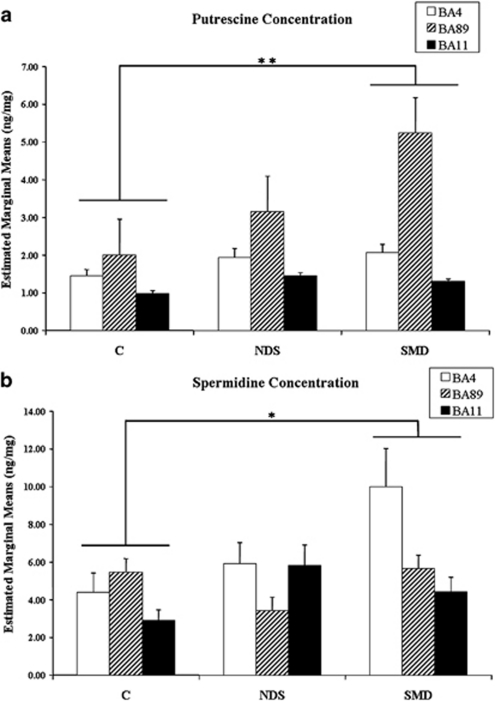
Recent studies have implicated alterations in the expression of polyamine-related genes in the brains of suicide completers including widespread downregulation of spermidine/spermine N1-acetyltransferase, the key enzyme in polyamine catabolism, suggesting compensatory mechanisms attempting to increase brain levels of polyamines. Given the complexity of the polyamine system, quantification of the levels of the polyamines is an essential step in understanding the downstream effects of dysregulated gene expression. We developed a method using high-resolution capillary gas chromatography (GC) in combination with mass spectrometry (MS) for quantitation of polyamines from post-mortem brain tissue, which allowed us to accurately measure spermidine and putrescine concentrations in post-mortem brain tissues. Using this method, we analyzed putrescine and spermidine levels in a total of 126 samples from Brodmann areas 4, 8/9, and 11, from 42 subjects, comprising 16 suicide completers with major depression, 13 non-depressed suicide completers, and 13 control subjects. Both putrescine and spermidine levels fell within the expected nanomolar ranges and were significantly elevated in the brain of suicide completers with a history of major depression as compared with controls. These results were not accounted by possible confounders. This is the first GC-MS study to analyze the expression of putrescine and spermidine from post-mortem brain tissue and confirms the hypothesis raised by previous studies indicating alterations in putrescine and spermidine levels in suicide/major depression.
Figures
References
-
- Banasr M, Chowdhury GM, Terwilliger R, Newton SS, Duman RS, Behar KL, et al. 2008Glial pathology in an animal model of depression: reversal of stress-induced cellular, metabolic and behavioral deficits by the glutamate-modulating drug riluzole Mol Psychiatryprint copy in press (originally published online 30 September 2008, at http://dx.doi.org/10.1038/mp.2008.106 ). - DOI - PMC - PubMed
-
- Barron S, Mulholland PJ, Littleton JM, Prendergast MA. Age and gender differences in response to neonatal ethanol withdrawal and polyamine challenge in organotypic hippocampal cultures. Alcohol Clin Exp Res. 2008;32:929–936. - PubMed
-
- Bastida CM, Cremades A, Castells MT, Lopez-Contreras AJ, Lopez-Garcia C, Sanchez-Mas J, et al. Sexual dimorphism of ornithine decarboxylase in the mouse adrenal: influence of polyamine deprivation on catecholamine and corticoid levels. Am J Physiol Endocrinol Metab. 2007;292:E1010–E1017. - PubMed
-
- Belle NA, Dalmolin GD, Fonini G, Rubin MA, Rocha JB. Polyamines reduces lipid peroxidation induced by different pro-oxidant agents. Brain Res. 2004;1008:245–251. - PubMed
-
- Bence AK, Rogers DT, Worthen DR, Fu M, Littleton JM, Crooks PA. Aminoanthraquinones as novel ligands at the polyamine binding site on the N-methyl-D-aspartate receptor complex. Bioorg Med Chem Lett. 2000;10:2621–2623. - PubMed
Publication types
MeSH terms
Substances
Grants and funding
LinkOut - more resources
Full Text Sources
Other Literature Sources
Medical
Miscellaneous
