


Variation in high-sensitivity C-reactive protein levels over 24 hours in patients with stable coronary artery disease
- PMID: 20200626
- PMCID: PMC2829811
Variation in high-sensitivity C-reactive protein levels over 24 hours in patients with stable coronary artery disease
Abstract
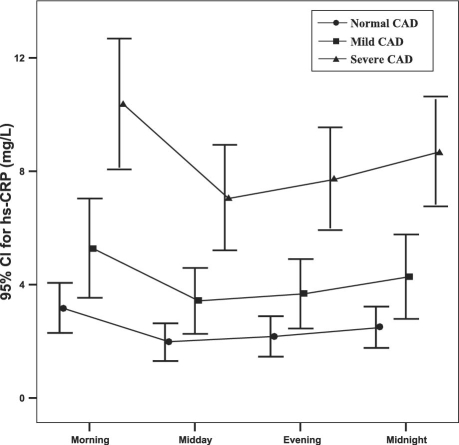
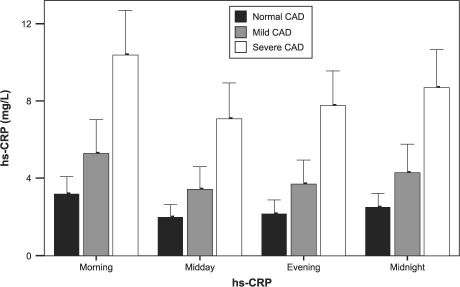
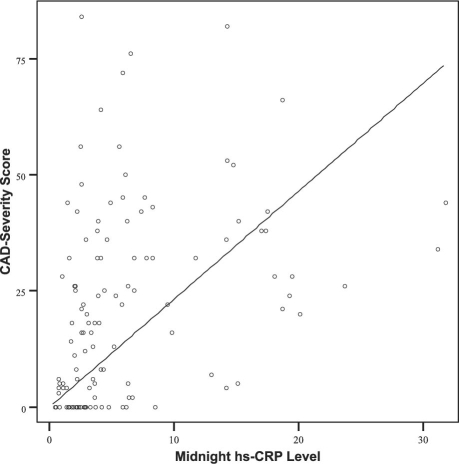
Limited, controversial data exist regarding changes in high-sensitivity C-reactive protein (hs-CRP) levels over short times and the importance of detecting these changes in patients who have coronary artery disease (CAD). We investigated the variation of hs-CRP levels and their association with the severity of CAD in patients with stable CAD.We measured morning, midday, evening, and midnight hs-CRP levels in 124 patients (94 with CAD, 30 with normal coronary arteries), who were evaluated via coronary angiography and Gensini scoring. Patients were divided into 3 groups (normal coronary arteries, mild CAD, or severe CAD) according to Gensini score.Temporal hs-CRP levels varied significantly--the highest mean concentrations were found in the morning, and the lowest concentrations at midday (P <0.001). All temporal hs-CRP measurements and the absolute increase in hs-CRP levels were significantly higher in patients with severe CAD (both P <0.001). The most significant predictors of CAD severity were age (P=0.005), midday hs-CRP level (P <0.001), and brain natriuretic peptide level (P=0.045). Receiver operating characteristic curve analysis showed that cutoff values of hs-CRP taken at different times predicted severe CAD with similar sensitivity and specificity. Different cutoff values for temporal hs-CRP levels correlated with the severity of CAD. Serum levels of hs-CRP varied over 24 hours, whether patients had CAD or normal coronary arteries.
Keywords: Analysis of variance; C-reactive protein/analysis; biological markers/ blood; coronary artery disease/blood; coronary stenosis; predictive value of tests; reference values; time factors.
Figures
Comment in
-
Inflammation, high-sensitivity C-reactive protein, and vascular protection.Tex Heart Inst J. 2010;37(1):40-1. Tex Heart Inst J. 2010. PMID: 20200625 Free PMC article. No abstract available.
References
-
- Ridker PM, Cushman M, Stampfer MJ, Tracy RP, Hennekens CH. Inflammation, aspirin, and the risk of cardiovascular disease in apparently healthy men [published erratum appears in N Engl J Med 1997;337(5):356]. N Engl J Med 1997;336(14):973–9. - PubMed
-
- Ridker PM, Hennekens CH, Buring JE, Rifai N. C-reactive protein and other markers of inflammation in the prediction of cardiovascular disease in women. N Engl J Med 2000;342 (12):836–43. - PubMed
-
- Arroyo-Espliguero R, Avanzas P, Quiles J, Kaski JC. Predictive value of coronary artery stenoses and C-reactive protein levels in patients with stable coronary artery disease. Atherosclerosis 2009;204(1):239–43. - PubMed
-
- Tataru MC, Heinrich J, Junker R, Schulte H, von Eckardstein A, Assmann G, Koehler E. C-reactive protein and the severity of atherosclerosis in myocardial infarction patients with stable angina pectoris. Eur Heart J 2000;21(12):1000–8. - PubMed
-
- Zebrack JS, Muhlestein JB, Horne BD, Anderson JL; Intermountain Heart Collaboration Study Group. C-reactive protein and angiographic coronary artery disease: independent and additive predictors of risk in subjects with angina. J Am Coll Cardiol 2002;39(4):632–7. - PubMed
MeSH terms
Substances
LinkOut - more resources
Full Text Sources
Medical
Research Materials
Miscellaneous