


Timing of ibuprofen use and bone mineral density adaptations to exercise training
- PMID: 20200939
- PMCID: PMC3152206
- DOI: 10.1002/jbmr.24
Timing of ibuprofen use and bone mineral density adaptations to exercise training
Abstract
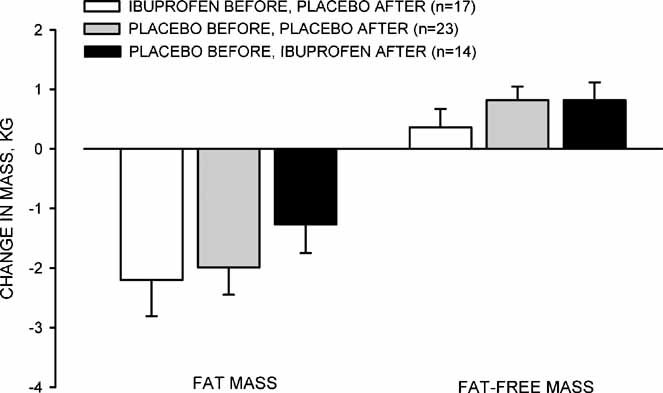
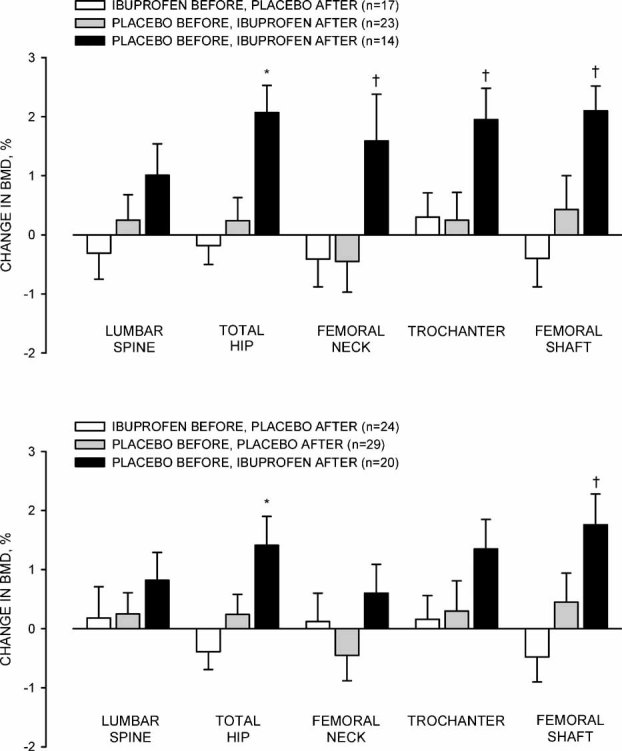
Prostaglandins (PGs) are essential signaling factors in bone mechanotransduction. In animals, inhibition of the enzyme responsible for PG synthesis (cyclooxygenase) by nonsteroidal anti-inflammatory drugs (NSAIDs) blocks the bone-formation response to loading when administered before, but not immediately after, loading. The aim of this proof-of-concept study was to determine whether the timing of NSAID use influences bone mineral density (BMD) adaptations to exercise in humans. Healthy premenopausal women (n = 73) aged 21 to 40 years completed a supervised 9-month weight-bearing exercise training program. They were randomized to take (1) ibuprofen (400 mg) before exercise, placebo after (IBUP/PLAC), (2) placebo before, ibuprofen after (PLAC/IBUP), or (3) placebo before and after (PLAC/PLAC) exercise. Relative changes in hip and lumbar spine BMD from before to after exercise training were assessed using a Hologic Delphi-W dual-energy X-ray absorptiometry (DXA) instrument. Because this was the first study to evaluate whether ibuprofen use affects skeletal adaptations to exercise, only women who were compliant with exercise were included in the primary analyses (IBUP/PLAC, n = 17; PLAC/PLAC, n = 23; and PLAC/IBUP, n = 14). There was a significant effect of drug treatment, adjusted for baseline BMD, on the BMD response to exercise for regions of the hip (total, p < .001; neck, p = .026; trochanter, p = .040; shaft, p = .019) but not the spine (p = .242). The largest increases in BMD occurred in the group that took ibuprofen after exercise. Total-hip BMD changes averaged -0.2% +/- 1.3%, 0.4% +/- 1.8%, and 2.1% +/- 1.7% in the IBUP/PLAC, PLAC/PLAC, and PLAC/IBUP groups, respectively. This preliminary study suggests that taking NSAIDs after exercise enhances the adaptive response of BMD to exercise, whereas taking NSAIDs before may impair the adaptive response.
(c) 2010 American Society for Bone and Mineral Research.
Figures
References
-
- Alam I, Warden SJ, Robling AG, Turner CH. Mechanotransduction in bone does not require a functional cyclooxygenase-2 (COX-2) gene. J Bone Miner Res. 2005;20:438–446. - PubMed
-
- Bakker AD, Klein-Nulend J, Burger EH. Mechanotransduction in bone cells proceeds via activation of COX-2, but not COX-1. Biochem Biophys Res Commun. 2003;305:677–683. - PubMed
-
- Bauer DC, Orwoll ES, Fox KM, et al. Aspirin and NSAID use in older women: effect on bone mineral density and fracture risk. Study of Osteoporotic Fractures Research Group. J Bone Miner Res. 1996;11:29–35. - PubMed
-
- Carbone LD, Tylavsky FA, Cauley JA, et al. Association between bone mineral density and the use of nonsteroidal anti-inflammatory drugs and aspirimpact of cyclooxygenase selectivity. J Bone Miner Res. 2003;18:1795–1802. - PubMed
-
- Cheng MZ, Zaman G, Rawlinson SC, Pitsillides AA, Suswillo RF, Lanyon LE. Enhancement by sex hormones of the osteoregulatory effects of mechanical loading and prostaglandins in explants of rat ulnae. J Bone Miner Res. 1997;12:1424–1430. - PubMed
