


TRPC channels and their implication in neurological diseases
- PMID: 20201820
- PMCID: PMC2846610
- DOI: 10.2174/187152710790966650
TRPC channels and their implication in neurological diseases
Abstract
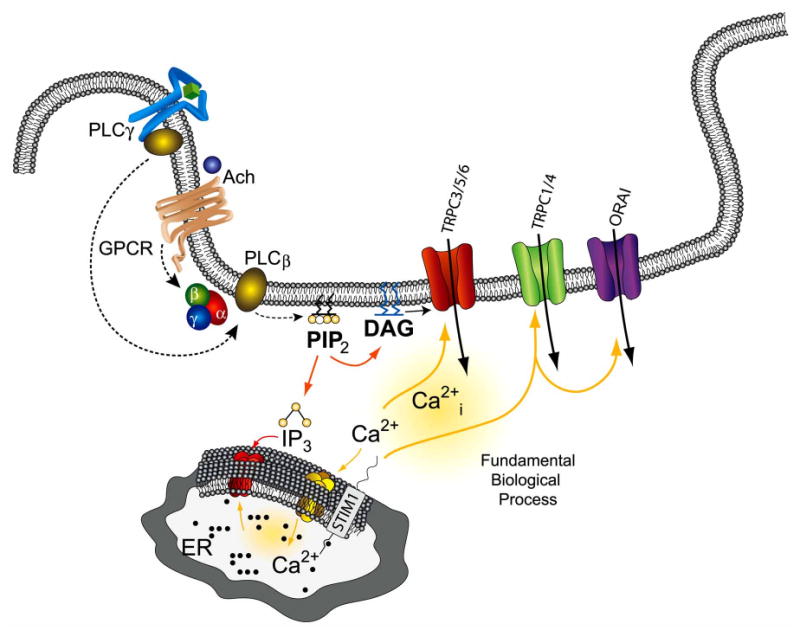
Calcium is an essential intracellular messenger and serves critical cellular functions in both excitable and non-excitable cells. Most of the physiological functions in these cells are uniquely regulated by changes in cytosolic Ca2+ levels ([Ca2+](i)), which are achieved via various mechanisms. One of these mechanism(s) is activated by the release of Ca2+ from the endoplasmic reticulum (ER), followed by Ca2+ influx across the plasma membrane (PM). Activation of PM Ca2+ channel is essential for not only refilling of the ER Ca2+ stores, but is also critical for maintaining [Ca2+](i) that regulates biological functions, such as neurosecretion, sensation, long term potentiation, synaptic plasticity, gene regulation, as well as cellular growth and differentiation. Alterations in Ca2+ homeostasis have been suggested in the onset/progression of neurological diseases, such as Parkinson's, Alzheimer's, bipolar disorder, and Huntington's. Available data on transient receptor potential conical (TRPC) protein indicate that these proteins initiate Ca2+ entry pathways and are essential in maintaining cytosolic, ER, and mitochondrial Ca2+ levels. A number of biological functions have been assigned to these TRPC proteins. Silencing of TRPC1 and TRPC3 has been shown to inhibit neuronal proliferation and loss of TRPC1 is implicated in neurodegeneration. Thus, TRPC channels not only contribute towards normal physiological processes, but are also implicated in several human pathological conditions. Overall, it is suggested that these channels could be used as potential therapeutic targets for many of these neurological diseases. Thus, in this review we have focused on the functional implication of TRPC channels in neuronal cells along with the elucidation of their role in neurodegeneration.
Figures
References
-
- Marty A. The physiological role of calcium-dependent channels. Trends Neurosci. 1989;12:420–424. - PubMed
-
- Malenka RC, Kauer JA, Perkel DJ, Nicoll RA. The impact of postsynaptic calcium on synaptic transmission--its role in long-term potentiation. Trends Neurosci. 1989;12:444–450. - PubMed
-
- Llinas RR. The intrinsic electrophysiological properties of mammalian neurons: insights into central nervous system function. Science. 1988;242:1654–1664. - PubMed
-
- McCormack JG, Halestrap AP, Denton RM. Role of calcium ions in regulation of mammalian intramitochondrial metabolism. Physiol Rev. 1990;70:391–425. - PubMed
-
- Orrenius S, Zhivotovsky B, Nicotera P. Regulation of cell death: the calcium-apoptosis link. Nat Rev Mol Cell Biol. 2003;4:552–565. - PubMed
Publication types
MeSH terms
Substances
Grants and funding
LinkOut - more resources
Full Text Sources
Medical
Miscellaneous