


The effect of long-term hormonal treatment on voiding patterns during filling cystometry and on urethral histology in a postpartum, ovariectomized female rat
- PMID: 20201831
- PMCID: PMC2912975
- DOI: 10.1111/j.1464-410X.2010.09268.x
The effect of long-term hormonal treatment on voiding patterns during filling cystometry and on urethral histology in a postpartum, ovariectomized female rat
Abstract
Objective: To study whether long-term treatment with oestrogen (E(2) ), selective E(2) receptor modulators (SERMs), or growth hormone (GH) can prevent the development of abnormal voiding patterns during filling cystometry (CMG) in a postpartum, ovariectomized (Ovx) female rat.
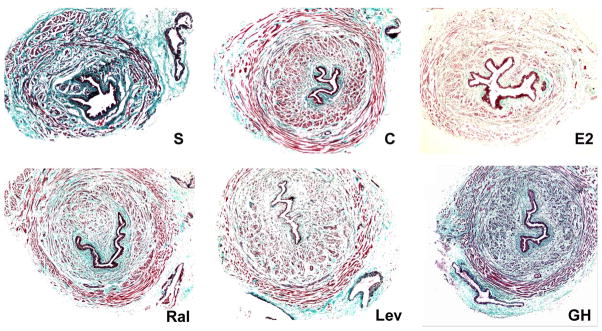
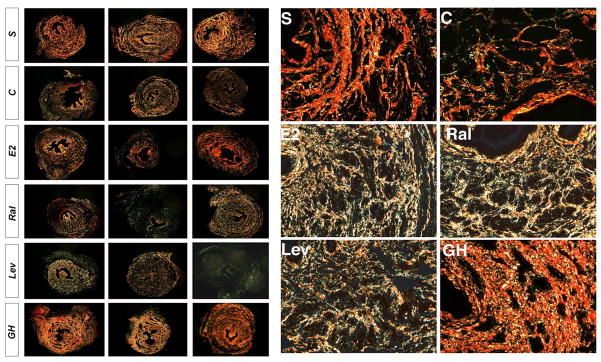
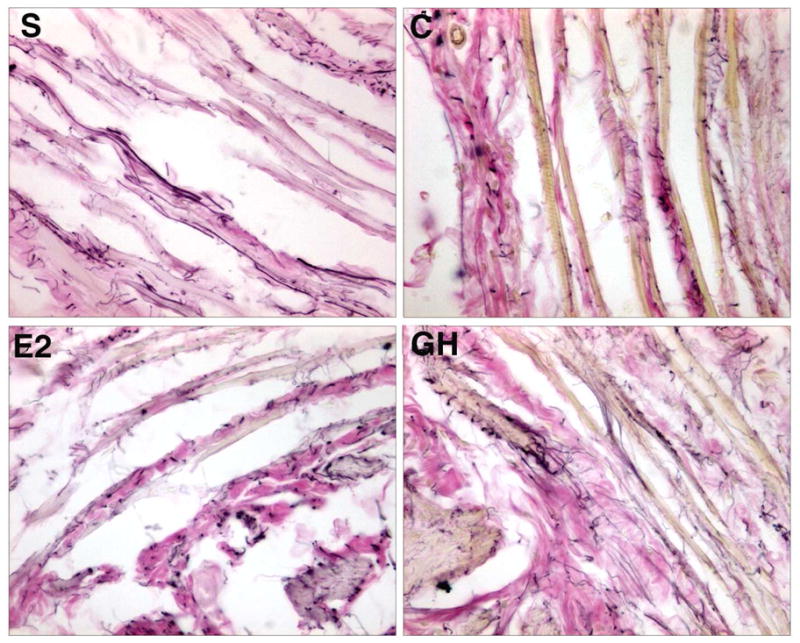
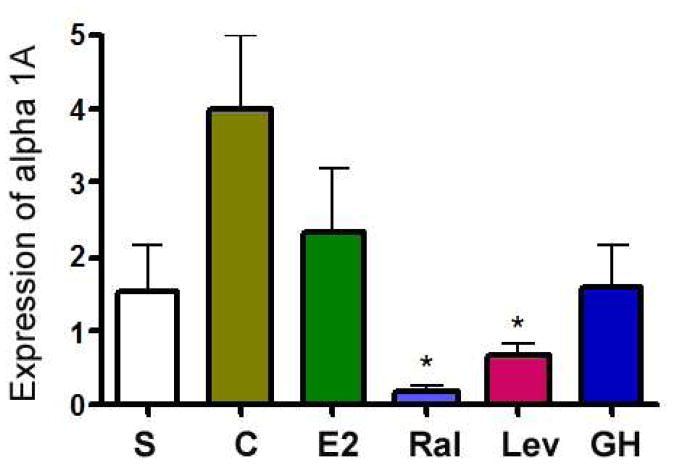
Materials and methods: Immediately after spontaneous delivery, 60 primiparous Sprague-Dawley rats were randomly divided into six equal groups. One group served as uninjured sham controls and five groups underwent intravaginal balloon dilatation. On day seven, previously dilated rats underwent bilateral Ovx and implantation of a subcutaneous hormone-delivery pump. The five treatment groups received normal saline (control), E(2) , raloxifene, levormeloxifene, or GH for 7 weeks. Conscious CMG was performed 7 weeks after Ovx. Urethral sphincter tissue was harvested for elastin immunohistochemistry and real-time polymerase chain reaction of α(1A) -adrenoceptor mRNA.
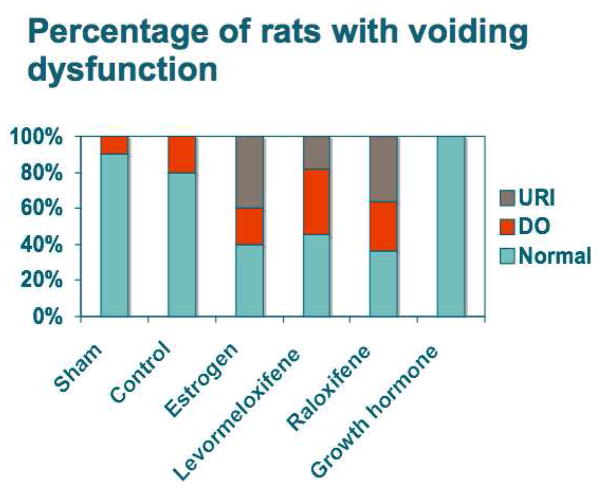
Results: No abnormal voiding patterns were detected in the group treated with GH. The E(2) , raloxifene and levormeloxifene groups had greater detrusor overactivity and urethral relaxation incontinence than control rats. The raloxifene group had a significantly lower baseline bladder pressure and opening pressure. GH-treated rats had higher elastin content in the urethra. Urethral α(1A) -adrenoceptor mRNA concentration was significantly lower in the SERM-treated rats compared with controls.
Conclusions: GH prevents the development of abnormal voiding patterns during filling CMG in a rat model of parturition-induced incontinence; E(2) and SERMs may worsen voiding patterns.
© 2010 THE AUTHORS. JOURNAL COMPILATION © 2010 BJU INTERNATIONAL.
Figures
References
-
- Huang AJ, Brown JS, Kanaya AM, et al. Quality-of-life impact and treatment of urinary incontinence in ethnically diverse older women. Arch Intern Med. 2006 Oct 9;166:2000–6. - PubMed
-
- Andersson KE. Drug therapy for urinary incontinence. Baillieres Best Pract Res Clin Obstet Gynaecol. 2000 Apr;14:291–313. - PubMed
-
- Brown JS, Grady D, Ouslander JG, Herzog AR, Varner RE, Posner SF. Prevalence of urinary incontinence and associated risk factors in postmenopausal women. Heart & Estrogen/Progestin Replacement Study (HERS) Research Group. Obstet Gynecol. 1999 Jul;94:66–70. - PubMed
-
- Hendrix SL, Cochrane BB, Nygaard IE, et al. Effects of estrogen with and without progestin on urinary incontinence. Jama. 2005 Feb 23;293:935–48. - PubMed
-
- Goldstein SR, Nanavati N. Adverse events that are associated with the selective estrogen receptor modulator levormeloxifene in an aborted phase III osteoporosis treatment study. Am J Obstet Gynecol. 2002 Sep;187:521–7. - PubMed
