


Work and its role in shaping the social gradient in health
- PMID: 20201870
- PMCID: PMC3704567
- DOI: 10.1111/j.1749-6632.2009.05338.x
Work and its role in shaping the social gradient in health
Abstract
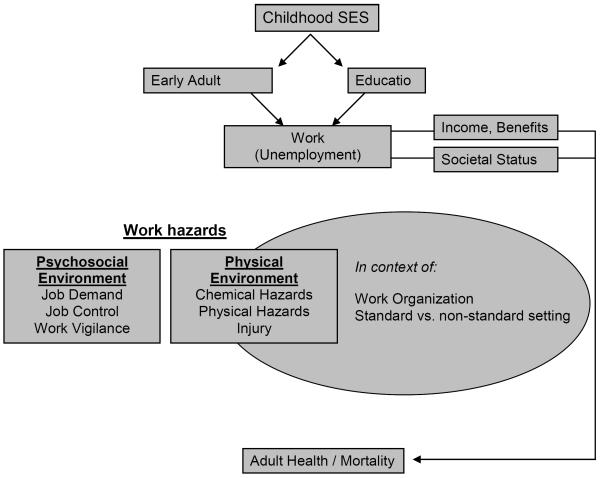
Adults with better jobs enjoy better health: job title was, in fact, the social gradient metric first used to study the relationship between social class and chronic disease etiology, a core finding now replicated in most developed countries. What has been less well proved is whether this correlation is causal, and if so, through what mechanisms. During the past decade, much research has been directed at these issues. Best evidence in 2009 suggests that occupation does affect health. Most recent research on the relationship has been directed at disentangling the pathways through which lower-status work leads to adverse health outcomes. This review focuses on six areas of recent progress: (1) the role of status in a hierarchical occupational system; (2) the roles of psychosocial job stressors; (3) effects of workplace physical and chemical hazard exposures; (4) evidence that work organization matters as a contextual factor; (5) implications for the gradient of new forms of nonstandard or "precarious" employment such as contract and shift work; and (6) emerging evidence that women may be impacted differently by adverse working conditions, and possibly more strongly, than men.
Figures
References
-
- Aboa-Eboule C, Brisson C, et al. Job strain and risk of acute recurrent coronary heart disease events. Journal of the American Medical Association. 2007;298(14):1652–1660. - PubMed
-
- Alexanderson K, Ostlin P. Worklife and health in Sweden. National Institute for Working Life; M. S. Stockholm: 2001. Work and ill-health among men and women in Sweden.
-
- American Thoracic Society American Thoracic Society Statement: Occupational contribution to the burden of airway disease. Am J Respir Crit Care Med. 2003;167:787–797. - PubMed
-
- Amick B. Relationship of job strain and iso-strain to health status in a cohort of women in the U.S. Scand. J Work Environ Health. 1998;24:54–61. - PubMed
-
- Arcand R, Labreche F, et al. enquete sociale et de sante 1998 (Social and Health Survey 1998) Institute de la statistique du Quebec; Quebec: 2000. Work environment and health. (environnement de travail et santé) pp. 525–570.
Publication types
MeSH terms
Grants and funding
LinkOut - more resources
Full Text Sources
Miscellaneous
