


Trends in the epidemiology of smoking recorded in UK general practice
- PMID: 20202355
- PMCID: PMC2828860
- DOI: 10.3399/bjgp10X483544
Trends in the epidemiology of smoking recorded in UK general practice
Abstract
Background: Smoking represents the most important cause of avoidable morbidity and mortality in the economically developed world. The UK has recently introduced a range of initiatives aiming to reduce smoking prevalence and smoking-related health inequalities.
Aim: To investigate the epidemiology of smoking in UK general practice.
Design of study: Cross-sectional study.
Setting: A total of 525 general practices contributing to the QRESEARCH database.
Method: A dataset was extracted on 2.7 million patients around each financial year for the period 2001-2007, including, age, sex, deprivation, and smoking status. For patients newly recorded as smoking, data were extracted on receipt of smoking cessation advice and referral to stop-smoking services.
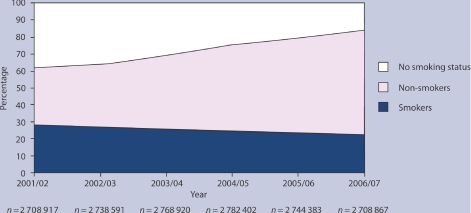
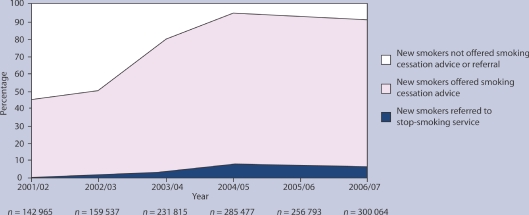
Results: Over the study period, the proportion of people with smoking status recorded increased by 32.9% (2001/2002: 46.6% to 2006/2007: 79.5%). A large overall increase in the provision of smoking cessation advice (2001/2002: 43.6% to 2006/2007: 84.0%) and referral to stop-smoking services (2001/2002: 1.0% to 2006/2007: 6.6%) was also observed. The proportion of people who smoked (with a recorded smoking status) reduced by 6.0% (2001/2002: 28.4% to 2006/2007: 22.4%). This decrease was greatest among patients in the most deprived areas (7.2%) and the youngest patients (16-25 years: 7.1%). In 2006/2007, more than twice as many patients in deprived areas smoked as those in affluent areas (most deprived: 33.8%; most affluent: 14.1%).
Conclusion: A significant and important reduction in the number of UK smokers occurred between April 2001 and April 2007. However, although this is an improvement, comparatively high rates of smoking remain among younger adults and those who are the most socioeconomically deprived.
Figures
References
-
- Office for National Statistics. General household survey, 2006. Colchester, Essex: UK Data Archive, Office for National Statistics, Social Survey Division; 2009.
-
- Department of Health. Smoking kills. A White Paper on tobacco. London: The Stationery Office; 1998.
-
- Department of Health. The NHS plan: a plan for investment, a plan for reform. London: HMSO; 2000.
-
- The NHS Confederation. Investing in general practice: the new general medical services contract. http://www.bma.org.uk/employmentandcontracts/independent_contractors/gen... (accessed 7 Sep 2009)
Publication types
MeSH terms
Grants and funding
LinkOut - more resources
Full Text Sources
Medical
Research Materials
Miscellaneous
