


Dynamic loading enhances integrative meniscal repair in the presence of interleukin-1
- PMID: 20202487
- PMCID: PMC2872683
- DOI: 10.1016/j.joca.2010.02.009
Dynamic loading enhances integrative meniscal repair in the presence of interleukin-1
Abstract
Objective: Meniscal tears are a common knee injury and increased levels of interleukin-1 (IL-1) have been measured in injured and degenerated joints. Studies have shown that IL-1 decreases the shear strength, cell accumulation, and tissue formation in meniscal repair interfaces. While mechanical stress and IL-1 modulate meniscal biosynthesis and degradation, the effects of dynamic loading on meniscal repair are unknown. The purpose of this study was to determine the effects of mechanical compression on meniscal repair under normal and inflammatory conditions.
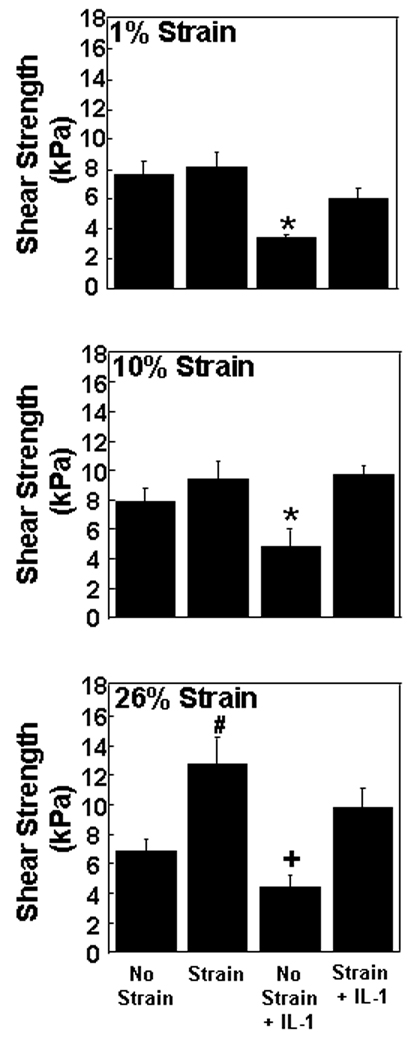
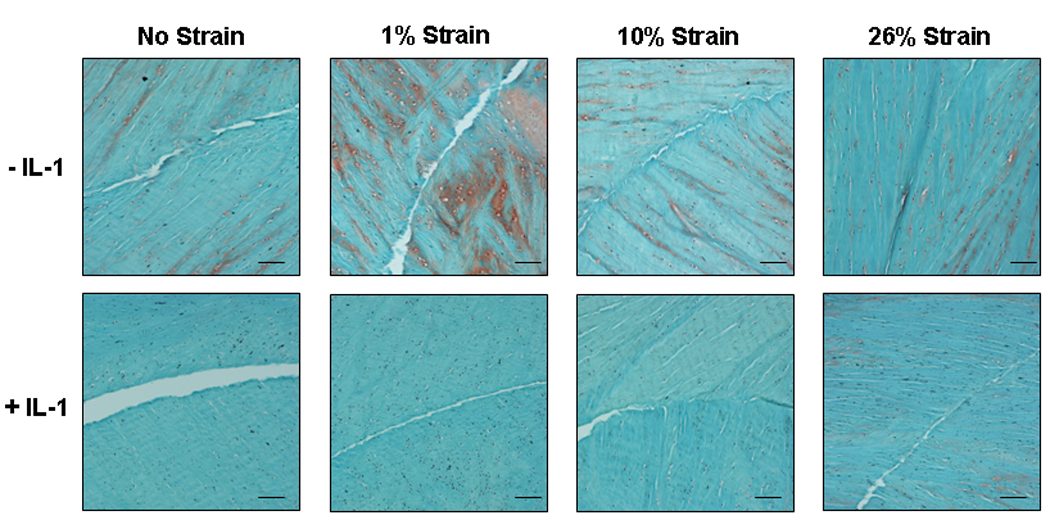
Experimental design: Explants were harvested from porcine medial menisci. To simulate a full-thickness defect, a central core was removed and reinserted. Explants were loaded for 4h/day at 1 Hz and 0%-26% strain for 14 days in the presence of 0 or 100 pg/mL of IL-1. Media were assessed for matrix metalloproteinase (MMP) activity, aggrecanase activity, sulfated glycosaminoglycan (S-GAG) release, and nitric oxide (NO) production. After 14 days, biomechanical testing and histological analyses were performed.
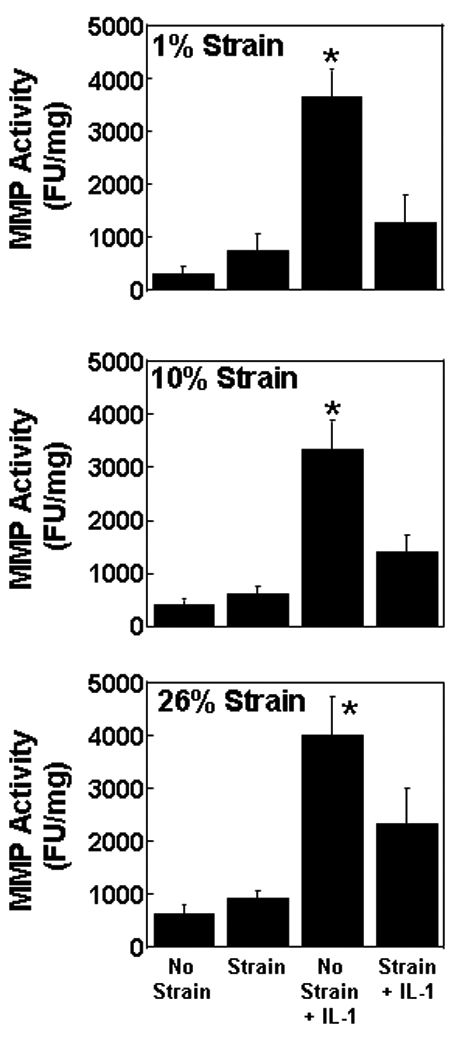
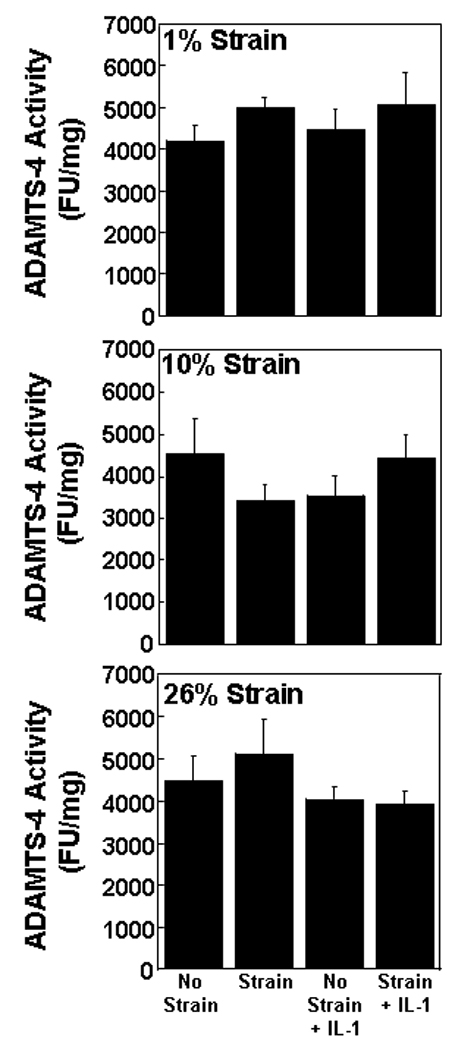
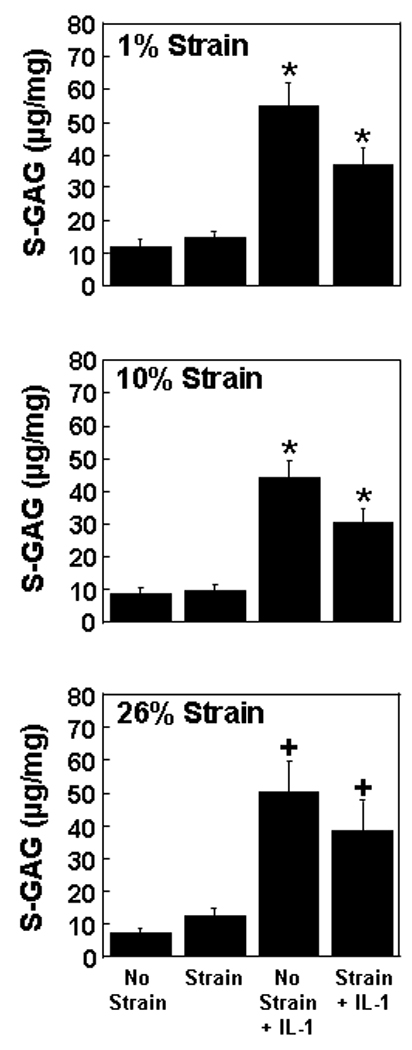
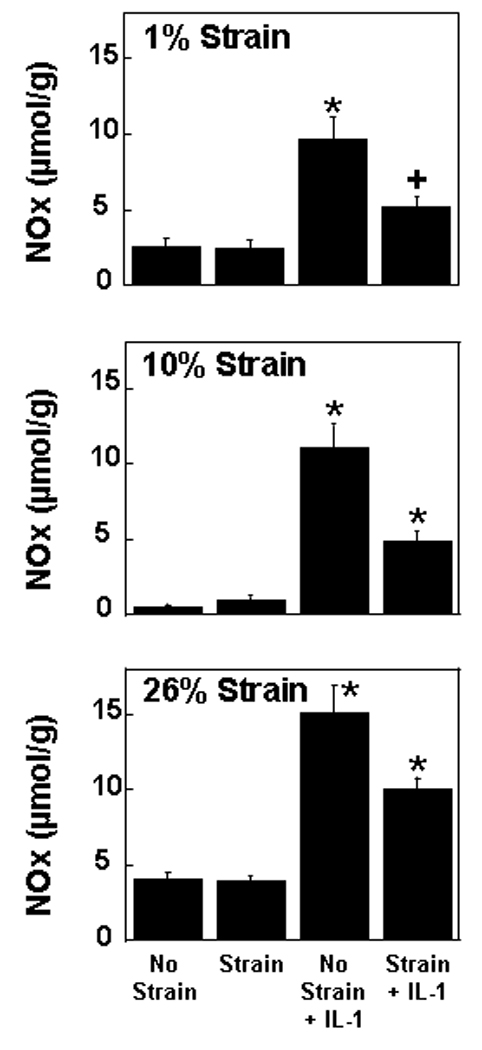
Results: IL-1 increased MMP activity, S-GAG release, and NO production, while decreasing the shear strength and tissue repair in the interface. Dynamic loading antagonized IL-1-mediated inhibition of repair at all strain amplitudes. Neither IL-1 treatment nor strain altered aggrecanase activity. Additionally, strain alone did not alter meniscal healing, except at the highest strain magnitude (26%), a level that enhanced the strength of repair.
Conclusions: Dynamic loading blocked the catabolic effects of IL-1 on meniscal repair, suggesting that joint loading through physical therapy may be beneficial in promoting healing of meniscal lesions under inflammatory conditions.
Copyright 2010 Osteoarthritis Research Society International. All rights reserved.
Conflict of interest statement
None of the authors have any financial or personal relationships with other people or organizations that influence this work.
Figures
References
-
- Markolf KL, Bargar WL, Shoemaker SC, Amstutz HC. The role of joint load in knee stability. J Bone Joint Surg Am. 1981;63:570–585. - PubMed
-
- Ahmed AM, Burke DL. In-vitro measurement of static pressure distribution in synovial joints--Part I: Tibial surface of the knee. J Biomech Eng. 1983;105:216–225. - PubMed
-
- Wojtys EM, Chan DB. Meniscus Structure and Function. AAOS Instructional Course Lectures. 2005;54:323–330. - PubMed
-
- Spilker RL, Donzelli PS, Mow VC. A transversely isotropic biphasic finite element model of the meniscus. J Biomech. 1992;25:1027–1045. - PubMed
-
- Zielinska B, Donahue TL. 3D finite element model of meniscectomy: changes in joint contact behavior. J Biomech Eng. 2006;128:115–123. - PubMed
Publication types
MeSH terms
Substances
Grants and funding
LinkOut - more resources
Full Text Sources
