


Long-term pulmonary regurgitation following balloon valvuloplasty for pulmonary stenosis risk factors and relationship to exercise capacity and ventricular volume and function
- PMID: 20202522
- PMCID: PMC4235281
- DOI: 10.1016/j.jacc.2010.01.016
Long-term pulmonary regurgitation following balloon valvuloplasty for pulmonary stenosis risk factors and relationship to exercise capacity and ventricular volume and function
Erratum in
- J Am Coll Cardiol. 2010 Apr 20;55(16):1767. Trang, Trang X [corrected to Tran, Trang X]
Abstract
Objectives: This study sought to examine the prevalence and predictors of pulmonary regurgitation (PR) following balloon dilation (BD) for pulmonary stenosis (PS) and to investigate its impact on ventricular volume and function, and exercise tolerance.
Background: Balloon pulmonary valvuloplasty relieves PS but can cause late PR. The sequelae of isolated PR are not well understood.
Methods: Patients were at least 7 years of age and 5 years removed from BD, and had no other form of congenital heart disease or significant residual PS. Cardiac magnetic resonance imaging and exercise testing were performed prospectively to quantify PR fraction, ventricular volumes and function, and exercise capacity.
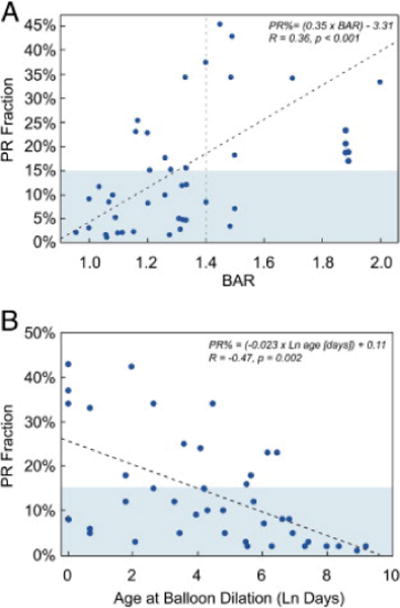
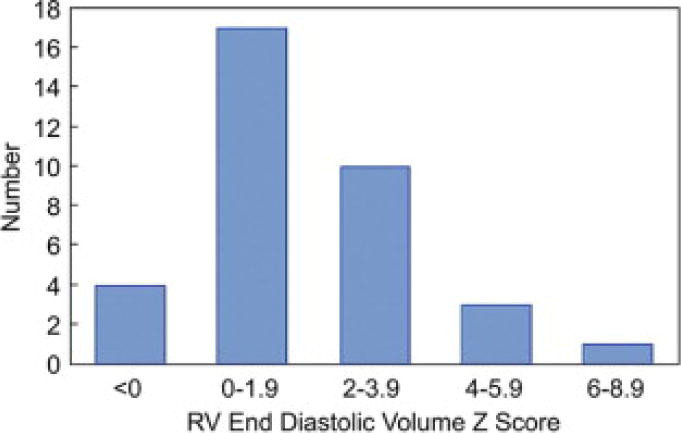
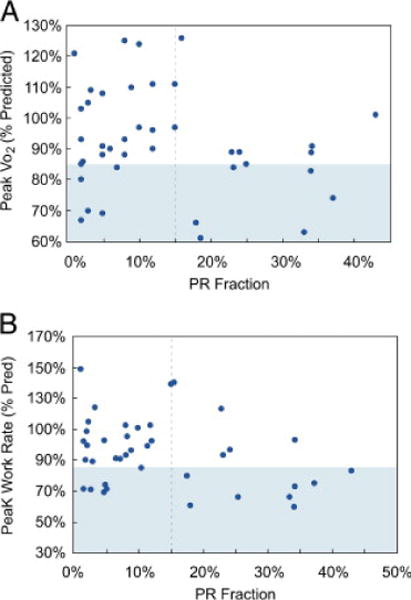
Results: Forty-one patients underwent testing a median of 13.1 years after BD. The median PR fraction was 10%; 14 patients (34%) had PR fraction >15%; 7 (17%) had PR >30%. PR fraction was associated with age at dilation (ln-transformed, R = -0.47, p = 0.002) and balloon:annulus ratio (R = 0.57, p < 0.001). The mean right ventricular (RV) end-diastolic volume z-score was 1.8 +/- 1.9; RV dilation (z-score > or =2) was present in 14/35 patients (40%). PR fraction correlated closely with indexed RV end-diastolic volume (R = 0.79, p < 0.001) and modestly with RV ejection fraction (R = 0.50, p < 0.001). Overall, peak oxygen consumption (Vo(2)) (% predicted) was below average (92 +/- 17%, p = 0.006). Patients with PR fraction >15% had significantly lower peak Vo(2) than those with less PR (85 +/- 17% vs. 96 +/- 16%, p = 0.03).
Conclusions: Mild PR and RV dilation are common in the long term following BD. A PR fraction >15% is associated with lower peak Vo(2), suggesting that isolated PR and consequent RV dilation are related to impaired exercise cardiopulmonary function.
Copyright (c) 2010 American College of Cardiology Foundation. Published by Elsevier Inc. All rights reserved.
Figures

Comment in
-
Balloon pulmonary valvuloplasty, pulmonary regurgitation, and exercise capacity the good, the bad, and the not yet clear.J Am Coll Cardiol. 2010 Mar 9;55(10):1048-9. doi: 10.1016/j.jacc.2010.01.017. J Am Coll Cardiol. 2010. PMID: 20202523 No abstract available.
References
-
- Price BO. Isolated incompetence of the pulmonic valve. Circulation. 1961;23:596–602. - PubMed
-
- Tanabe Y, Takahashi M, Kuwano H, et al. Long-term fate of isolated congenital absent pulmonary valve. Am Heart J. 1992;124:526–529. - PubMed
-
- Spigelman, Wright JS. Isolated congenital pulmonary incompetence: case report and literature review. Aust N Z J Surg. 1984;54:177–181. - PubMed
-
- Shimazaki Y, Blackstone EH, Kirklin JW. The natural history of isolated congenital pulmonary valve incompetence: surgical implications. Thorac Cardiovasc Surg. 1984;32:257–259. - PubMed
-
- Kan JS, White RI, Jr, Mitchell SE, Gardner TJ. Percutaneous balloon valvuloplasty: a new method for treating congenital pulmonary-valve stenosis. N Engl J Med. 1982;307:540–542. - PubMed
Publication types
MeSH terms
Substances
Grants and funding
LinkOut - more resources
Full Text Sources
Other Literature Sources
Research Materials
