


Reversal of impaired myocardial beta-adrenergic receptor signaling by continuous-flow left ventricular assist device support
- PMID: 20202864
- PMCID: PMC2876229
- DOI: 10.1016/j.healun.2010.01.010
Reversal of impaired myocardial beta-adrenergic receptor signaling by continuous-flow left ventricular assist device support
Abstract
Background: Myocardial beta-adrenergic receptor (beta-AR) signaling is severely impaired in chronic heart failure (HF). This study was conducted to determine if left ventricular (LV) beta-AR signaling could be restored after continuous-flow LV assist device (LVAD) support.
Methods: Twelve patients received LVADs as a bridge to transplant. Paired LV biopsy specimens were obtained at the time of LVAD implant (HF group) and transplant (LVAD group). The mean duration of LVAD support was 152 +/- 34 days. Myocardial beta-AR signaling was assessed by measuring adenylyl cyclase (AC) activity, total beta-AR density (B(max)), and G protein-coupled receptor kinase-2 (GRK2) expression and activity. LV specimens from 8 non-failing hearts (NF) were used as controls.
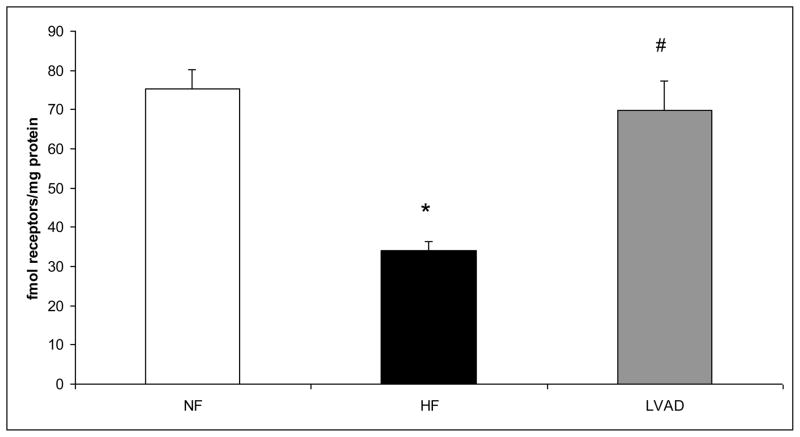
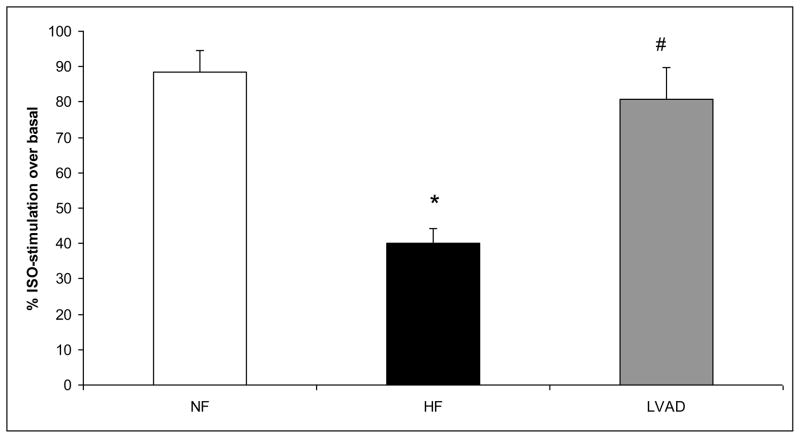
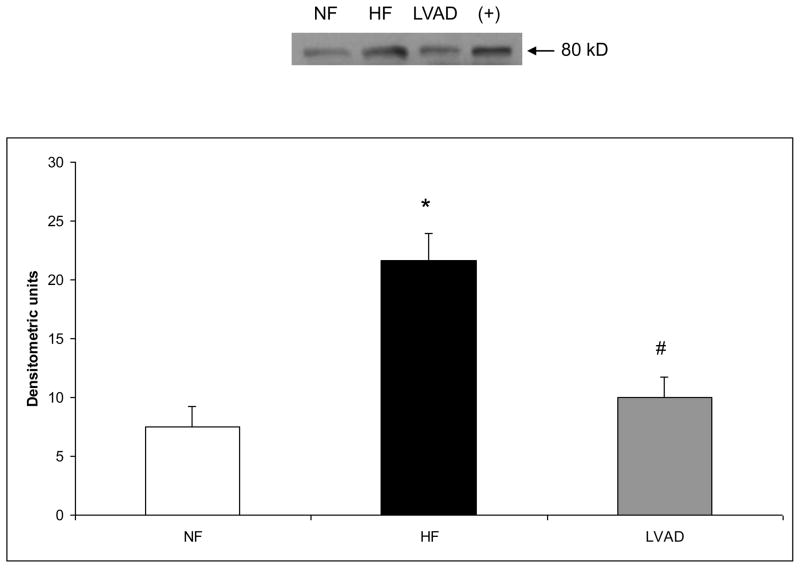
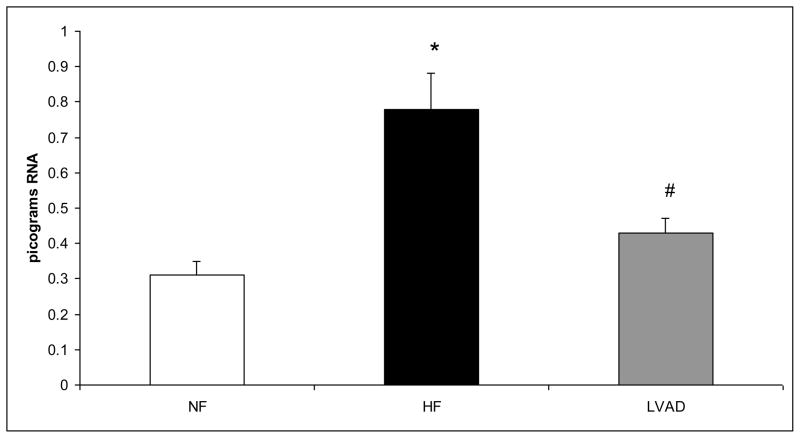
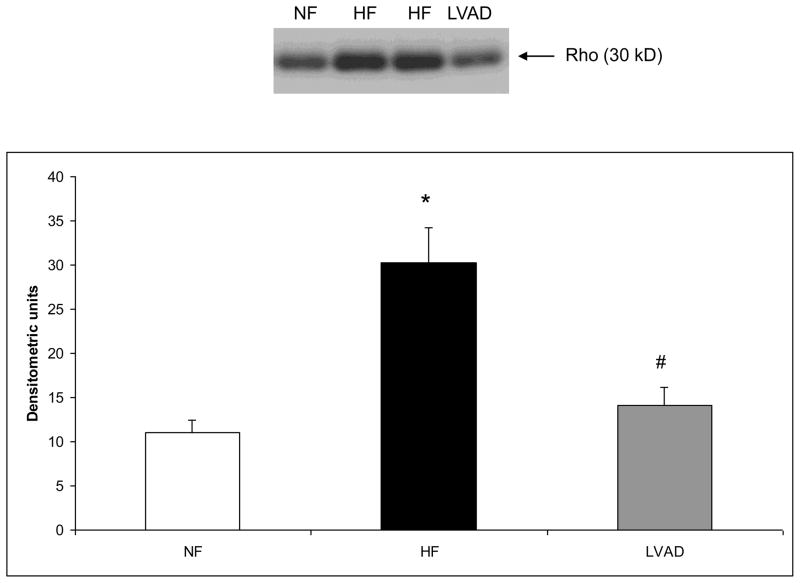
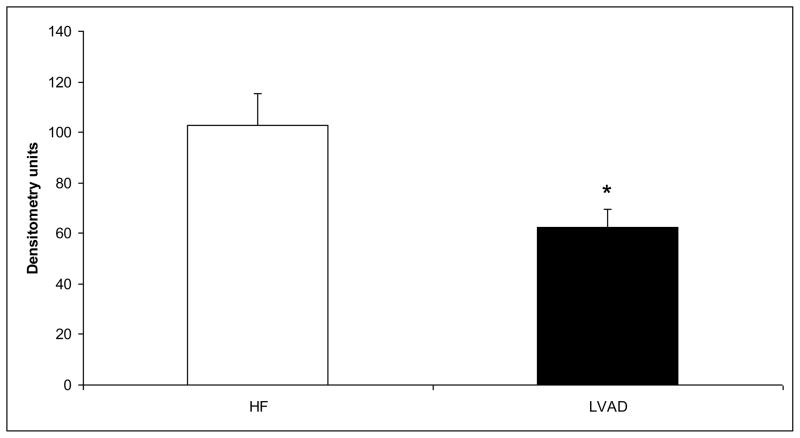
Results: Basal and isoproterenol-stimulated AC activity was significantly lower in HF vs NF, indicative of beta-AR uncoupling. Continuous-flow LVAD support restored basal and isoproterenol-stimulated AC activity to levels similar to NF. B(max) was decreased in HF vs NF and increased to nearly normal in the LVAD group. GRK2 expression was increased 2.6-fold in HF vs NF and was similar to NF after LVAD support. GRK2 activity was 3.2-fold greater in HF vs NF and decreased to NF levels in the LVAD group.
Conclusions: Myocardial beta-AR signaling can be restored to nearly normal after continuous-flow LVAD support. This is similar to previous data for volume-displacement pulsatile LVADs. Decreased GRK2 activity is an important mechanism and indicates that normalization of the neurohormonal milieu associated with HF is similar between continuous-flow and pulsatile LVADs. This may have important implications for myocardial recovery.
Copyright 2010 International Society for Heart and Lung Transplantation. Published by Elsevier Inc. All rights reserved.
Figures
References
-
- Bristow MR, Ginsburg R, Minobe W, et al. Decreased catecholamine sensitivity and beta-adrenergic-receptor density in failing human hearts. N Engl J Med. 1982;307:205–211. - PubMed
-
- Brodde OE, Michel MC, Zerkowski HR. Signal transduction mechanisms controlling cardiac contractility and their alterations in chronic heart failure. Cardiovasc Res. 1995;30:570–584. - PubMed
-
- Inglese J, Freedman NJ, Koch WJ, et al. Structure and mechanism of the G protein-coupled receptor kinases. J Biol Chem. 1993;268:23735–23738. - PubMed
-
- Ungerer M, Parruti G, Bohm M, et al. Expression of beta-arrestins and beta-adrenergic receptor kinases in the failing human heart. Circ Res. 1994;74:206–213. - PubMed
-
- Ungerer M, Bohm M, Elce JS, et al. Altered expression of beta-adrenergic receptor kinase and beta 1-adrenergic receptors in the failing human heart. Circulation. 1993;87:454–463. - PubMed
Publication types
MeSH terms
Substances
Grants and funding
LinkOut - more resources
Full Text Sources
Medical
Research Materials
Miscellaneous
