


A commercial real-time PCR kit provides greater sensitivity than direct sequencing to detect KRAS mutations: a morphology-based approach in colorectal carcinoma
- PMID: 20203003
- PMCID: PMC2860464
- DOI: 10.2353/jmoldx.2010.090139
A commercial real-time PCR kit provides greater sensitivity than direct sequencing to detect KRAS mutations: a morphology-based approach in colorectal carcinoma
Abstract
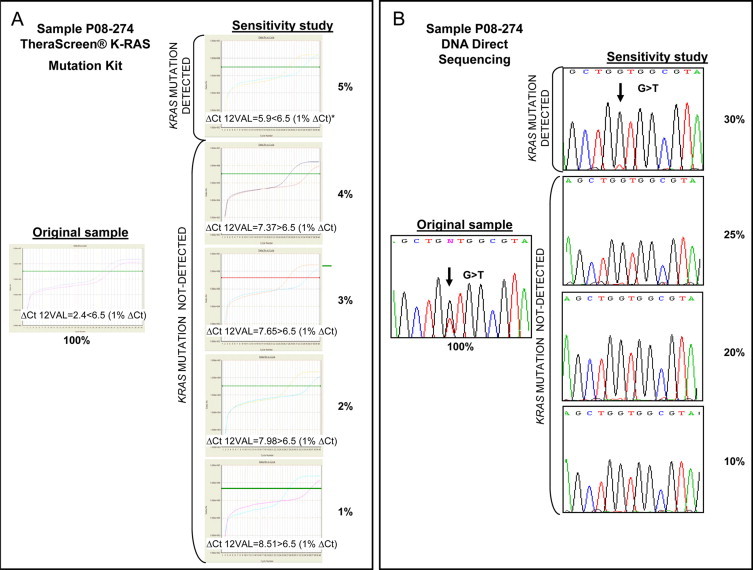
KRAS mutation testing has become a standard procedure in the management of patients with carcinomas. The most frequently used method for KRAS testing is direct sequencing of PCR products. The development of commercial real-time quantitative PCR kits offers a useful alternative since they are in theory much more sensitive than direct sequencing and they avoid post- PCR handling. We present our experience as a reference center for the study of KRAS mutations, comparing direct sequencing and the use of a commercial real-time quantitative PCR kit, as well as determining the sensitivity of both procedures in clinical practice. The TheraScreen K-RAS Mutation Kit identified mutations in 75 (44%) of the 170 tumors. Three cases were tested positive using TheraScreen K-RAS Mutation Kit and negative by direct sequencing. We then compared the sensitivity of the kit and that of direct sequencing using 74 mutant tumors. The kit was able to detect the presence of a mutation in a 1% dilution of the total DNA in 13.5% of the tumors and, in 84%, KRAS mutation was identified at a dilution of 5%. Sequencing was able to detect KRAS mutations when the mutant DNA represented 10% of the total DNA in 20/74 (27%) of the tumors. When the mutant DNA represented 30% of the total DNA, sequencing could detect mutations in 56/74 (76%).
Figures
References
-
- Allegra CJ, Jessup JM, Somerfield MR, Hamilton SR, Hammond EH, Hayes DF, McAllister PK, Morton RF, Schilsky RL. American Society of Clinical Oncology provisional clinical opinion: testing for KRAS gene mutations in patients with metastatic colorectal carcinoma to predict response to anti-epidermal growth factor receptor monoclonal antibody therapy. J Clin Oncol. 2009;27:2091–2096. - PubMed
-
- van Krieken JH, Jung A, Kirchner T, Carneiro F, Seruca R, Bosman FT, Quirke P, Fléjou JF, Plato Hansen T, de Hertogh G, Jares P, Langner C, Hoefler G, Ligtenberg M, Tiniakos D, Tejpar S, Bevilacqua G, Ensari A. KRAS mutation testing for predicting response to anti-EGFR therapy for colorectal carcinoma: proposal for an European quality assurance program. Virchows Arch. 2008;453:417–431. - PubMed
-
- Jimeno A, Messersmith WA, Hirsch FR, Franklin WA, Eckhardt SG. KRAS mutations and sensitivity to epidermal growth factor receptor inhibitors in colorectal cancer: practical application of patient selection. J Clin Oncol. 2009;27:1130–1136. - PubMed
-
- Linardou H, Dahabreh IJ, Kanaloupiti D, Siannis F, Bafaloukos D, Kosmidis P, Papadimitriou CA, Murray S. Assessment of somatic k-RAS mutations as a mechanism associated with resistance to EGFR-targeted agents: a systematic review and meta-analysis of studies in advanced non-small-cell lung cancer and metastatic colorectal cancer. Lancet Oncol. 2008;9:962–972. - PubMed
Publication types
MeSH terms
Substances
LinkOut - more resources
Full Text Sources
Other Literature Sources
Medical
Miscellaneous
