. 2010 Mar 5;327(5970):1254-8.
doi: 10.1126/science.1183112.

RTEL-1 enforces meiotic crossover interference and homeostasis

Affiliations

RTEL-1 enforces meiotic crossover interference and homeostasis

Jillian L Youds et al. Science. .

Abstract

Meiotic crossovers (COs) are tightly regulated to ensure that COs on the same chromosome are distributed far apart (crossover interference, COI) and that at least one CO is formed per homolog pair (CO homeostasis). CO formation is controlled in part during meiotic double-strand break (DSB) creation in Caenorhabditis elegans, but a second level of control must also exist because meiotic DSBs outnumber COs. We show that the antirecombinase RTEL-1 is required to prevent excess meiotic COs, probably by promoting meiotic synthesis-dependent strand annealing. Two distinct classes of meiotic COs are increased in rtel-1 mutants, and COI and homeostasis are compromised. We propose that RTEL-1 implements the second level of CO control by promoting noncrossovers.


Figures
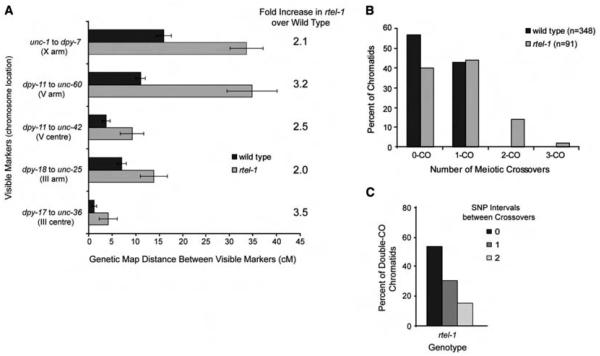
Fig. 1
Fig. 1
Recombination is increased in multiple chromosomal regions in rtel-1 mutants. (A) Recombination as measured by genetic map distance (in centimorgans) between pairs of marker genes in wild-type and rtel-1 mutants. Error bars are 95% CI. (B) Percentage of total chromatids (n) with no CO or single, double, or triple COs in wild-type and rtel-1 mutants. (C) Number of SNP intervals occurring between COs on double-CO chromatids.
Fig. 2
Fig. 2
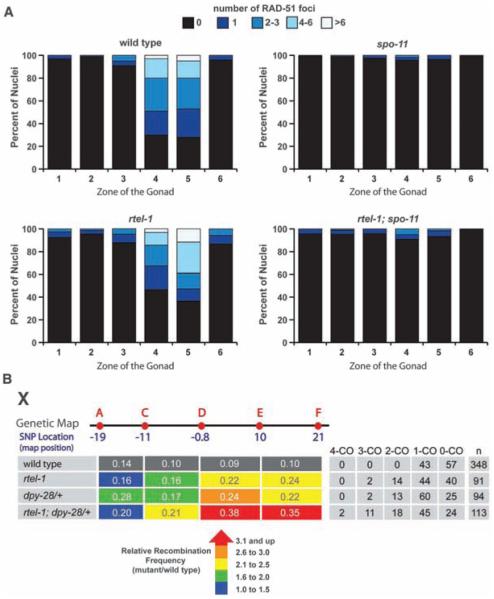
DSBs are similar in wild-type and rtel-1 mutants; rtel-1 and dpy-28/+ mutations have an additive effect on CO frequency. (A) Number of RAD-51 foci in 100 nuclei in each zone of the gonad for each genotype. Zones are as previously defined (17). (B) Recombination frequenciesmeasured between SNPs A to C, C to D, D to E, and E to F in each genotype. Relative recombination frequencies in each mutant compared with wild type are by color: blue, 1.0- to 1.5-fold; green, 1.6- to 2.0-fold; yellow, 2.1- to 2.5-fold; orange, 2.6- to 3.0-fold; and red, 3.1-fold increase or greater. The table at right shows the percentage of total chromatids (n) with no COs or single, double, triple, or quadruple COs.
Fig. 3
Fig. 3
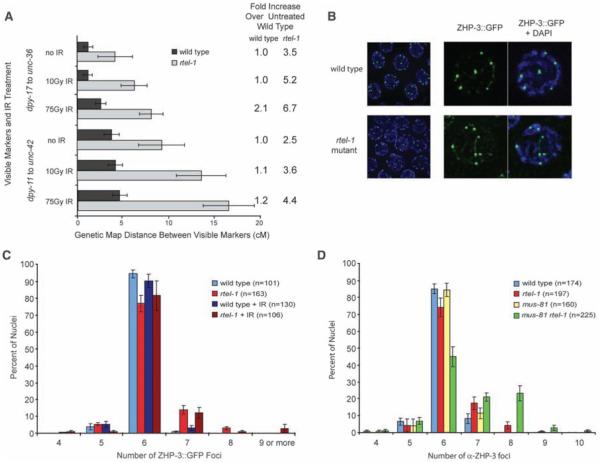
Recombination increases greatly in rtel-1 mutants after IR treatment but ZHP-3::GFP foci do not; ZHP-3 foci are increased in mus-81 rtel-1 mutants. (A) Recombination as measured by genetic map distance between pairs of marker genes for two intervals with no IR or 10 or 75 Gy IR in wildtype and rtel-1 mutants. Fold increase in recombination is comparedwith untreated wild type. Error bars are 95% CI. (B) ZHP-3::GFP foci (green) and 4′,6′-diamidino-2-phenylindole (DAPI)–stained (blue) in wildtype and rtel-1 mutants at meiotic diplotene. (C) Percentage of total nuclei (n) with the indicated number of ZHP-3::GFP foci in wild-type and rtel-1 mutants without treatment and 24 hours after 75Gy IR. Error bars are SEM. (D) Percentage of total nuclei (n) with the indicated number of anti–ZHP-3 foci in each genotype. Error bars are SEM.
Fig. 4
Fig. 4
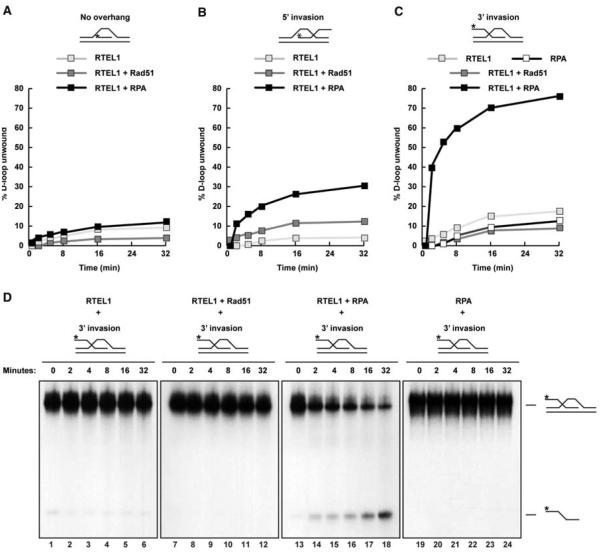
RTEL1 preferentially dissociates D loops with 3′ invasion and is dependent on RPA. D loop substrates with (A)nooverhang, (B) 5′ invasion, or (C) 3′ invasion. Shown is quantification of the percentage of D loop unwound over time. (D) Time course of RTEL1 activity toward a D loop substrate with 3′ invasion alone or with the indicated proteins. The fastest migrating band is the displaced radiolabeled (*) ssDNA probe; the slower species is the D loop substrate.

References

    1. Hillers KJ, Villeneuve AM. Curr. Biol. 2003;13:1641. - PubMed
    1. Wood W. The Nematode Caenorhabditis elegans. Cold Spring Harbor Laboratory Press, Cold Spring Harbor; NY; 1988.
    1. Mets DG, Meyer BJ. Cell. 2009;139:73. - PMC - PubMed
    1. Barber LJ, et al. Cell. 2008;135:261. - PMC - PubMed
    1. Materials and methods are available as supporting material on Science Online.

Publication types

MeSH terms