Review
. 2010 Jul;24(7):1322-37.
doi: 10.1210/me.2009-0519. Epub 2010 Mar 4.

Minireview: steroidogenic factor 1: its roles in differentiation, development, and disease

Affiliations
Review

Minireview: steroidogenic factor 1: its roles in differentiation, development, and disease

Bernard P Schimmer et al. Mol Endocrinol. 2010 Jul.

Abstract

The orphan nuclear receptor steroidogenic factor 1 (SF-1, also called Ad4BP, encoded by the NR5A1 gene) is an essential regulator of endocrine development and function. Initially identified as a tissue-specific transcriptional regulator of cytochrome P450 steroid hydroxylases, studies of both global and tissue-specific knockout mice have demonstrated that SF-1 is required for the development of the adrenal glands, gonads, and ventromedial hypothalamus and for the proper functioning of pituitary gonadotropes. Many genes are transcriptionally regulated by SF-1, and many proteins, in turn, interact with SF-1 and modulate its activity. Whereas mice with heterozygous mutations that disrupt SF-1 function have only subtle abnormalities, humans with heterozygous SF-1 mutations can present with XY sex reversal (i.e. testicular failure), ovarian failure, and occasionally adrenal insufficiency; dysregulation of SF-1 has been linked to diseases such as endometriosis and adrenocortical carcinoma. The current state of knowledge of this important transcription factor will be reviewed with a particular emphasis on the pioneering work on SF-1 by the late Keith Parker.


Figures
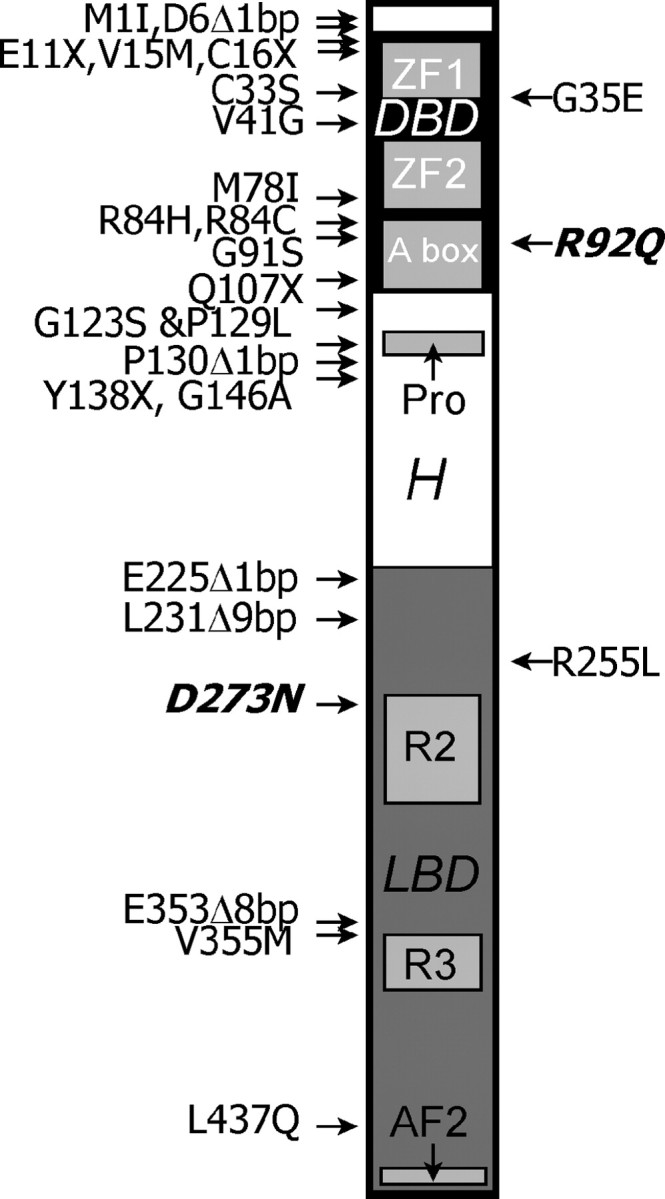
Fig. 1.
Fig. 1.
Schematic of SF-1 with mutations causing human disease (only coding sequence mutations are shown). The N terminus is at the top. A DBD (denoted by the black box) is near the N terminus, containing two zinc finger (ZF) domains and an accessory binding domain (A box). A proline-rich (pro) region is followed by a hinge (H) region. A ligand-binding domain (LBD, denoted by the dark gray box), contains two highly conserved regions (R2 and R3) and an activation domain (AF2) near the C terminus. Mutations to the right of the schematic are associated with adrenal insufficiency with or without gonadal failure, whereas those to the left are associated with gonadal failure (XY sex reversal or XX ovarian failure) without adrenal insufficiency. All of these mutations were found in the heterozygous state except for R92Q and D273N (in bold and italic), which cause disease only in homozygous individuals. Nearby mutations separated by commas are independent, but G123S and P129L occur in cis in the same patient. Δ, Deletion.
Fig. 2.
Fig. 2.
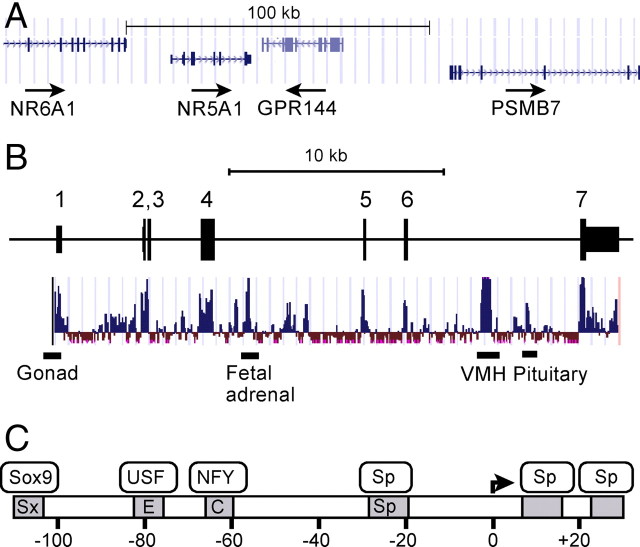
Transcriptional regulation of NR5A1, which encodes SF-1. This gene is transcribed left to right. A, The genomic region surrounding NR5A1 on chromosome 9q33.3. A 100-kb scale is shown. Arrows denote direction of transcription. Vertical bars in each gene denote exons. NR6A1 encodes germ cell nuclear factor (GCNF); only the 3′-portion of this gene is shown. GPR144 encodes a G protein-coupled receptor, and PSMB7 encodes the β7 proteosome subunit. Almost the entire depicted region is required for full NR5A1 transgene expression in mice. B, The NR5A1 gene. A 10-kb scale is shown; exons are numbered. A graph of sequence conservation is below, and aligned with, the schematic of the gene. Note that exons are relatively highly conserved, but there are highly conserved intronic regions as well. Tissue-specific enhancers have been localized to several of these highly conserved intronic regions and are denoted by horizontal bars. C, The proximal promoter of NR5A1. The scale is marked in base pairs, with the main transcriptional start site at 0, denoted by an arrow. Several conserved elements are shown as shaded boxes, with binding proteins denoted by ovals. Not all elements are used in all cell types, and many more proteins than are depicted here are assembled in transcriptional complexes on these sites. Sx, A binding site for SOX9 (used in Sertoli cells); E, an E box that binds upstream factors 1 and 2 (USF1 and USF2); C, a CCAAT box that binds isoforms of nuclear factor Y (NFY); Sp, a binding site for Sp1 and Sp3 transcription factors.

Similar articles

Cited by

References

    1. Parker KL, Chaplin DD, Wong M, Seidman JG, Smith JA, Schimmer BP1985. Expression of murine 21-hydroxylase in mouse adrenal glands and in transfected Y1 adrenocortical tumor cells. Proc Natl Acad Sci USA 82:7860–7864 - PMC - PubMed
    1. Handler JD, Schimmer BP, Flynn TR, Szyf M, Seidman JG, Parker KL1988. An enhancer element and a functional cyclic AMP-dependent protein kinase are required for expression of adrenocortical 21-hydroxylase. J Biol Chem 263:13068–13073 - PubMed
    1. Parker KL, Schimmer BP, Chaplin DD, Seidman JG1986. Characterization of a regulatory region of the steroid 21-hydroxylase gene. J Biol Chem 261:15353–15355 - PubMed
    1. Parker KL, Schimmer BP1997. Steroidogenic factor 1: a key determinant of endocrine development and function. Endocr Rev 18:361–377 - PubMed
    1. Lala DS, Rice DA, Parker KL1992. Steroidogenic factor 1, a key regulator of steroidogenic enzyme expression, is the mouse homolog of Fushi Tarazu-Factor 1. Mol Endocrinol 6:1249–1258 - PubMed

Publication types

Substances