


Striatal muscarinic receptors promote activity dependence of dopamine transmission via distinct receptor subtypes on cholinergic interneurons in ventral versus dorsal striatum
- PMID: 20203199
- PMCID: PMC2866006
- DOI: 10.1523/JNEUROSCI.5620-09.2010
Striatal muscarinic receptors promote activity dependence of dopamine transmission via distinct receptor subtypes on cholinergic interneurons in ventral versus dorsal striatum
Abstract
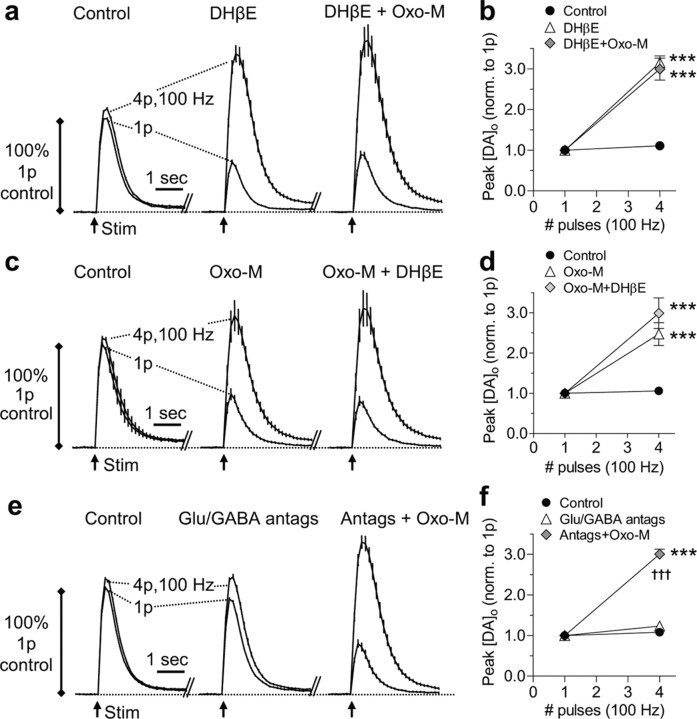
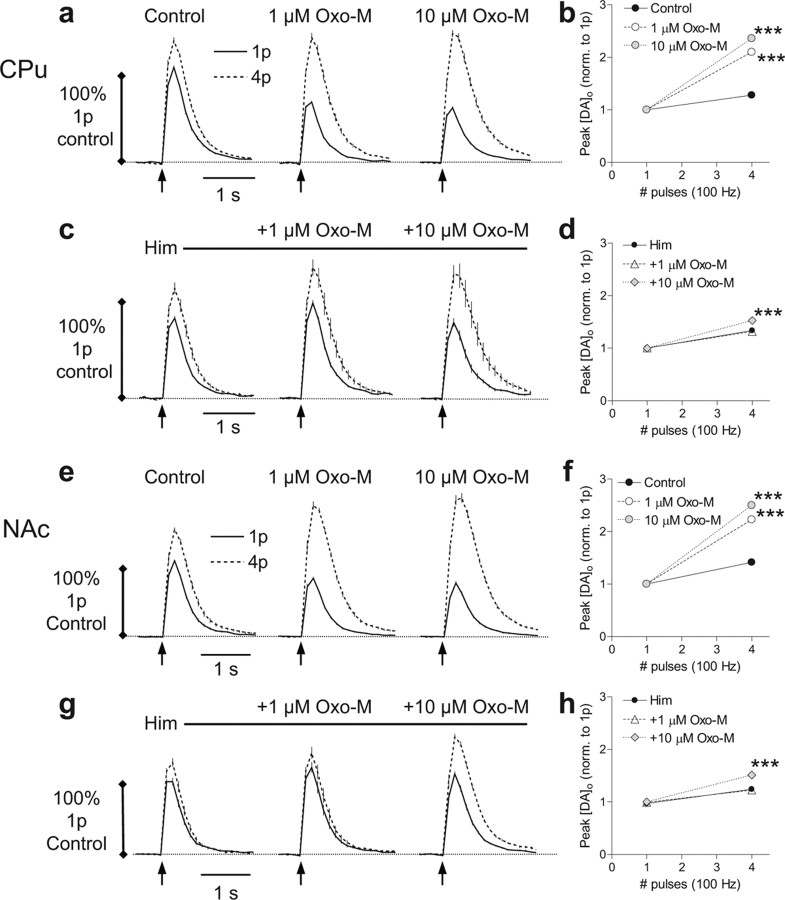
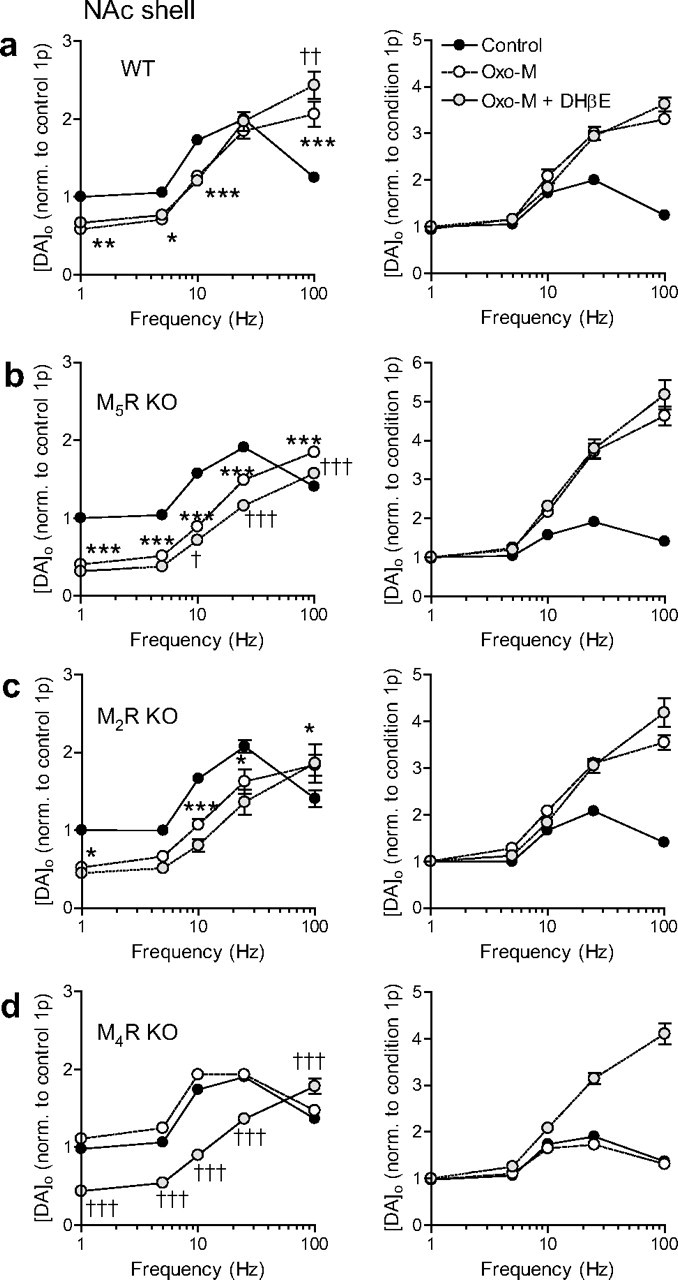
Striatal dopamine (DA) and acetylcholine (ACh) regulate motivated behaviors and striatal plasticity. Interactions between these neurotransmitters may be important, through synchronous changes in parent neuron activities and reciprocal presynaptic regulation of release. How DA signaling is regulated by striatal muscarinic receptors (mAChRs) is unresolved; contradictory reports indicate suppression or facilitation, implicating several mAChR subtypes on various neurons. We investigated whether mAChR regulation of DA signaling varies with presynaptic activity and identified the mAChRs responsible in sensorimotor- versus limbic-associated striatum. We detected DA in real time at carbon fiber microelectrodes in mouse striatal slices. Broad-spectrum mAChR agonists [oxotremorine-M, APET (arecaidine propargyl ester tosylate)] decreased DA release evoked by low-frequency stimuli (1-10 Hz, four pulses) but increased the sensitivity of DA release to presynaptic activity, even enhancing release by high frequencies (e.g., >25 Hz for four pulses). These bidirectional effects depended on ACh input to striatal nicotinic receptors (nAChRs) on DA axons but not GABA or glutamate input. In caudate-putamen (CPu), knock-out of M(2)- or M(4)-mAChRs (not M(5)) prevented mAChR control of DA, indicating that M(2)- and M(4)-mAChRs are required. In nucleus accumbens (NAc) core or shell, mAChR function was prevented in M(4)-knock-outs, but not M(2)- or M(5)-knock-outs. These data indicate that striatal mAChRs, by inhibiting ACh release from cholinergic interneurons and thus modifying nAChR activity, offer variable control of DA release probability that promotes how DA release reflects activation of dopaminergic axons. Furthermore, different coupling of striatal M(2)/M(4)-mAChRs to the control of DA release in CPu versus NAc suggests targets to influence DA/ACh function differentially between striatal domains.
Figures




References
-
- Abeliovich A, Schmitz Y, Fariñas I, Choi-Lundberg D, Ho WH, Castillo PE, Shinsky N, Verdugo JM, Armanini M, Ryan A, Hynes M, Phillips H, Sulzer D, Rosenthal A. Mice lacking alpha-synuclein display functional deficits in the nigrostriatal dopamine system. Neuron. 2000;25:239–252. - PubMed
-
- Alcantara AA, Mrzljak L, Jakab RL, Levey AI, Hersch SM, Goldman-Rakic PS. Muscarinic m1 and m2 receptor proteins in local circuit and projection neurons of the primate striatum: anatomical evidence for cholinergic modulation of glutamatergic prefronto-striatal pathways. J Comp Neurol. 2001;434:445–460. - PubMed
-
- Apicella P. Tonically active neurons in the primate striatum and their role in the processing of information about motivationally relevant events. Eur J Neurosci. 2002;16:2017–2026. - PubMed
Publication types
MeSH terms
Substances
Grants and funding
LinkOut - more resources
Full Text Sources
Other Literature Sources
