. 2010 Feb 26:4:18.
doi: 10.3389/fnhum.2010.00018. eCollection 2010.

Pupil dilation betrays the timing of decisions

Affiliations

Pupil dilation betrays the timing of decisions

Wolfgang Einhäuser et al. Front Hum Neurosci. .

Abstract

The notion of "mind-reading" by carefully observing another individual's physiological responses has recently become commonplace in popular culture, particularly in the context of brain imaging. The question remains, however, whether outwardly accessible physiological signals indeed betray a decision before a person voluntarily reports it. In one experiment we asked observers to push a button at any time during a 10-s period ("immediate overt response"). In a series of three additional experiments observers were asked to select one number from five sequentially presented digits but concealed their decision until the trial's end ("covert choice"). In these experiments observers either had to choose the digit themselves under conditions of reward and no reward, or were instructed which digit to select via an external cue provided at the time of the digit presentation. In all cases pupil dilation alone predicted the choice (timing of button response or chosen digit, respectively). Consideration of the average pupil-dilation responses, across all experiments, showed that this prediction of timing was distinct from a general arousal or reward-anticipation response. Furthermore, the pupil dilation appeared to reflect the post-decisional consolidation of the selected outcome rather than the pre-decisional cognitive appraisal component of the decision. Given the tight link between pupil dilation and norepinephrine levels during constant illumination, our results have implications beyond the tantalizing mind-reading speculations. These findings suggest that similar noradrenergic mechanisms may underlie the consolidation of both overt and covert decisions.

Keywords: behavior; cognition; decision-making; norepinephrine; pupil.


Figures
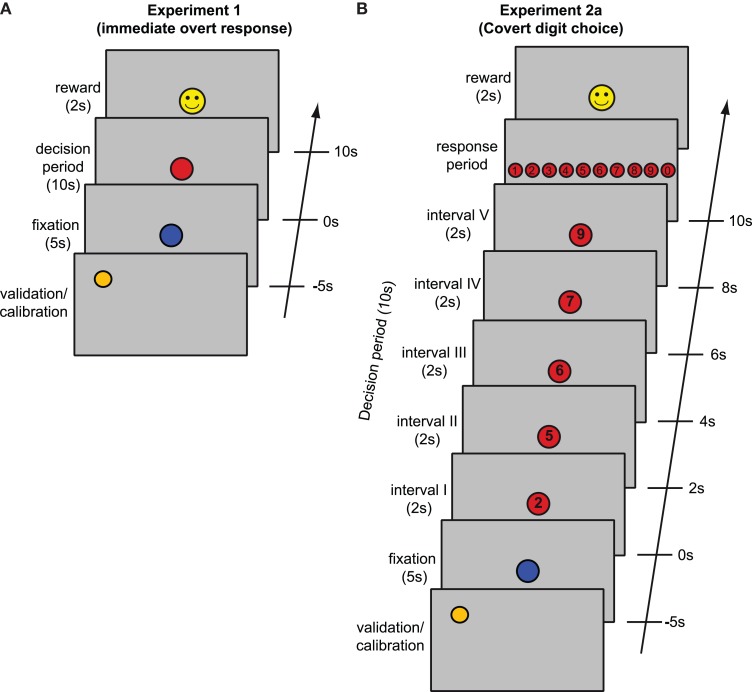
Figure 1
Figure 1
Paradigm. Schematic of a single trial, including the preceding validation/calibration period, the fixation period (blue circle), the actual trial (decision and response), and reward indication (details see Materials and Methods). (A) Experiment 1 (B) Experiment 2a. Time is running from bottom to top, display items are not to scale.
Figure 2
Figure 2
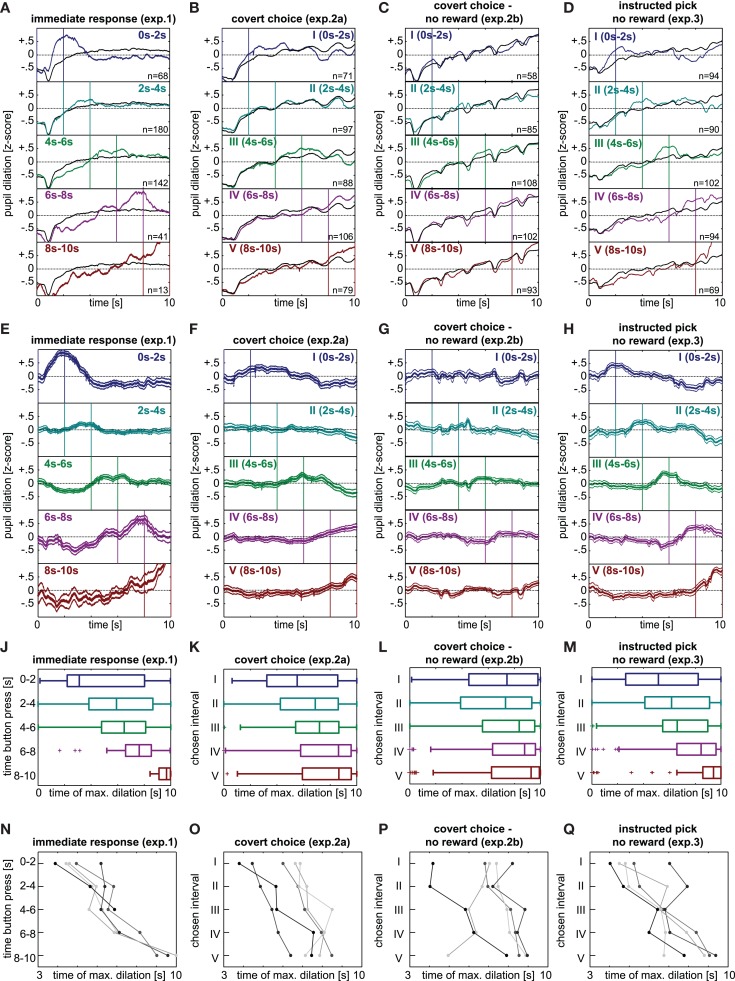
(A) Valid trials of experiment 1 binned into 2-s intervals based on button-press times; number of trials indicated at the lower right of each panel. Z-score normalization within each trial, but not across subjects or trials; colored lines: mean pupil-dilation averaged over trials with same chosen interval (color-coded); black lines: mean pupil-dilation trace over all valid trials. (B–D) Valid trials of the digit selection experiments, binned according to chosen interval. Notation as in panel A. (B) Experiment 2a (C) Experiment 2b (D) Experiment 3. (E–H) Mean pupil-dilation traces, binned as in (A–D) with grand averages (black lines of panel A–D) subtracted. (E) Experiment 1 (F) Experiment 2a (G) Experiment 2b (H) Experiment 3. Note that the strong reduction of the effect in experiment 2b is mainly a consequence of one observer with opposing trend (see P and text). (J–M) Time of maximum (non-normalized) pupil dilation grouped by chosen interval. Boxes denote quartiles, lines medians, whiskers the whole data range, except outliers beyond 1.5 times the interquartile range (crosses). (J) Experiment 1 (K) Experiment 2a (L) Experiment 2b (M) Experiment 3. (N–Q) Mean time of maximum (non-normalized) pupil dilation grouped by chosen interval, separated by individuals. Each individual encoded by distinct shade of gray. Note that the individuals do not overlap across experiments. (N) Experiment 1 (O) Experiment 2a (P) Experiment 2b (Q) Experiment 3.
Figure 3
Figure 3
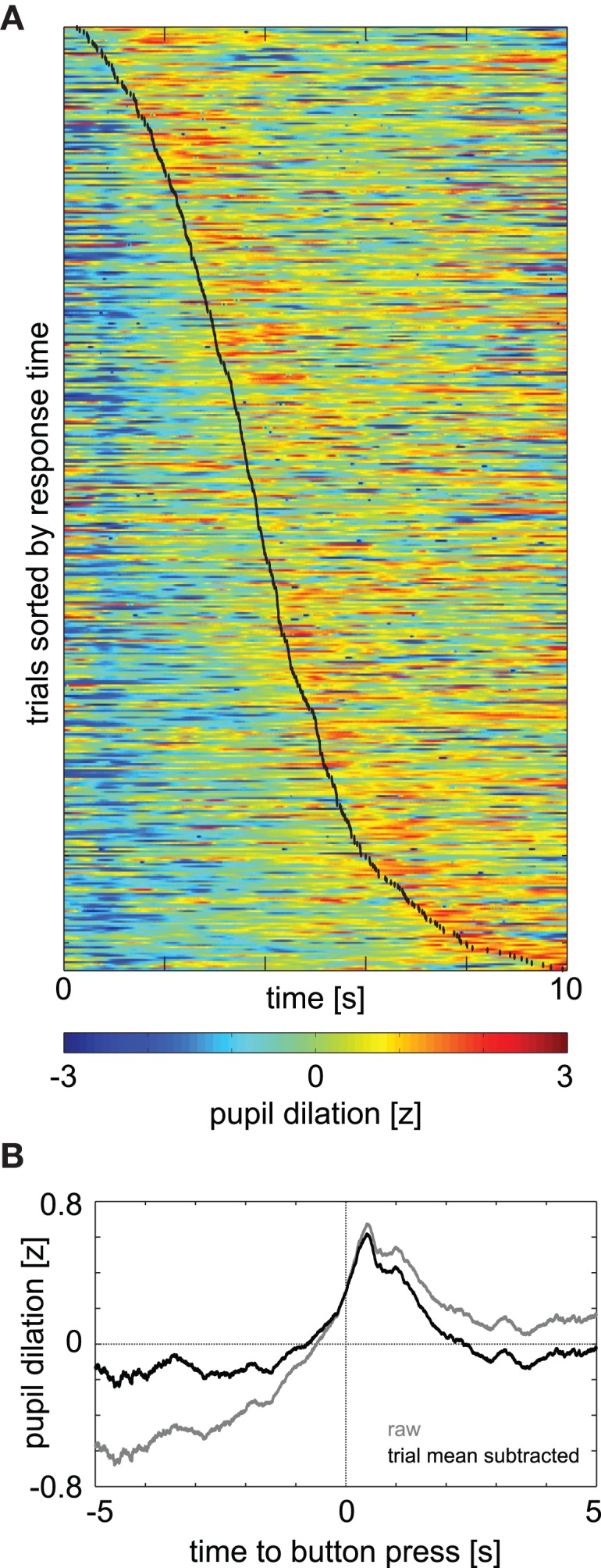
(A) Valid trials of experiment 1 sorted by time of button press (black line) and presented in ascending order (rows); columns denote time since start of the decision period, colors the pupil dilation. For display purposes, pupil diameter was z-normalized within individual trials, but not across trials or subjects. The timing of maximum pupil dilation generally occurring 1–2 s after the button press (red color to the right of the black line), is unaffected by this normalization and thus corresponds to the data used for the main analysis and prediction. (B) Average pupil-dilation in experiment 1 aligned to time of button-press. Gray: raw (z-score normalized data); black: grand mean subtracted from each trial before aligning and averaging.
Figure 4
Figure 4
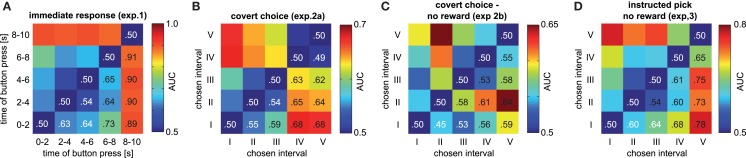
Pairwise discriminability of chosen intervals based on the time of maximum pupil dilation. Values above 50% (chance) consistently indicate that the later chosen interval corresponds to later pupil dilation maxima, yielding a symmetric plot. (A) Experiment 1 (B) Experiment 2. The reduced discriminability between intervals IV and V in experiment 2 may be due to the latency of the maximum response, which is effectively truncated by the end of the 10-s decision period; it reaches 55% if an additional second is included (maximally up to the report). (C) Experiment 2b (D) Experiment 3.

References

    1. Andrews T., Purves D. (1997). Similarities in normal and binocular rivalrous viewing. Proc. Natl. Acad. Sci. U.S.A. 94, 9905–990810.1073/pnas.94.18.9905 - DOI - PMC - PubMed
    1. Aston-Jones G., Cohen J. (2005). An integrative theory of locus coeruleus-norepinephrine function: adaptive gain and optimal performance. Annu. Rev. Neurosci. 28, 403–45010.1146/annurev.neuro.28.061604.135709 - DOI - PubMed
    1. Beatty J., Lucero-Wagoner B. (2000). The pupillary system. In Handbook of Psychophysiology 2nd edn Cacioppo J., et al., eds (Cambridge, Cambridge University Press; ).
    1. Bouret S., Richmond B. J. (2009). Relation of locus coeruleus neurons in monkeys to Pavlovian and operant behaviors. J. Neurophysiol. 101, 898–91110.1152/jn.91048.2008 - DOI - PMC - PubMed
    1. Bouret S., Sara S. (2005). Network reset: a simplified overarching theory of locus coeruleus noradrenaline function. Trends Neurosci. 28, 574–58210.1016/j.tins.2005.09.002 - DOI - PubMed