


Circadian rhythms of psychomotor vigilance, mood, and sleepiness in the ultra-short sleep/wake protocol
- PMID: 20205564
- PMCID: PMC3248591
- DOI: 10.3109/07420521003648604
Circadian rhythms of psychomotor vigilance, mood, and sleepiness in the ultra-short sleep/wake protocol
Abstract
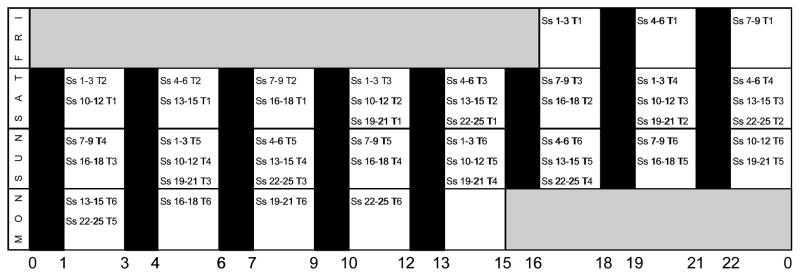
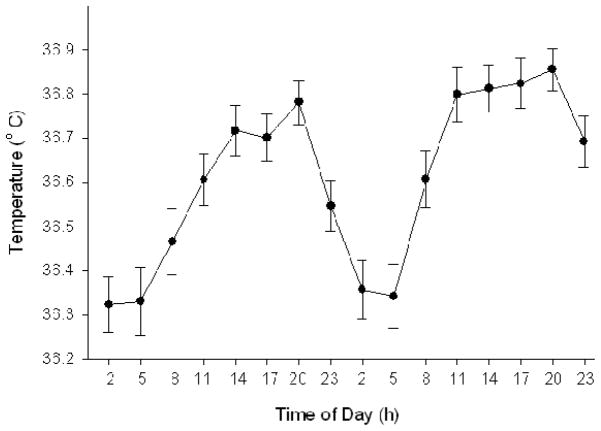
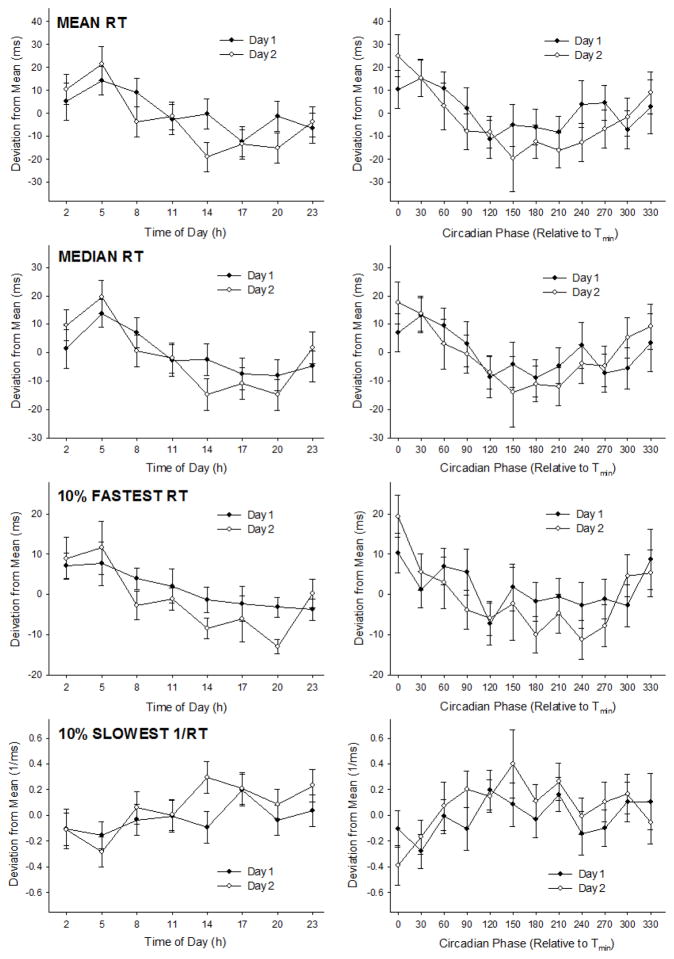
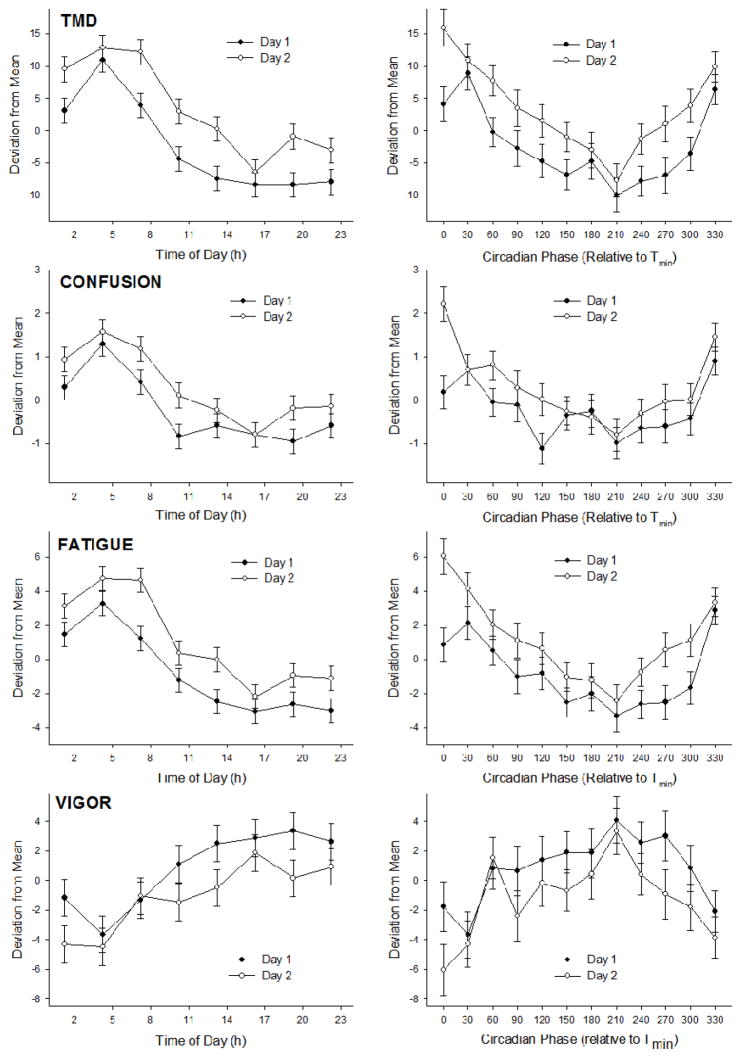
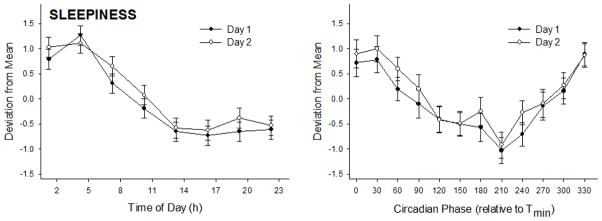
Despite its advantages as a chronobiological technique, the ultra-short sleep/wake protocol remains underutilized in circadian rhythm research. The purpose of this study was to examine circadian rhythms of psychomotor vigilance (PVT), mood, and sleepiness in a sample (n=25) of healthy young adults while they adhered to a 3 h ultra-short sleep/wake protocol. The protocol involved 1 h sleep intervals in darkness followed by 2 h wake intervals in dim light, repeated for 50-55 h. A 5 min PVT test was conducted every 9 h with the standard metrics of mean reaction time (RT; RT(mean)), median RT (RT(med)), fastest 10% of responses (RT(10fast)), and reciprocal of the 10% slowest responses (1/RT(10slow)). Subjective measures of mood and sleepiness were assessed every 3 h. A cosine fit of intra-aural temperature, assessed three times per wake period, established the time of the body temperature minimum (T(min)). Mood, sleepiness, and PVT performances were expressed relative to individual means and compared across eight times of day and twelve 2 h intervals relative to T(min). Significant time-of-day and circadian patterns were demonstrated for each of the PVT metrics, as well as for mood and sleepiness. Most mood subscales exhibited significant deterioration in day 2 of the protocol without alteration of circadian pattern. However, neither sleepiness nor performance was worse on the second day of observation compared to the first day. These data provide further support for the use of the ultra-short sleep/wake protocol for measurement of circadian rhythms.
Conflict of interest statement
The authors report no conflicts of interest. The authors alone are responsible for the content and writing of the paper.
Figures
References
-
- Blatter K, Graw P, Munch M, Knoblauch V, Wirz-Justice A, Cajochen C. Gender and age differences in psychomotor vigilance performance under differential sleep pressure conditions. Behav Brain Res. 2006;168:312–317. - PubMed
-
- Boivin DB, Czeisler CA, Dijk DJ, Duffy JF, Folkard S, Minors DS, Totterdell P, Waterhouse JM. Complex interaction of the sleep-wake cycle and circadian phase modulates mood in healthy subjects. Arch Gen Psychiatry. 1997;54:145–152. - PubMed
-
- Buysse DJ, Monk TH, Carrier J, Begley A. Circadian patterns of sleep, sleepiness, and performance in older and younger adults. Sleep. 2005;28:1365–1376. - PubMed
-
- Carskadon MA, Dement WC. Sleep studies on a 90-minute day. Electroencephalogr Clin Neurophysiol. 1975;39:145–155. - PubMed
-
- Dinges DF, Powell JW. Microcomputer analyses of performance on a portable, simple visual RT task during sustained operations. Beh Res Meth Inst Comp. 1985;17:652–655.
Publication types
MeSH terms
Grants and funding
LinkOut - more resources
Full Text Sources
