


Mechanisms of action of non-steroidal anti-inflammatory drugs for the prevention of Alzheimer's disease
- PMID: 20205646
- PMCID: PMC4312283
- DOI: 10.2174/187152710791011991
Mechanisms of action of non-steroidal anti-inflammatory drugs for the prevention of Alzheimer's disease
Abstract
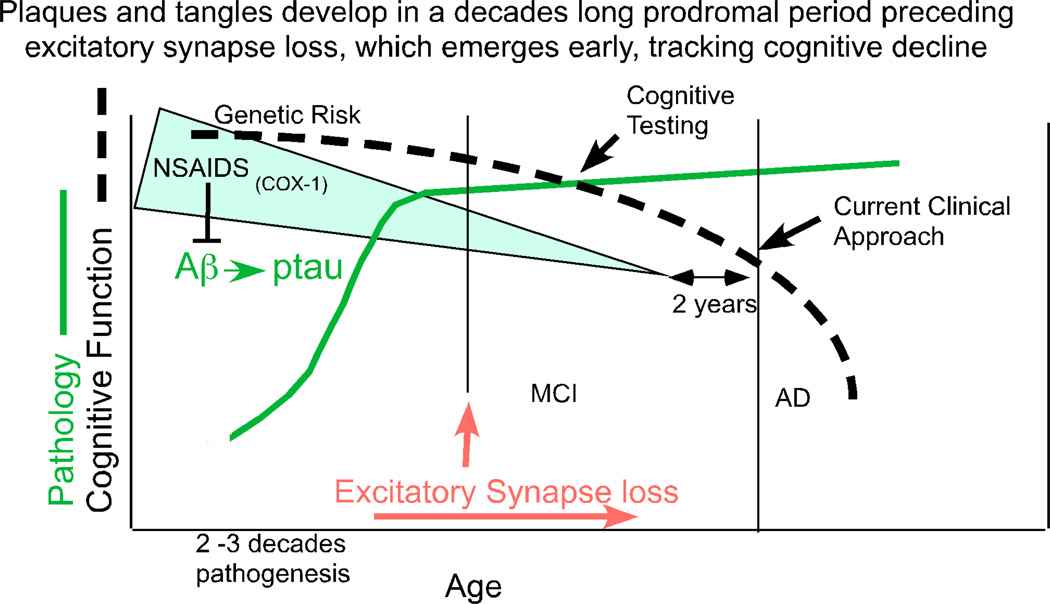
Alzheimer's disease (AD) is accompanied by an activation of the innate immune system, and many epidemiological studies have shown reduced risk for dementia or AD associated with chronic consumption of non-steroidal anti-inflammatory drugs (NSAIDs). These observations led to animal model studies to test the hypothesis that NSAIDs can be disease-modifying for some aspects of AD pathogenesis. NSAIDs cannot only suppress inflammatory targets, which could contribute to neuroprotection, they also slow amyloid deposition by mechanisms that remain unclear. Several large clinical trials with NSAID therapies with AD subjects have failed, and cyclooxygenase-2 does not appear to be a useful target for disease modifying therapy. However, there may be apolipoprotein E E4 pharmacogenomic effects and a real but delayed positive signal in a large primary prevention trial with naproxen. This encourages researchers to re-address possible mechanisms for a stage-dependent NSAID efficacy, the subject of this review.
Figures
References
-
- Akiyama H, Barger S, Barnum S, Bradt B, Bauer J, Cole GM, Cooper NE, Eikelenboom P, Emmerling M, Fiebich BL, Finch CE, Frautschy S, Griffin WS, Hampel H, Hull M, Landreth G, Lue L, Mrak R, Mackenzie IR, McGeer PL, O'Banion MK, Pachter J, Pasinetti G, Plata-Salaman C, Rogers J, Rydel R, Shen Y, Streit W, Strohmeyer R, Tooyoma I, Van Muiswinkel FL, Veerhuis R, Walker D, Webster S, Wegrzyniak B, Wenk G, Wyss-Coray T. Inflammation and Alzheimer's disease. Neurobiol. Aging. 2000;21:383–421. - PMC - PubMed
-
- McGeer PL, McGeer EG. NSAIDs and Alzheimer disease: epidemiological, animal model and clinical studies. Neurobiol. Aging. 2007;28:639–647. - PubMed
-
- Aisen PS, Thal LJ, Ferris SH, Assaid C, Nessly ML, Giuliani MJ, Lines CR, Norman BA, Potter WZ. Rofecoxib in patients with mild cognitive impairment: further analyses of data from a randomized, double-blind, trial. Curr. Alzheimer Res. 2008;5:73–82. - PubMed
-
- Szekely CA, Thorne JE, Zandi PP, Ek M, Messias E, Breitner JC, Goodman SN. Nonsteroidal anti-inflammatory drugs for the prevention of Alzheimer's disease: a systematic review. Neuroepidemiology. 2004;23:159–169. - PubMed
Publication types
MeSH terms
Substances
Grants and funding
- R01 AT006816/AT/NCCIH NIH HHS/United States
- U01 AG028583/AG/NIA NIH HHS/United States
- P50 AG016570/AG/NIA NIH HHS/United States
- AG021975/AG/NIA NIH HHS/United States
- R01 AG010685/AG/NIA NIH HHS/United States
- I01 BX001257/BX/BLRD VA/United States
- R01 AT003008/AT/NCCIH NIH HHS/United States
- I01 BX000542/BX/BLRD VA/United States
- U01AG28583/AG/NIA NIH HHS/United States
- R01 AG016793/AG/NIA NIH HHS/United States
- R01 AG013741/AG/NIA NIH HHS/United States
- R01 AG13471/AG/NIA NIH HHS/United States
- R01AT3008/AT/NCCIH NIH HHS/United States
- R01 AG021975/AG/NIA NIH HHS/United States
LinkOut - more resources
Full Text Sources
Other Literature Sources
Medical
Research Materials