. 2010 Mar 7:10:43.
doi: 10.1186/1471-2229-10-43.

Small chloroplast-targeted DnaJ proteins are involved in optimization of photosynthetic reactions in Arabidopsis thaliana

Affiliations

Small chloroplast-targeted DnaJ proteins are involved in optimization of photosynthetic reactions in Arabidopsis thaliana

Kun-Ming Chen et al. BMC Plant Biol. .

Abstract

Background: DnaJ proteins participate in many metabolic pathways through dynamic interactions with various components of these processes. The role of three small chloroplast-targeted DnaJ proteins, AtJ8 (At1 g80920), AtJ11 (At4 g36040) and AtJ20 (At4 g13830), was investigated here using knock-out mutants of Arabidopsis thaliana. Photochemical efficiency, capacity of CO2 assimilation, stabilization of Photosystem (PS) II dimers and supercomplexes under high light illumination, energy distribution between PSI and PSII and phosphorylation of PSII-LHCII proteins, global gene expression profiles and oxidative stress responses of these DnaJ mutants were analyzed.

Results: Knockout of one of these proteins caused a series of events including a decrease in photosynthetic efficiency, destabilization of PSII complexes and loss of control for balancing the redox reactions in chloroplasts. Data obtained with DNA microarray analysis demonstrated that the lack of one of these DnaJ proteins triggers a global stress response and therefore confers the plants greater tolerance to oxidative stress induced by high light or methyl viologen treatments. Expression of a set of genes encoding enzymes that detoxify reactive oxygen species (ROS) as well as a number of stress-related transcription factors behaved in the mutants at growth light similarly to that when wild-type (WT) plants were transferred to high light. Also a set of genes related to redox regulation were upregulated in the mutants. On the other hand, although the three DnaJ proteins reside in chloroplasts, the expression of most genes encoding thylakoid membrane proteins was not changed in the mutants.

Conclusion: It is proposed that the tolerance of the DnaJ protein knockout plants to oxidative stress occurs at the expense of the flexibility of photosynthetic reactions. Despite the fact that the effects of the individual protein knockout on the response of plants to high light treatment are quite similar, it is conceivable that both specific- and cross-talk functions exist between the three small chloroplast-targeted DnaJ proteins, AtJ8, AtJ11 and AtJ20.


Figures
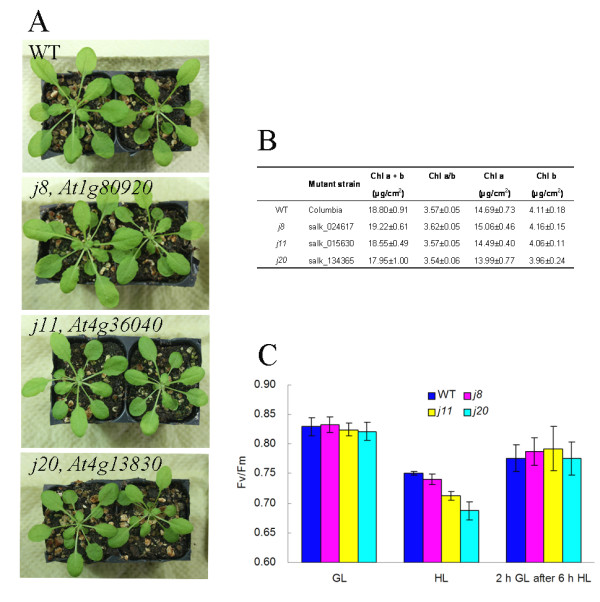
Figure 1
Figure 1
Phenotypes of DnaJ protein knockout mutants. A, Images of 4-week old wild-type (WT) and j8, j11 and j20 mutants; B, Contents of leaf chlorophyll in WT and the DnaJ mutants under growth light condition (120 μmol photons m-2 s-1), the values are means ± SD (n = 10) of ten independent experiments; C, PSII photochemical efficiency of DnaJ mutants, the values are means ± SD (n = 10) of ten independent experiments. WT, wild-type; GL, growth light (120 μmol photons m-2 s-1); HL, high light (1000 μmol photons m-2 s-1).
Figure 2
Figure 2
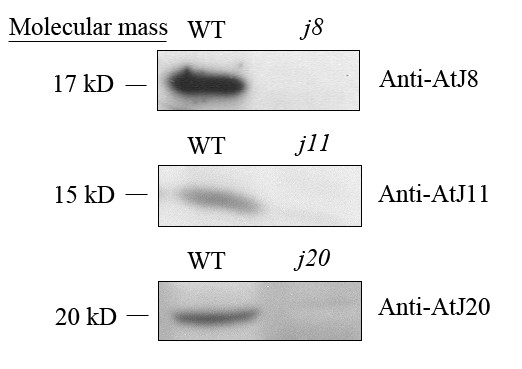
Immunodetection of the three DnaJ proteins AtJ8, AtJ11 and AtJ20 in chloroplasts. Chloroplasts were isolated from the leaves of WT and respective mutants after 3 h treatment in darkness. Total chloroplast proteins were used for immunoblotting, and for immunodetection of the AtJ8 protein, 30 μg protein was loaded whereas for immunodetection of AtJ11 and AtJ20 proteins, 100 μg protein was loaded. WT, wild-type.
Figure 3
Figure 3
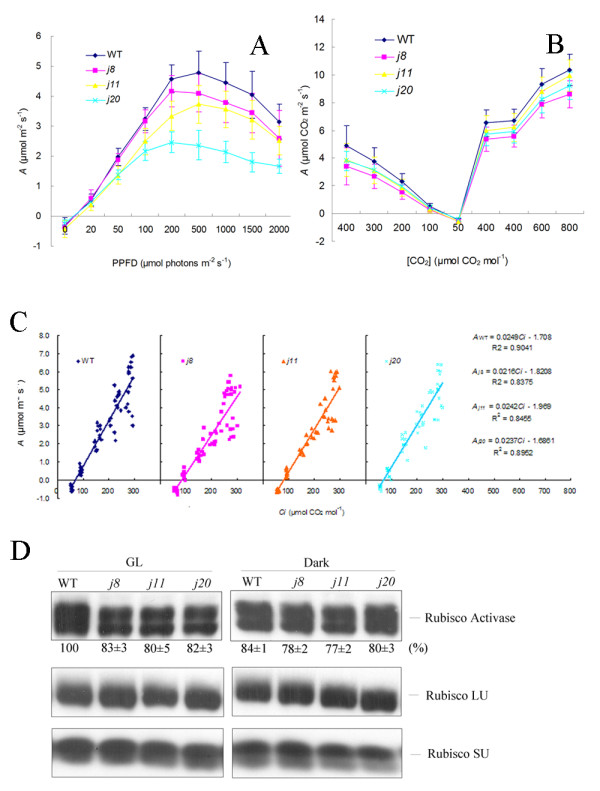
Capacity of CO2 assimilation in DnaJ mutants and WT. A, Light response curves; B, CO2 response curves; C, A-Ci curves which based on intracellular CO2 concentration less than 300 μmol mol-1; D, Immunoblot analysis of Rubisco Activase, Rubisco large subunit (Rubisco LU) and small subunit (Rubisco SU) in leaves collected from growth light conditions and from darkness. Total proteins were isolated from leaves after 6 h illumination under growth light and in the end of the diurnal dark period. 10 μg of leaf total proteins was loaded. Protein quantification (indicated below the blots as a percentage of protein from that present in WT in the light) is based on three independent immunoblot experiments (mean ± SD). A, CO2 assimilation; Ci, intracellular CO2 consentration; PPFD, photosynthetic photon flux density. WT, wild-type; GL, growth light (120 μmol photons m-2 s-1).
Figure 4
Figure 4
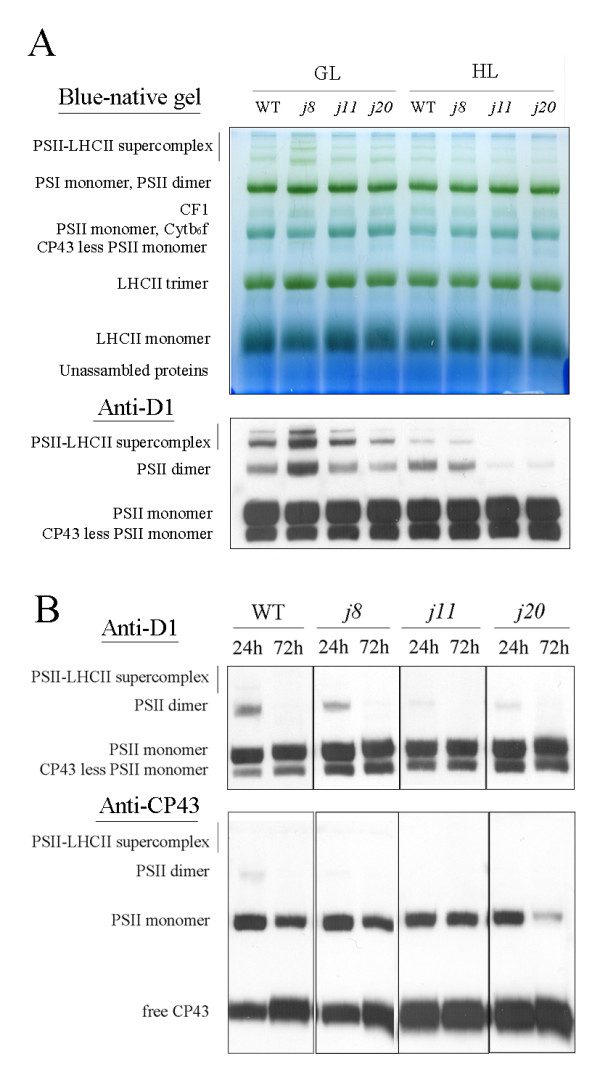
BN-PAGE analysis of thylakoid protein complexes from WT and the DnaJ mutants. Thylakoids corresponding 4 μg Chl were loaded in each lane. A, A BN gel of thylakoid protein complexes from plants exposed to growth light conditions for 6 h and from plants exposed to high light for 6 h. Top panel, BN gel directly after electrophoresis; lower panel, BN gel immunoblotted with D1 antibody. B, Immunoblots of the BN gels prepared from plants after a long-term high light (1000 μmol photons m-2 s-1) exposure. Thylakoid membrane protein complexes of WT and the DnaJ mutants were subjected to Blue-native gel electrophoresis following immunoblotting with D1 (top panel) and CP43 (lower panel) antibodies. GL, 120 μmol photons m-2 s-1 growth light; HL, 1000 μmol photons m-2 s-1 high light.
Figure 5
Figure 5
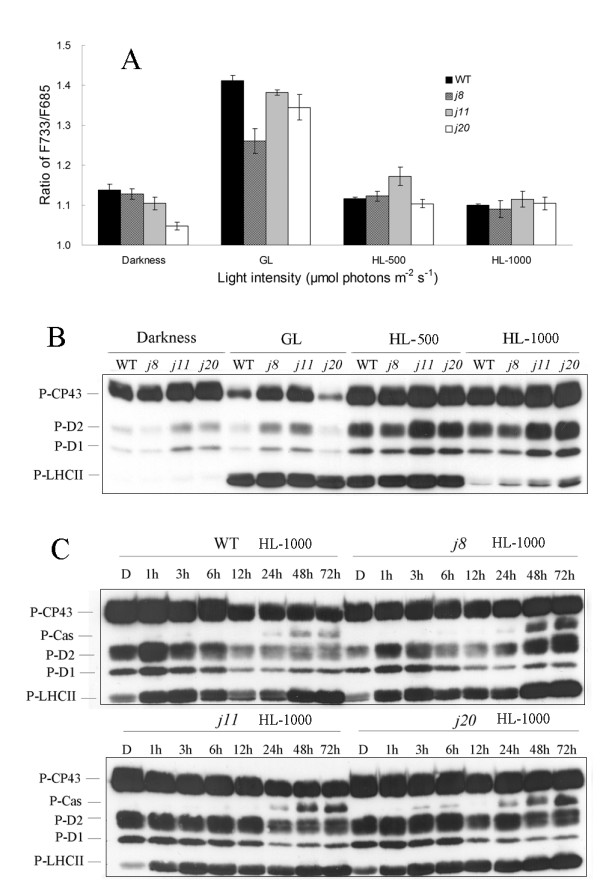
The 77 K fluorescence emission ratio F733/F685 and the thylakoid protein phosphorylation in WT and the DnaJ mutants. A, F733/F685 ratio in WT and the DnaJ mutants after 6 h treatment of plants under different light conditions. The values are means ± SD (n = 9~12) of three independent experiments with 3 to 4 replicates. B, Phosphorylation levels of thylakoid proteins after similar light treatments of plants as in A. C, Changes in thylakoid protein phosphorylation during a long-term high light (1000 μmol photons m-2 s-1) treatment. Thylakoid membranes were isolated from leaves after treatment of plants in darkness and after illumination at growth light and high light conditions for time periods indicated. 1.0 μg of chlorophyll was loaded to the wells for immunoblotting with p-thr antibody. WT, wild-type; D, darkness; GL, 120 μmol photons m-2 s-1 growth light; HL-500, 500 μmol photons m-2 s-1high light; HL-1000, 1000 μmol photons m-2 s-1 high light.
Figure 6
Figure 6
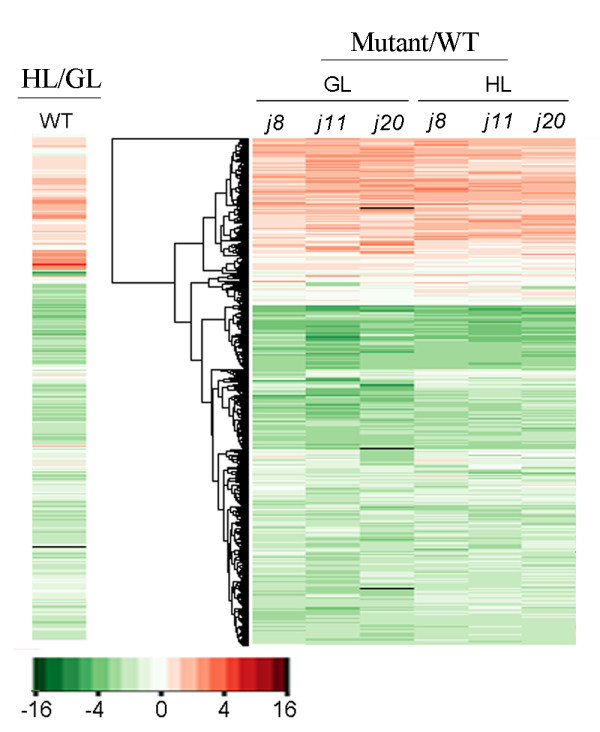
Gene expression-profilings of the DnaJ mutants with comparison to WT. Genes whose expression showed more than a two-fold change (up- or down-regulated) with the p-value less than 0.05 and the B-value more than 2.0 were selected for making the heatmaps using the R program and Bioconductor packages. The values are averages from three independent biological replicates starting from the growth of a new set of plants. The heatmap marked by WT shows the changes of gene expression in WT after 6 h illumination at 1000 μmol photons m-2 s-1 against 6 h illumination at 120 μmol photons m-2 s-1. The heatmaps marked by the names of the DnaJ mutant show the changes of gene expression in each mutant against WT under both GL and HL conditions after 6 h illumination. WT, wild-type; GL, 120 μmol photons m-2 s-1 growth light; HL, 1000 μmol photons m-2 s-1 high light. (red, upregulated; green, downregulated; black, missing value).
Figure 7
Figure 7
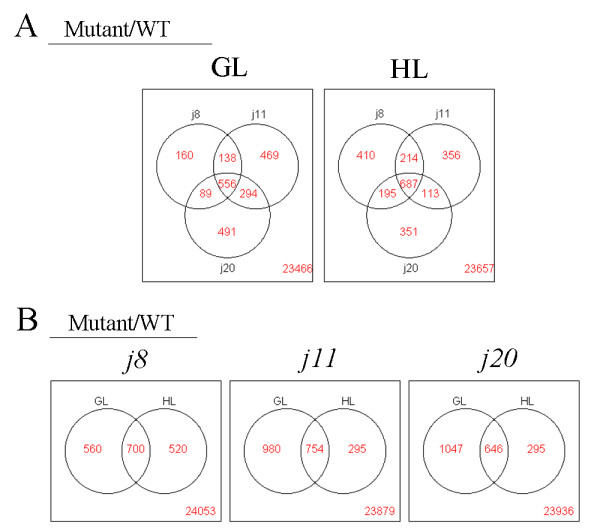
Venn diagrams of genes impacted by a HL treatment and by a DnaJ protein knockout. A, More than half of the genes changing expression are coregulated in the three DnaJ mutants and the mutants share 556 and 687 coregulated genes under GL and HL conditions, respectively. B, Coregulation analysis of gene expression between GL and HL conditions for each DnaJ mutant. WT, wild-type; GL, 120 μmol photons m-2 s-1 growth light; HL, 1000 μmol photons m-2 s-1 high light.
Figure 8
Figure 8
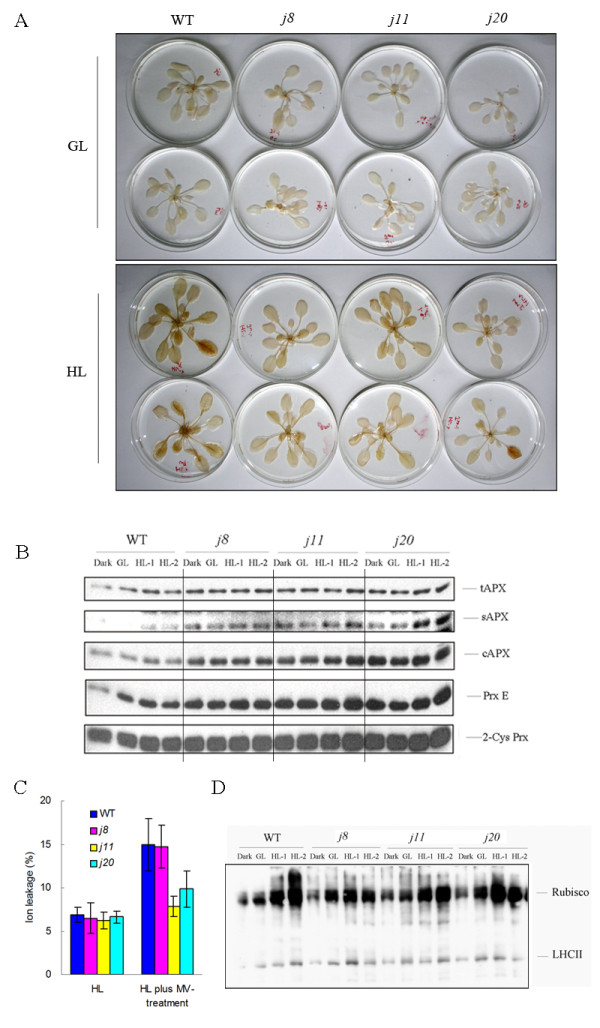
Production of ROS and the stress tolerance of WT and the DnaJ mutant j8, j11 and j20. A, Histochemical detection of H2O2 in the leaves with DAB staining after 6 h incubation of leaves under GL (120 μmol photons m-2 s-1) and HL (1000 μmol photons m-2 s-1). B, Immunoblots depicting the levels of H2O2-detoxifying enzymes in WT and the DnaJ mutant leaves after 6 h incubation of plants under different light conditions. 10 μg of the leaf total proteins loaded. C, Ion leakage induced by 6 h HL (1000 μmol photons m-2 s-1) illumination of leaves in the presence and absence of Methyl viologen (MV), the values are means ± SD (n = 8) of two independent experiments with 4 replicates. D, OxyBlot of leaf total proteins (10 μg proteins loaded) after treatment of plants at different light intensities. GL, 120 μmol photons m-2 s-1 growth light; HL-1, 500 μmol photons m-2 s-1 high light; HL-2, 1000 μmol photons m-2 s-1 high light. WT, wild-type.

References

    1. Walsh P, Bursac D, Law YC, Cyr D, Lithgow T. The J-protein family: modulating protein assembly, disassembly and translocation. EMBO Rep. 2004;5:567–571. doi: 10.1038/sj.embor.7400172. - DOI - PMC - PubMed
    1. Liberek K, Lewandowska A, Zietkiewicz S. Chaperones in control of protein disaggregation. EMBO J. 2008;27:328–335. doi: 10.1038/sj.emboj.7601970. - DOI - PMC - PubMed
    1. Cheetham ME, Caplan AJ. Structure, function and evolution of DnaJ: conservation and adaptation of chaperone function. Cell Stress Chaperon. 1998;3:28–36. doi: 10.1379/1466-1268(1998)003<0028:SFAEOD>2.3.CO;2. - DOI - PMC - PubMed
    1. Thomas JG, Baneyx F. Protein folding in the cytoplasm of Escherichia coli: requirements for the DnaK-DnaJ-GrpE and GroEL-GroES molecular chaperone machines. Mol Microbiol. 1996;21:1185–1196. doi: 10.1046/j.1365-2958.1996.651436.x. - DOI - PubMed
    1. Voos W, Rottgers K. Molecular chaperones as essential mediators of mitochondria biogenesis. Biochim Biophys Acta. 2002;1592:52–62. - PubMed

Publication types

MeSH terms