Review
. 2010 Mar 2;5(3):e9434.
doi: 10.1371/journal.pone.0009434.

Effect of animal and industrial trans fatty acids on HDL and LDL cholesterol levels in humans--a quantitative review

Affiliations
Review

Effect of animal and industrial trans fatty acids on HDL and LDL cholesterol levels in humans--a quantitative review

Ingeborg A Brouwer et al. PLoS One. .

Erratum in

Abstract

Background: Trans fatty acids are produced either by industrial hydrogenation or by biohydrogenation in the rumens of cows and sheep. Industrial trans fatty acids lower HDL cholesterol, raise LDL cholesterol, and increase the risk of coronary heart disease. The effects of conjugated linoleic acid and trans fatty acids from ruminant animals are less clear. We reviewed the literature, estimated the effects trans fatty acids from ruminant sources and of conjugated trans linoleic acid (CLA) on blood lipoproteins, and compared these with industrial trans fatty acids.

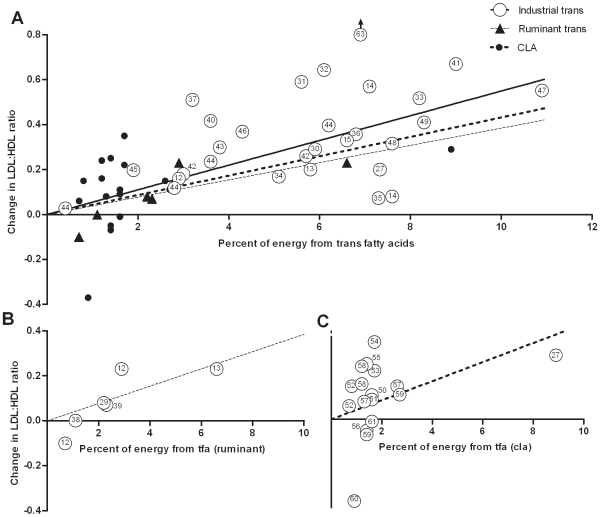
Methodology/principal findings: We searched Medline and scanned reference lists for intervention trials that reported effects of industrial trans fatty acids, ruminant trans fatty acids or conjugated linoleic acid on LDL and HDL cholesterol in humans. The 39 studies that met our criteria provided results of 29 treatments with industrial trans fatty acids, 6 with ruminant trans fatty acids and 17 with CLA. Control treatments differed between studies; to enable comparison between studies we recalculated for each study what the effect of trans fatty acids on lipoprotein would be if they isocalorically replaced cis mono unsaturated fatty acids. In linear regression analysis the plasma LDL to HDL cholesterol ratio increased by 0.055 (95%CI 0.044-0.066) for each % of dietary energy from industrial trans fatty acids replacing cis monounsaturated fatty acids The increase in the LDL to HDL ratio for each % of energy was 0.038 (95%CI 0.012-0.065) for ruminant trans fatty acids, and 0.043 (95% CI 0.012-0.074) for conjugated linoleic acid (p = 0.99 for difference between CLA and industrial trans fatty acids; p = 0.37 for ruminant versus industrial trans fatty acids).

Conclusions/significance: Published data suggest that all fatty acids with a double bond in the trans configuration raise the ratio of plasma LDL to HDL cholesterol.


Conflict of interest statement

Competing Interests: The authors have declared that no competing interests exist.

Figures

Figure 1
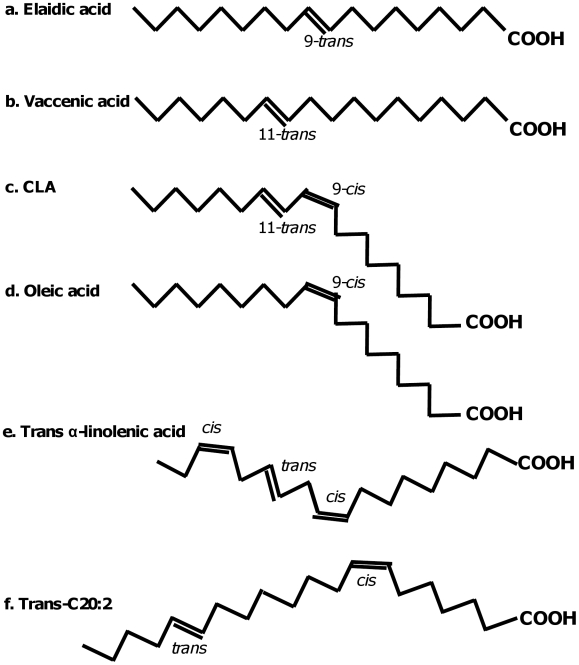
Figure 1. Structures of cis- and trans fatty acids.
Elaidic acid (9-trans-C18:1) is a typical industrial trans fatty acid, produced by partial hydrogenation of vegetable oil. Vaccenic acid (11-trans-C18:1) is the predominant trans fatty acid in milk and meat from ruminant animals, although small amounts are also found in industrially hydrogenated fats. The 9,11 isomer of conjugated linoleic acid or CLA (9-cis, 11-trans-C18:2) is found almost exclusively in ruminant fat; industrial production of CLA yields a mixture of 9,11 and 10,12 isomers. Oleic acid (9-cis -C18:1) is the predominant cis-unsaturated fatty acid in the diet. The location of the trans bond in trans isomers of alpha-linolenic acid is not known precisely; for this figure it has been assigned arbitrarily to the 6 location. The same holds for the trans bonds in the trans isomers of C20:1, C20:2, C22:1 and C22:2 that arise from eicosapentaenoic acid (EPA) and docosahexaenoic acid (DHA) during partial hydrogenation of fish oil.
Figure 2
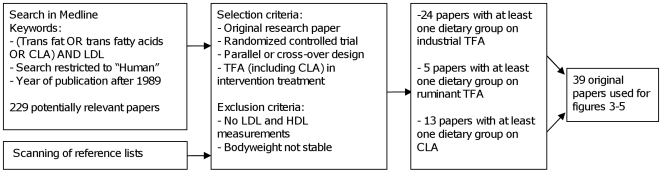
Figure 2. Flow chart of a search details for trials included in figure 3.
TFA: trans fatty acids.
Figure 3
Figure 3. Results of randomized studies of the effects of diets high in industrial trans fatty acids (---○○○○○ ---) or ruminant trans fatty acids (····▴····) or CLA (▪▪▪•▪▪▪) compared with cis-unsaturated fatty acids on the ratio of LDL- tot HDL-cholesterol.
a: Results of all studies on the ratio of LDL- to HDL-cholesterol. Results of studies using saturated fatty acids as comparison group , , , , , , , , , and of the Transfact study, which compared two sources of trans fatty acids were recalculated to effects relative to isocaloric amounts of cis mono-unsaturated fatty acids according to Mensink et al. . To maintain uniformity, we calculated the ratio of LDL to HDL cholesterol from mean LDL and HDL levels, even where ratios had been reported. Numbers indicate reference numbers. Point no. 63 was not included in estimating the regression line because we considered it an outlier. Regression lines were forced through the origin because a zero change in diet should produce a zero change in blood lipids. The black solid line indicates the best-fit regression for industrial trans fatty acids (y = 0.055x), the dashed line for ruminant trans fatty acids (y = 0.038x) and the grey line for CLA (y = 0.045x). The slopes of the regression lines were not significantly different. b: Results of randomized studies of the effects of diets high in ruminant trans fatty acids compared with cis-unsaturated fatty acids on the ratio of LDL- to HDL-cholesterol. Results of one study using saturated fatty acids as comparison group and of the Transfact study, which compared two sources of trans fatty acids , were recalculated to effects relative to isocaloric amounts of cis mono-unsaturated fatty acids according to Mensink et al. . To maintain uniformity, we calculated the ratio of LDL to HDL cholesterol from mean LDL and HDL levels, even where ratios had been reported. Numbers indicate reference numbers. c: Results of randomized studies of the effects of CLA compared with cis-unsaturated fatty acids on the ratio of LDL- to HDL-cholesterol. To maintain uniformity, we calculated the ratio of LDL to HDL cholesterol from mean LDL and HDL levels, even where ratios had been reported. Numbers indicate reference numbers. Results of two studies using placebo supplements with a high saturated fat content , were recalculated to effects relative to isocaloric amounts of cis mono-unsaturated fatty acids according to Mensink et al. .
Figure 4
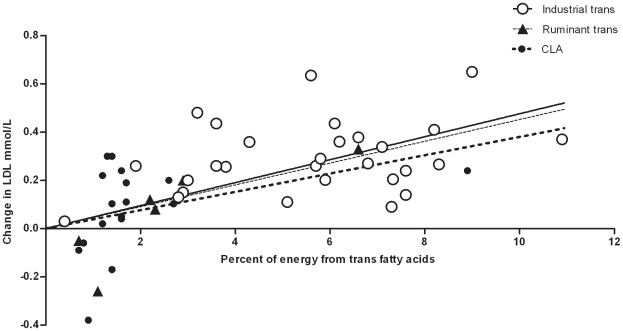
Figure 4. Results of randomized studies of the effects of diets high in industrial trans fatty acids (---○○○○○ ---) or ruminant trans fatty acids (····▴····) or CLA (▪▪▪•▪▪▪) compared with cis-unsaturated fatty acids on LDL cholesterol.
Figure 5
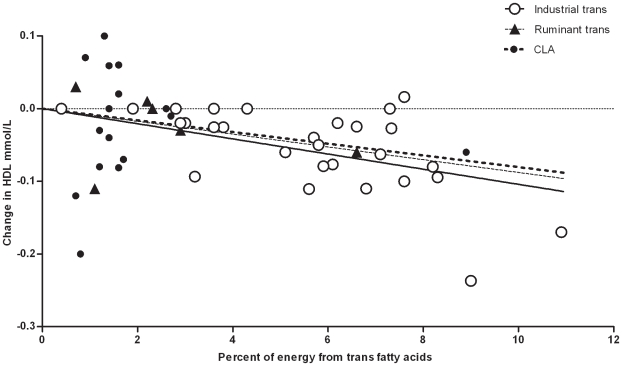
Figure 5. Results of randomized studies of the effects of diets high in industrial trans fatty acids (---○○○○○ ---) or ruminant trans fatty acids (····▴····) or CLA (▪▪▪•▪▪▪) compared with cis-unsaturated fatty acids on HDL cholesterol.

References

    1. Ascherio A, Hennekens CH, Buring JE, Master C, Stampfer MJ, et al. Trans-fatty acids intake and risk of myocardial infarction. Circulation. 1994;89:94–101. - PubMed
    1. Willett WC, Stampfer MJ, Manson JE, Colditz GA, Speizer FE, et al. Intake of trans fatty acids and risk of coronary heart disease among women. Lancet. 1993;341:581–585. - PubMed
    1. Pietinen P, Ascherio A, Korhonen P, Hartman AM, Willett WC, et al. Intake of fatty acids and risk of coronary heart disease in a cohort of Finnish men. The Alpha-Tocopherol, Beta-Carotene Cancer Prevention Study. Am J Epidemiol. 1997;145:876–887. - PubMed
    1. Oomen CM, Ocke MC, Feskens EJ, van Erp-Baart MA, Kok FJ, et al. Association between trans fatty acid intake and 10-year risk of coronary heart disease in the Zutphen Elderly Study: a prospective population-based study. Lancet. 2001;357:746–751. - PubMed
    1. Mozaffarian D, Katan MB, Ascherio A, Stampfer MJ, Willett WC. Trans fatty acids and cardiovascular disease. N Engl J Med. 2006;354:1601–1613. - PubMed

Publication types