


Mitochondrial dynamics in Alzheimer's disease: opportunities for future treatment strategies
- PMID: 20210366
- PMCID: PMC2923854
- DOI: 10.2165/11532140-000000000-00000
Mitochondrial dynamics in Alzheimer's disease: opportunities for future treatment strategies
Abstract
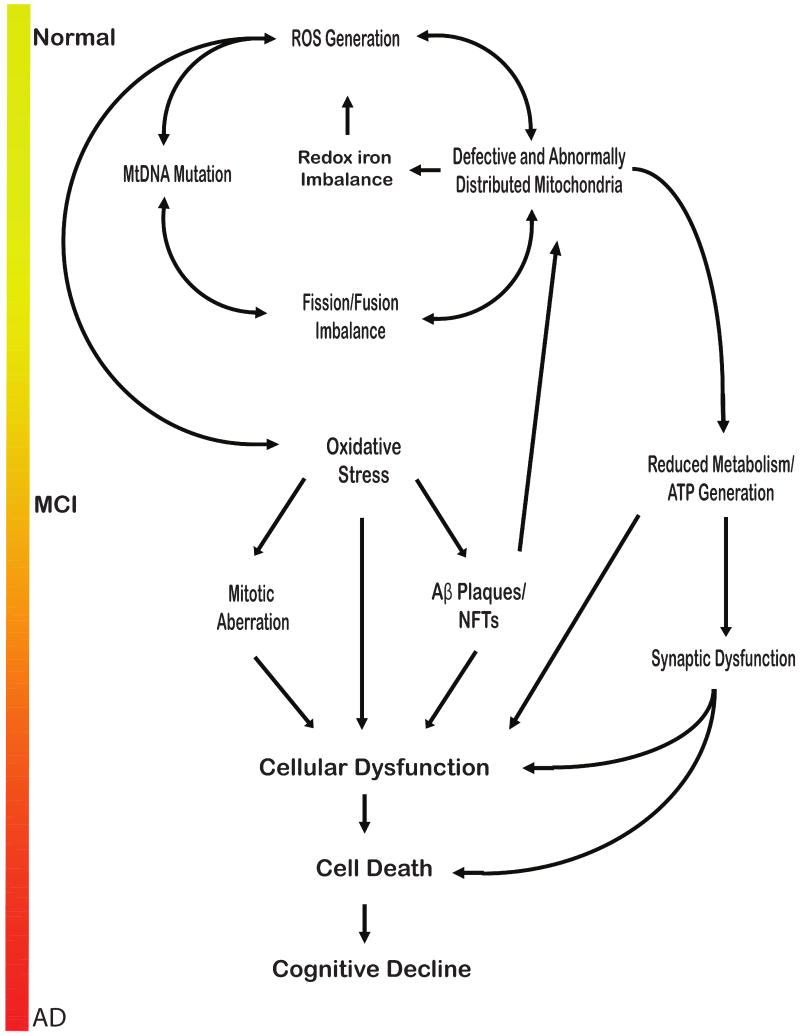
The complexities that underlie the cognitive impairment and neurodegeneration characteristic of Alzheimer's disease (AD) have yet to be completely understood, although many factors in disease pathogenesis have been identified. Particularly important in disease development seem to be mitochondrial disturbances. As pivotal role players in cellular metabolism, mitochondria are pertinent to cell survival and thus any deviation from their operation is certainly fatal. In this review, we describe how the dynamic balance of mitochondrial fission and fusion in particular is a necessary aspect of cell proliferation and that, as the cell ages, such balance is inevitably compromised to yield a destructive environment in which the cell cannot exist. Evidence for such disturbance is abundant in AD. Specifically, the dynamic balance of fission and fusion in AD is greatly shifted toward fission, and, as a result, affected neurons contain abnormal mitochondria that are unable to meet the metabolic demands of the cell. Moreover, mitochondrial distribution in AD cells is perinuclear, with few metabolic organelles in the distal processes, where they are normally distributed in healthy cells and are needed for exocytosis, ion channel pumps, synaptic function and other activities. AD neurons are thus characterized by increases in reactive oxidative species and decreases in metabolic capability, and, notably, these changes are evident very early in AD progression. We therefore believe that oxidative stress and altered mitochondrial dynamics contribute to the precipitation of AD pathology and thus cognitive decline. These implications provide a window for therapeutic intervention (i.e. mitochondrial protection) that has the potential to significantly deter AD progression if adequately developed. Current treatment strategies under investigation are described in this review.
Figures
References
-
- Smith MA. Alzheimer disease. Int Rev Neurobiol. 1998;42:1–54. - PubMed
-
- Serretti A, Olgiati P, De Ronchi D. Genetics of Alzheimer's disease: a rapidly evolving field. J Alzheimers Dis. 2007 Aug;12(1):73–92. - PubMed
-
- Rogaeva E, Kawarai T, George-Hyslop PS. Genetic complexity of Alzheimer's disease: successes and challenges. J Alzheimers Dis. 2006;9(3 Suppl):381–7. - PubMed
-
- Iqbal K, Zaidi T, Thompson CH, et al. Alzheimer paired helical filaments: bulk isolation, solubility, and protein composition. Acta Neuropathol (Berl) 1984;62(3):167–77. - PubMed
Publication types
MeSH terms
Substances
Grants and funding
LinkOut - more resources
Full Text Sources
Other Literature Sources
Medical
Research Materials
Miscellaneous
