The development of object categorization in young children: hierarchical inclusiveness, age, perceptual attribute, and group versus individual analyses
- PMID: 20210495
- PMCID: PMC2856652
- DOI: 10.1037/a0018411
The development of object categorization in young children: hierarchical inclusiveness, age, perceptual attribute, and group versus individual analyses
Abstract
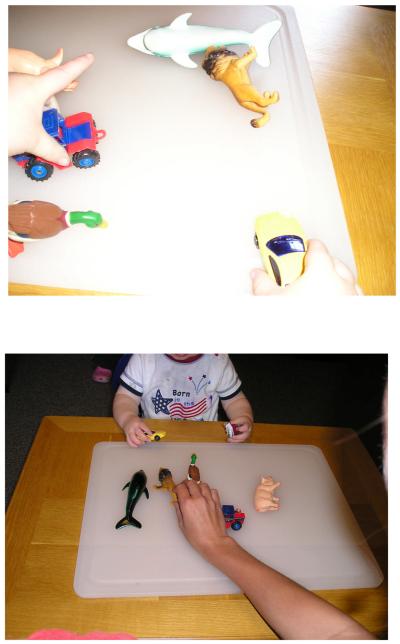
Multiple levels of category inclusiveness in 4 object domains (animals, vehicles, fruit, and furniture) were examined using a sequential touching procedure and assessed in both individual and group analyses in eighty 12-, 18-, 24-, and 30-month-olds. The roles of stimulus discriminability and child motor development, fatigue, and actions were also investigated. More inclusive levels of categorization systematically emerged before less inclusive levels, and a consistent advantage for categorizing high versus low perceptual contrasts was found. Group and individual analyses generally converged, but individual analyses added information about child categorization over group analyses. The development of object categorization in young children is discussed in light of efficiency of processing and similarity-differentiation theories.
Figures
References
-
- Adolph KE, Berger SE. Physical and motor development. In: Bornstein MH, Lamb ME, editors. Developmental psychology: an advanced textbook. 5e. Erlbaum; Mahwah, NJ: 2005. pp. 223–282.
-
- Altman D, Machin D, Bryan T, Gardner S. Statistics with confidence: Confidence intervals and statistical guidelines. BMJ Books; London, UK: 2000.
-
- Atran S. Cognitive foundations of natural history: Towards an anthropology of science. Cambridge University Press; New York: 1990.
-
- Baldwin DA, Markman EM, Melartin EM. Infants’ ability to draw inferences about nonobvious object properties: evidence from exploratory play. Child Development. 1993;64:711–728. - PubMed
-
- Bauer PJ, Dow GA, Hertzgaard LA. Effects of prototypicality on categorization in 1- to 2-year-olds: Getting down to basic. Cognitive Development. 1995;10:43–68.