


doi: 10.1086/651419.
Average adherence to boosted protease inhibitor therapy, rather than the pattern of missed doses, as a predictor of HIV RNA replication
Affiliations
- PMID: 20210643
- PMCID: PMC3591724
- DOI: 10.1086/651419
Item in Clipboard
Average adherence to boosted protease inhibitor therapy, rather than the pattern of missed doses, as a predictor of HIV RNA replication
Clin Infect Dis.
.
Abstract
Consecutive missed doses may differentially impact the efficacy of antiretroviral therapy associated with the use of a nonnucleoside reverse-transcriptase inhibitor (NNRTI) and a ritonavir-boosted protease inhibitor (PI). In a cohort of 72 subjects receiving a boosted PI, average adherence to dosage was a better predictor of human immunodeficiency virus (HIV) replication than was the duration or frequency of treatment interruption. In contrast with an NNRTI, consecutive missed doses of a boosted PI did not emerge as a major risk factor for HIV replication.
Figures

Virologic suppression rates, based on the average percent adherence to boosted protease inhibitor therapy.
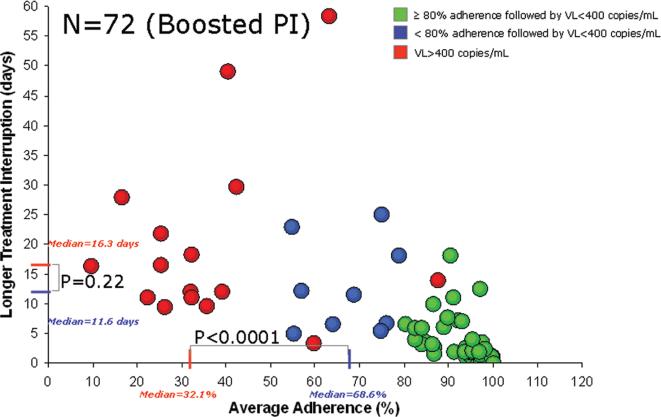
Relationship between average percent adherence to boosted protease inhibitor (PI) therapy and longer treatment interruption among subjects with (red) and without (green and blue) HIV replication. The red lines on the X-axis and the Y-axis correspond to the median average adherence rate and the duration of treatment interruption, respectively, among subjects with a subsequent HIV RNA level (ie, viral load [VL]) of ≥400 copies/mL. The blue lines on the X-axis and the Y-axis correspond to the median average adherence rate and the duration of treatment interruption, respectively, among subjects with a subsequent VL of <400 copies/mL and low-to-moderate adherence (<80%). The difference in average percent adherence, but not treatment interruption duration, is statistically significant between those with a VL of ≥400 copies/mL and those with a VL of <400 copies/mL.
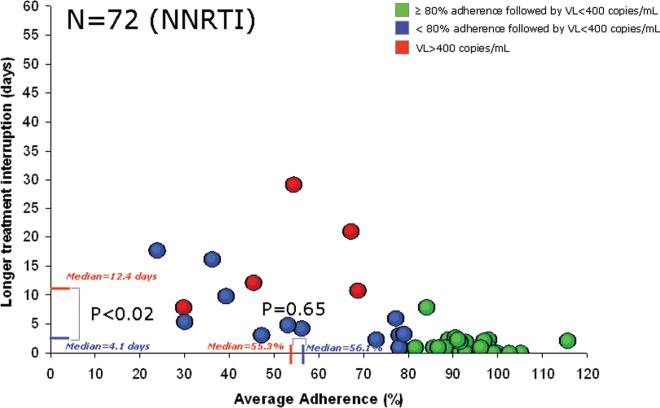
Relationship between average percent adherence to nonnucleoside reverse-transcriptase inhibitor (NNRTI) and longer treatment interruption among subjects with (red) and without (green and blue) HIV replication. The red lines on the X-axis and the Y-axis correspond to the median average percent adherence rate and duration of treatment interruption, respectively, among subjects with a subsequent HIV RNA level (ie, viral load [VL]) of ≥400 copies/mL. The blue lines on the X-axis and the Y-axis correspond to the median average adherence percent rate and the duration of treatment interruption, respectively, among subjects with a subsequent VL of <400 copies/mL and low-to-moderate adherence (<80%). The difference in duration of treatment interruption, but not average percent adherence rate, is statistically significant between those with a VL of ≥400 copies/mL and those with a VL of <400 copies/mL. This figure was adapted from Figure 2 in Parienti et al [10].
References
-
- Bangsberg DR, Perry S, Charlebois ED, et al. Non-adherence to highly active antiretroviral therapy predicts progression to AIDS. AIDS. 2001;15:1181–1183. - PubMed
-
- Hogg RS, Heath K, Bangsberg D, et al. Intermittent use of triple-combination therapy is predictive of mortality at baseline and after 1 year of follow-up. AIDS. 2002;16:1051–1058. - PubMed
-
- Parienti JJ, Massari V, Descamps D, et al. Predictors of virologic failure and resistance in HIV-infected patients treated with nevirapine- or efavirenz-based antiretroviral therapy. Clin Infect Dis. 2004;38:1311–1316. - PubMed
-
- Nachega JB, Hislop M, Dowdy DW, Chaisson RE, Regensberg L, Maartens G. Adherence to nonnucleoside reverse transcriptase inhibitor–based HIV therapy and virologic outcomes. Ann Intern Med. 2007;146:564–573. - PubMed
Publication types
MeSH terms
Substances
Grants and funding
LinkOut - more resources
Full Text Sources
Medical
Research Materials
Miscellaneous
