. 2010 May;101(5):1125-32.
doi: 10.1111/j.1349-7006.2010.01525.x. Epub 2010 Feb 5.

Mitochondria regulate the unfolded protein response leading to cancer cell survival under glucose deprivation conditions

Affiliations

Mitochondria regulate the unfolded protein response leading to cancer cell survival under glucose deprivation conditions

Naomi Haga et al. Cancer Sci. 2010 May.

Abstract

Cancer cells consume large amounts of glucose because of their specific metabolic pathway. However, cancer cells exist in tumor tissue where glucose is insufficient. To survive, cancer cells likely have the mechanism to elude their glucose addiction. Here we show that functional mitochondria are essential if cancer cells are to avoid glucose addiction. Cancer cells with dysfunctional mitochondria, such as mitochondrial DNA-deficient rho(0) cells and electron transport chain blocker-treated cells, were highly sensitive to glucose deprivation. Our data demonstrated that this sensitization was associated with failure of the unfolded protein response (UPR), an adaptive response mediated by the endoplasmic reticulum (ER). This study suggests a link between mitochondria and the ER during the UPR under glucose deprivation conditions and that mitochondria govern cell fate, not only through ATP production and apoptosis regulation, but also through modulating the UPR for cell survival.


Figures
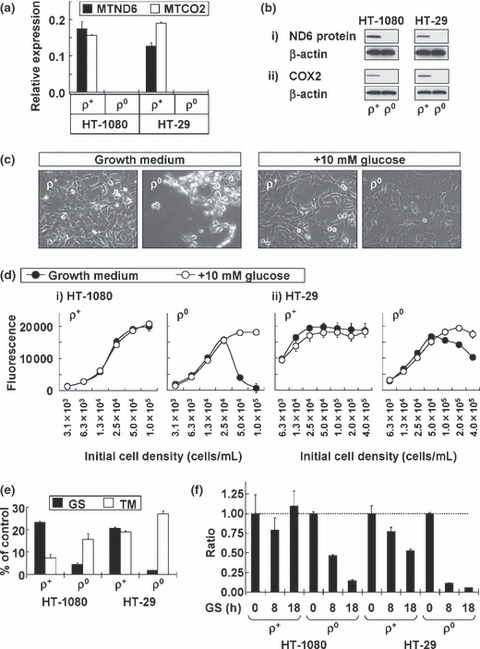
Figure 1
Figure 1
Characterization of ρ0 cells. (a) Mito‐chondrial DNA‐coded transcripts (MTND6 and MTCO2) in HT‐1080 and HT‐29 cells examined by real‐time RT‐PCR analysis. Data were normalized by b2‐microglobulin (B2M) mRNA expression. Results shown are the means of three independent experiments; bars, ±SD. (b) Mitochondrial DNA‐coded proteins (ND6 protein and cyclooxygenase‐2 [COX2]) in HT‐1080 and HT‐29 cells examined by immunoblotting. The amount of β‐actin is used as a loading control. (c) Phase contrast images of HT‐1080 cells. (d) Overgrowth‐induced cell death in ρ0 cells and its inhibition by additional glucose. Results shown are the means of three independent experiments; bars, ± SD. (e) Stress sensitivity. 2.5 ×104 cells/mL of HT‐1080 cells or 5.0 × 104 cells/mL of HT‐29 cells were plated into 96‐well plates in glucose starvation (GS) medium or tunicamycin (TM)‐containing medium. After 72 h, calcein‐AM assay was performed. Cell viability was indicated as the rate of the data in growth medium (% of control). (f) Intracellular adenosine triphosphate (ATP) content alteration under glucose deprivation conditions. ATP content was indicated as the rate of the data in growth medium (ratio).
Figure 2
Figure 2
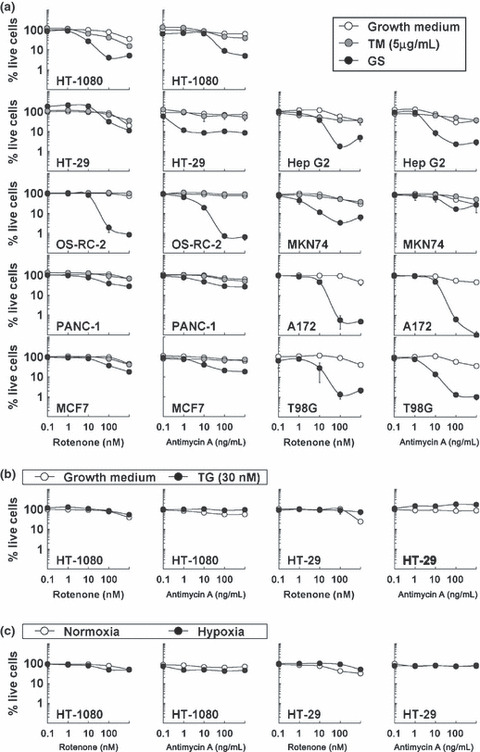
Increased sensitivity to glucose deprivation by electron transport chain blockers (ETCBs) in human cancer cell lines. The effect of ETCBs on the growth of human cancer cell lines under stress conditions: (a) tunicamycin (TM) or glucose starvation (GS); (b) thapsigargin (TG); (c) Hypoxia). (a–c) Results shown are the means of three independent experiments; bars, ±SD.
Figure 3
Figure 3
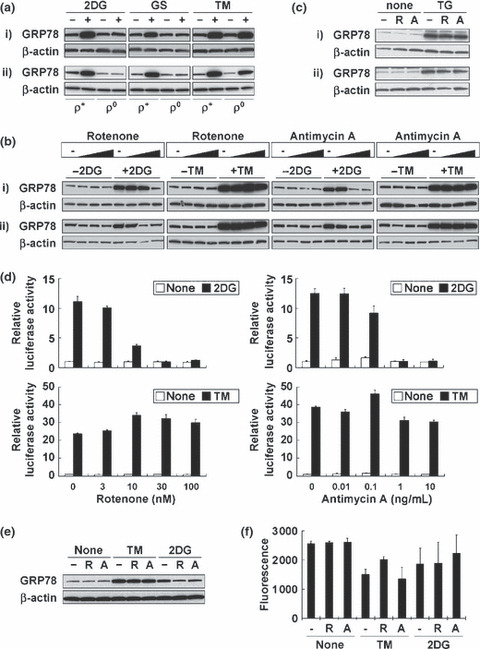
Respiratory chain is required for GRP78 up‐regulation induced by glucose deprivation. (a) GRP78 up‐regulation under stress conditions for 18 h. (b) The effect of electron transport chain blockers (ETCBs) on GRP78 up‐regulation under stress conditions for 18 h. Rotenone: 0, 10, 100, 1000 nM. Antimycin A: 0, 1, 10, 100 ng/mL. (c) The effect of ETCBs on thapsigargin (TG)‐induced GRP78 up‐regulation (18 h). –, no inhibitor; R, 100 nM rotenone; A, 10 ng/mL antimycin A. (a–c) The amount of β‐actin is used as a loading control. (i) HT‐1080; (ii) HT‐29. (d) The effect of ETCBs on GRP78 up‐regulation under stress conditions in HT‐1080 cells using GRP78 reporter assay. Results shown are the means of three independent experiments; bars, ±SD. (e) The effect of ETCBs on GRP78 up‐regulation under stress conditions for 18 h in HMECs. (f) The effect of ETCBs on the growth of HMECs under stress conditions. Results shown are the means of three independent experiments; bars, ±SD. (e,f) –, no inhibitor; R, 100 nM rotenone; A, 10 ng/mL antimycin A.
Figure 4
Figure 4
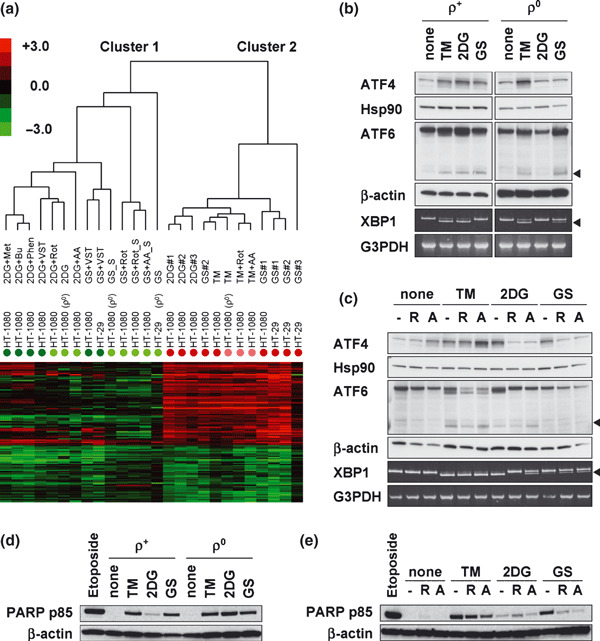
Respiratory chain is required for the unfolded protein response (UPR) induced by glucose deprivation. (a) Clustering analysis using the glucose deprivation signature. Colored, closed circles indicate each group shown in Table 1. Colored bar indicates signal log ratio. Capital S (_S) indicates the supernatant of sample including floating cells. (b,c) Activation of the UPR‐related transcription factors (ATF4, ATF6, and XBP1) under stress conditions for 6 h in HT‐1080 cells with or without electron transport chain blockers (ETCBs). Arrowheads indicate activated ATF6 or splicing variant of XBP1 mRNA. The amounts of HSP90, β‐actin, and G3PDH are used as controls, respectively. (d) The expression of poly(ADP‐ribose) polymerase (PARP) p85 fragment in stress‐treated (48 h) ρ+‐ or ρ0‐HT‐1080 cells. (e) The effect of ETCBs on stress‐treated (48 h) PARP p85 fragment expression in ρ+‐HT‐1080 cells. (c,e) –, no inhibitor; R, 100 nM rotenone; A, 10 ng/mL antimycin A. (d,e) Whole cell lysate of 10 μg/mL etoposide‐treated (24 h) cells was used as control of apoptosis induction.
Figure 5
Figure 5
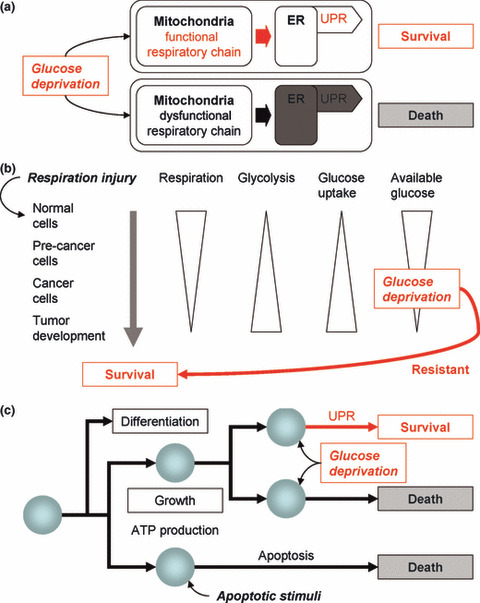
Cancer cell survival under glucose deprivation conditions. (a) Mitochondria are required for the unfolded protein response (UPR) leading to cancer cell survival under glucose deprivation conditions. (b) The shift in glucose metabolism during cancer cell generation and its survival in tumors. Cancer cells are exposed to glucose deprivation caused by abundant glucose uptake or in the tumor microenvironment. The glucose deprivation‐resistant phenotype is essential for their survival. (c) Cell behavior in multicellular organisms and mitochondrial functions. Mitochondria are not only involved growth, differentiation, and death, but also in the survival of cancer cells.

References

    1. Haga N, Fujita N, Tsuruo T. Mitochondrial aggregation precedes cytochrome c release from mitochondria during apoptosis. Oncogene 2003; 22: 5579–85. - PubMed
    1. Kroemer G, Reed JC. Mitochondrial control of cell death. Nat Med 2000; 6: 513–9. - PubMed
    1. Griguer CE, Oliva CR, Gobin E et al. CD133 is a marker of bioenergetic stress in human glioma. PLoS ONE 2008; 3: e3655. - PMC - PubMed
    1. Chen C, Liu Y, Liu R et al. TSC‐mTOR maintains quiescence and function of hematopoietic stem cells by repressing mitochondrial biogenesis and reactive oxygen species. J Exp Med 2008; 205: 2397–408. - PMC - PubMed
    1. Warburg O. On the origin of cancer cells. Science 1956; 123: 309–14. - PubMed

Publication types