


Discovery and validation of new molecular targets in treating dyslipidemia: the role of human genetics
- PMID: 20211435
- PMCID: PMC3328807
- DOI: 10.1016/j.tcm.2009.12.003
Discovery and validation of new molecular targets in treating dyslipidemia: the role of human genetics
Abstract
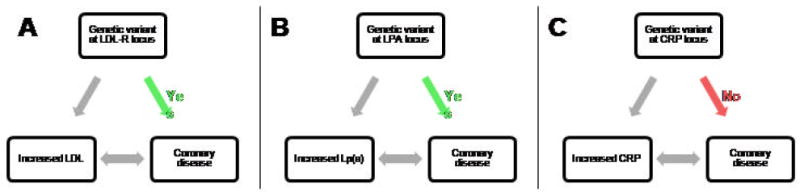
Several high-profile failures of lipid-related therapeutics in clinical trials have led to intense interest in improved discovery and preclinical prioritization of potential targets. The careful study of patients with rare monogenic disorders has played a key role in establishing the causal role of cholesterol in atherosclerosis and highlighting viable drug targets. Systematic efforts to extend the association of common variants linked with lipid levels to coronary disease enable assessment of the vascular consequences of lifelong differences in lipids due to variation in specific molecules. This application of genetic epidemiology, termed Mendelian randomization, may prove useful in informing ongoing drug development efforts.
(c) 2009 Elsevier Inc. All rights reserved.
Figures
References
-
- Smith GD, Timpson N, Ebrahim S. Strengthening causal inference in cardiovascular epidemiology through Mendelian randomization. Ann Med. 2008;40:524–541. - PubMed
-
- Abifadel M, Varret M, Rabès JP, et al. Mutations in PCSK9 cause autosomal dominant hypercholesterolemia. Nat Genet. 2003;34:154–156. - PubMed
-
- Barter P, Gotto AM, LaRosa JC, et al. HDL cholesterol, very low levels of LDL cholesterol, and cardiovascular events. N Engl J Med. 2007a;357:1301–1310. - PubMed
-
- Barter PJ, Caulfield M, Eriksson M, et al. Effects of torcetrapib in patients at high risk for coronary events. N Engl J Med. 2007b;357:2109–2122. - PubMed
-
- Benlian P, De Gennes JL, Foubert L, et al. Premature atherosclerosis in patients with familial chylomicronemia caused by mutations in the lipoprotein lipase gene. N Engl J Med. 1996;335:848–54. - PubMed
Publication types
MeSH terms
Substances
Grants and funding
LinkOut - more resources
Full Text Sources
Medical
