


doi: 10.1128/AAC.01418-09.
Epub 2010 Mar 8.
Synergistic effects between conventional antibiotics and 2-aminoimidazole-derived antibiofilm agents
Affiliations
- PMID: 20211901
- PMCID: PMC2863642
- DOI: 10.1128/AAC.01418-09
Item in Clipboard
Synergistic effects between conventional antibiotics and 2-aminoimidazole-derived antibiofilm agents
Antimicrob Agents Chemother.
2010 May.
Abstract
2-aminoimidazoles are an emerging class of small molecules that possess the ability to inhibit and disperse biofilms across bacterial order, class, and phylum. Herein, we report the synergistic effect between a 2-aminoimidazole/triazole conjugate and antibiotics toward dispersing preestablished biofilms, culminating with a 3-orders-of-magnitude increase of biofilm dispersion toward Staphylococcus aureus biofilms. Furthermore, we document that the 2-aminoimidazole/triazole conjugate will also resensitize multidrug-resistant strains of bacteria to the effects of conventional antibiotics, including methicillin-resistant Staphylococcus aureus (MRSA) and multidrug-resistant Acinetobacter baumannii.
Figures
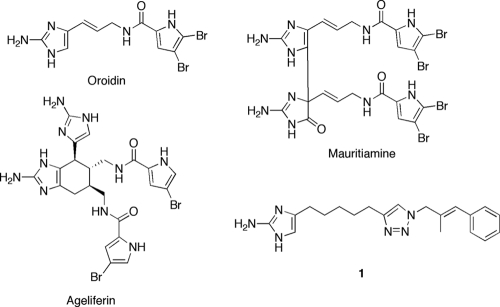
2-Aminoimidazoles that have antibiofilm and antibiofouling properties.
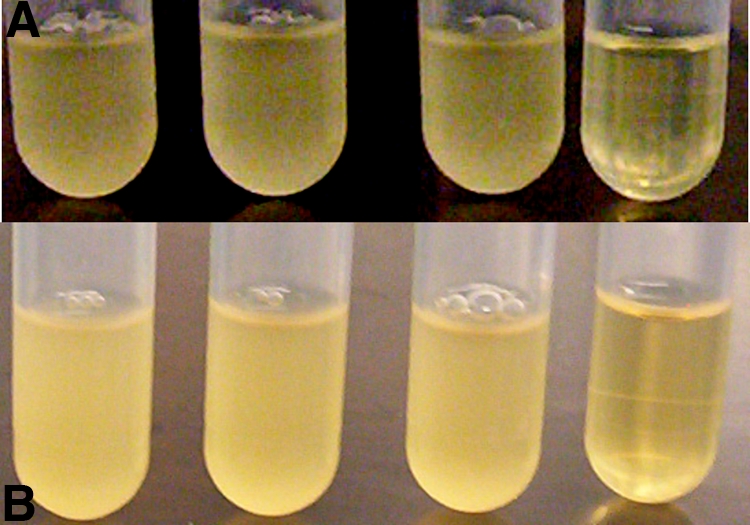
(Top) Tetracycline-resistant E. coli. From left to right: E. coli control, E. coli with 50 μM tetracycline, E. coli with 150 μM compound 1, E. coli with 50 μM tetracycline and 150 μM compound 1. (Bottom) MRSA strain BAA-44. From left to right: MRSA control, MRSA with 25 μM methicillin, MRSA with 45 μM compound 1, MRSA with 25 μM methicillin and 45 μM compound 1.
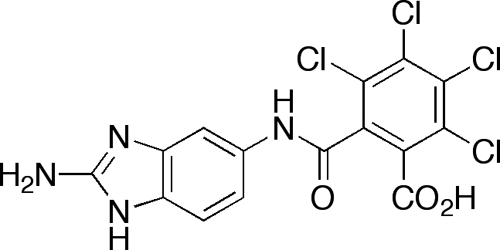
A 2-aminobenzimidazole that inhibits and disperses Gram-positive biofilms through a zinc-dependent mechanism.
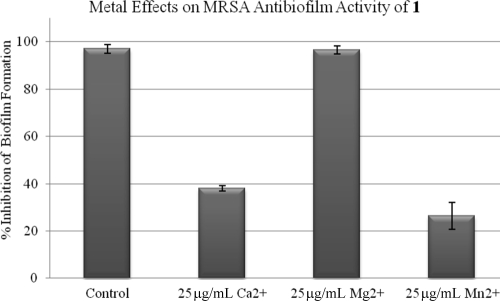
Metal effects on the ability of compound 1 to inhibit MRSA biofilm formation.
References
-
- Al Mourabit, A., and P. Potier. 2001. Sponge's molecular diversity through the ambivalent reactivity of 2-aminoimidazole: a universal chemical pathway to the oroidin-based pyrrole-imidazole alkaloids and their palau'amine congeners. Eur. J. Org. Chem. 2001(2):237-243.
-
- Ballard, T. E., J. J. Richards, A. Aquino, C. S. Reed, and C. Melander. 2009. Antibiofilm activity of a diverse oroidin library generated through reductive acylation. J. Org. Chem. 74:1755-1758. - PubMed
-
- Ballard, T. E., J. J. Richards, A. L. Wolfe, and C. Melander. 2008. Synthesis and antibiofilm activity of a second-generation reverse-amide oroidin library: a structure-activity relationship study. Chemistry 14:10745-10761. - PubMed
Publication types
MeSH terms
Substances
LinkOut - more resources
Full Text Sources
Other Literature Sources
Medical
Molecular Biology Databases
