. 2010 Jun;38(6):917-22.
doi: 10.1124/dmd.109.031161. Epub 2010 Mar 8.

N-desmethyl-loperamide is selective for P-glycoprotein among three ATP-binding cassette transporters at the blood-brain barrier

Affiliations

N-desmethyl-loperamide is selective for P-glycoprotein among three ATP-binding cassette transporters at the blood-brain barrier

Pavitra Kannan et al. Drug Metab Dispos. 2010 Jun.

Abstract

[(11)C]N-desmethyl-Loperamide ([(11)C]dLop) is used in positron emission tomography (PET) to measure the in vivo activity of efflux transporters that block the passage of drugs across the blood-brain barrier. The three most prevalent ATP-binding cassette efflux transporters at the blood-brain barrier are P-glycoprotein (P-gp), multidrug resistance protein 1 (Mrp1), and breast cancer resistance protein (BCRP). We sought to measure the selectivity of dLop among these three transporters. The selectivity of dLop at low concentrations (< or =1 nM) was measured both as the accumulation of [(3)H]dLop in human cells that overexpress each transporter and as the uptake of [(11)C]dLop in brains of mice that lack genes encoding P-gp, Mrp1, or BCRP. The selectivity of dLop at high concentrations (> or =20 microM) was measured as the inhibition of uptake of a fluorescent substrate and the change in cytotoxicity of drugs effluxed at each transporter. Accumulation of [(3)H]dLop was lowest in cells overexpressing P-gp, and the uptake of [(11)C]dLop was highest in brains of mice lacking P-gp. At high concentrations, dLop selectively inhibited P-gp function and also decreased the resistance of only the P-gp-expressing cells to cytotoxic agents. dLop is selective for P-gp among these three transporters, but its activity is dependent on concentration. At low concentrations (< or =1 nM), dLop acts only as a substrate; at high concentrations (> or =20 microM), it acts as both a substrate and an inhibitor (i.e., a competitive substrate). Because low concentrations of radiotracer are used for PET imaging, [(11)C]dLop acts selectively and only as a substrate for P-gp.


Figures
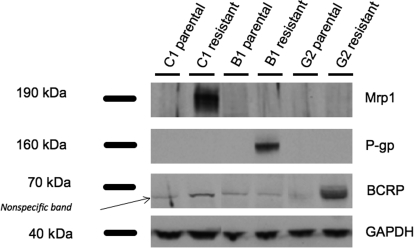
Fig. 1.
Fig. 1.
Expression of P-gp, Mrp1, and BCRP in three pairs of cell lines as determined by Western blot analysis. The three pairs are (listed as parental and resistant, respectively) as follows: MCF-7 and MCF-7/VP16 (ABCC1); KB-3-1 and KB-8-5-11 (ABCB1); and H460 and H460/MX20 (ABCG2). A protein ladder was loaded with each Western blot to mark the bands for Mrp1 (190 kDa), P-gp (160 kDa), BCRP (70 kDa), and GAPDH (40 kDa). Cell lysates were probed for GAPDH as a control for the amount of protein loaded. A nonspecific band appears in all the lanes when probed against BCRP.
Fig. 2.
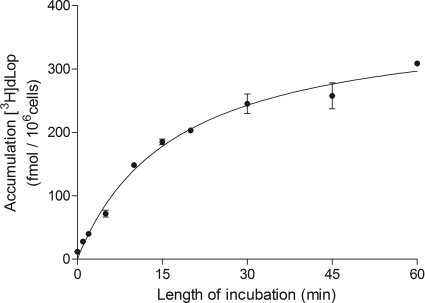
Fig. 2.
Time-dependent accumulation of [3H]dLop in parental cells of the ABCB1 line. Cells were incubated with [3H]dLop (1 nM), lysed at the times indicated, and assayed for radioactivity. Data represent means ± S.D. of three observations.
Fig. 3.
Fig. 3.
Accumulation of [3H]dLop by three pairs of parental (□) and drug-resistant (■) cells. Accumulation was significantly different between the parental and resistant cells of only the ABCB1 pair. The amount of [3H]dLop in cells was assayed 45 min after the addition of [3H]dLop (1 nM). Data represent means ± S.D. of three observations. ***, P < 0.001 by unpaired Student's two-tailed t test (α = 0.05).
Fig. 4.
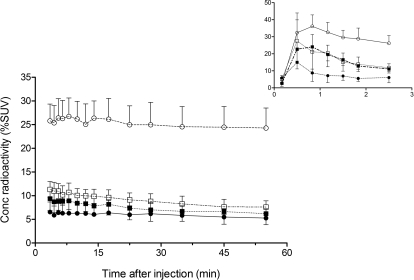
Fig. 4.
Concentration of radioactivity (% SUV) measured by PET in brains of four strains of mice after injection of [11C]dLop. Three strains of mice were selectively knocked out for the gene that encodes either P-gp (○), Mrp1 (□), or BCRP (■); the fourth strain was wild-type (●). Concentration of radioactivity in abcb1a/b-knockout mice was at least 2.5 times higher (P < 0.0001 by two-way ANOVA) than that in the other three strains of mice. Symbols represent mean ± S.D. values from four mice per strain. For clarity, the concentration of radioactivity taken up into brain in the first 3 min is shown as an inset.
Fig. 5.
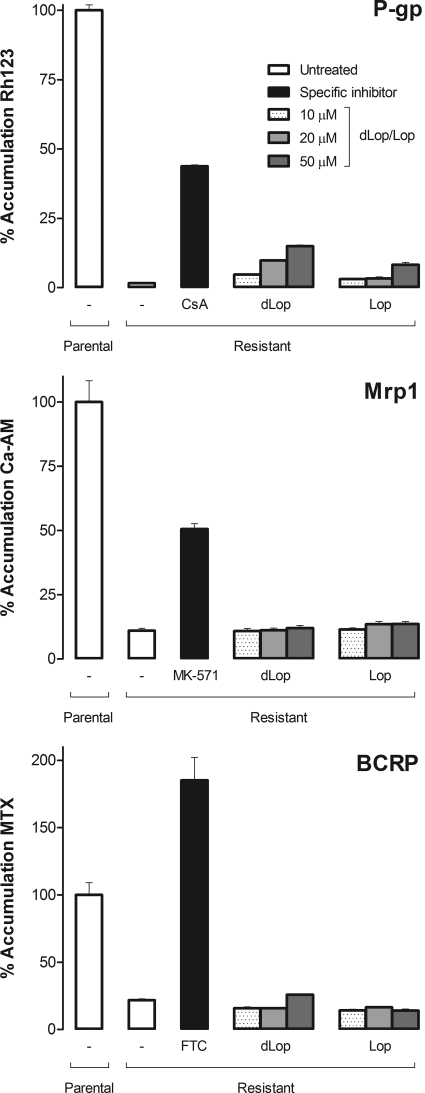
Fig. 5.
The ability of dLop and Lop to inhibit (as competitive substrates) the function of P-gp, Mrp1, and BCRP. Both dLop and Lop selectively inhibited only P-gp function. The cellular accumulation of transporter-specific fluorescent substrate is shown as a bar that represents the mean fluorescence intensity normalized to accumulation of untreated parental cells for a total of 10,000 cells. For each cell line pair, accumulation is shown for untreated parental and resistant cells (white bar), inhibitor-treated resistant cells (black bar), and dLop- or Lop-treated resistant cells (shade-graduated bars). Fluorescent substrates with activity for each transporter were used: rhodamine 123 (Rh123) for P-gp, calcein-AM (Ca-AM) for Mrp1, and mitoxantrone (MTX) for BCRP. In addition to substrate, an inhibitor was used for each ABC transporter: cyclosporin A (CsA; 10 μM) for P-gp, MK-571 (50 μM) for Mrp1, and fumitremorgin C (FTC; 5 μM) for BCRP. Bars represent the mean ± S.D. of three observations. Some error bars are smaller than the line thickness of the bars and, therefore, are not visible.

References

    1. Ambudkar SV, Dey S, Hrycyna CA, Ramachandra M, Pastan I, Gottesman MM. (1999) Biochemical, cellular, and pharmacological aspects of the multidrug transporter. Annu Rev Pharmacol Toxicol 39:361–398 - PubMed
    1. Brimacombe KR, Hall MD, Auld DS, Inglese J, Austin CP, Gottesman MM, Fung KL. (2009) A dual-fluorescence high-throughput cell line system for probing multidrug resistance. Assay Drug Dev Technol 7:233–249 - PMC - PubMed
    1. Cirrito JR, Deane R, Fagan AM, Spinner ML, Parsadanian M, Finn MB, Jiang H, Prior JL, Sagare A, Bales KR, et al. (2005) P-glycoprotein deficiency at the blood-brain barrier increases amyloid-beta deposition in an Alzheimer disease mouse model. J Clin Invest 115:3285–3290 - PMC - PubMed
    1. Clark JD, Balwin RL, Bayne KA, Brown MJ, Gebhart GF, Gonder JC, Gwathmey JK, Keeling ME, Kohn DF, Robb JW, Smith OA, Steggerda JA, VandeBer JL. (1996) Guide for the Care and Use of Laboratory Animals, National Academy Press, Washington, DC:
    1. Fox E, Bates SE. (2007) Tariquidar (XR9576): a P-glycoprotein drug efflux pump inhibitor. Expert Rev Anticancer Ther 7:447–459 - PubMed

Publication types

MeSH terms

Substances